Showing posts with label Name Game. Show all posts

Thursday, July 12, 2012

1950-1951: The Discovery of Gender Differences

I was born in the midst of the Roswell melodrama in the U.S. Navy military location of Norfolk ("northern people"), Virginia ("maiden"), on July 12, 1947.

My family moved back to Illinois ("tribe of superior people"), specifically Decatur ("sign of the cat"), soon afterward.

Today, my sister Susan ("lily") forwarded me proof that I discovered the female of the Homo sapiens species, sometime between 1950 and 1951 (a full decade before becoming a Fortean/cryptozoologist).

Here's the photographic evidence:

Loren Coleman, September 1950.

Loren Coleman and a friend, 1951.

Did I mention I grew up in Illinois. :-) 

Now, for the great synchromystic researchers out there, what is my middle name, which means "from the old forest" and/or "of the old, noble woods"?

Wednesday, July 11, 2012

Hockomock Name Game


Hockomock Swamp, Massachusetts.

I have written frequently of the bond between places named Devil and Forteana. Europeans coming to America were quite taken with the sinister experiences they had or they would hear about from the Native Americans already here, and these colonists started giving the name Devil to all the locations that were tied to unexplainable phenomena. Almost four decades ago, I wrote my first article about "Devil Names and Fortean Place," and people are still looking into it. A researcher with a remarkable names database living in the Pacific Northwest, Henry Franzoni, told me that as of August 1998, for example, he had found 2,635 places named (or which were formerly named) Devil, Diablo or Diabla in the United States.

Hockomock Point, Lincoln County, Maine.

In a related vein is the Algonquin Indian word for the Devil - Hockomock. I first mentioned this connection to the word "devil" in my book Curious Encounters and in early columns in Fortean Times. Franzoni found a total of 10 places in the US named Hockomock: six in Maine, where I now live; two in Massachusetts; one in New Jersey (Hockamik); and one in Minnesota (Hockamin Creek).

I once traveled to, explored thoroughly, and wrote about one of the most famous Hockomocks in the country - the Hockomock Swamp in the Bridgewater (Massachusetts) Triangle. It is a place where people vanish and creatures like giant snakes, Bigfoot, Thunderbirds, and Mystery Cats are frequently seen. Also, sinister crimes and cultic activity centers on locations within the area too. I have talked to Hockomock-area residents and Native Americans about the meaning of the name "Hockomock" to first discover its link to the word devil. Then I looked in a Depression-era Writers Project Administration (WPA) guide, the one entitled Massachusetts, and found it defined the variant name for the swamp, "Hoccomocco," as "evil spirit".

WPA guides are wonderful books to use to track down the origins of place names.

Most libraries have a specific reference book that is usually helpful in the playing of this game, George R. Stewart's American Place Names (NY: Oxford University Press 1970). The book contains and defines the meanings of 12,000 place names, and is a wonderful resource. But Stewart does not always get it completely correct.

Stewart, for instance, writes that "Hockanum, Hockamock, and Hocquan" are Algonquian for "the general idea of being hook-shaped." I know from my research about Hockomock in Massachusetts and Maine, that is not the whole story. Stewart goes on, however, and relates the words "Hobomak, Hobbomoc, Hobbomocka [as] Algonquian, with reference to an evil spirit (cf. Medicine, Waban) or the idea of a place being haunted; by the colonists taken to be 'the Indian devil,' [the name is found in connection to] several features in New England." (p. 207)

In Maine, of course, the "Indian devil" (or locally, "Injun Devil") was a Bigfoot-like creature in the mountains, seen up until the turn-of-the-19th-20th-century, or a panther-like beast in sighted in some forests.

Stewart is not to be totally trusted. For example, even though he clearly senses a relationship between the "evil spirit" origins of his "Hobomak" and "Waban," he defines "Waban" elsewhere in his book as "Algonquin, a name for the east wind," (p. 516).

For more, I have written about these lexilinks, of course, in 1983's and later editions of Mysterious America and in 1985's and later versions of Curious Encounters.

Also, you may find more on these name games:

Fayette/Lafayette/Fayetteville/Lafayetteville/LaGrange

Manitou

Bell/Beall

Watts/Watkins

Hopkins/Hopkinsville

Hobbs (plus 33 + 23)

Hemingway

Adamski/Burr Oak

Name Game and Synchromysticism

Thursday, June 28, 2012

Fayetteville Shooting


Army investigators look for evidence in a field where a soldier from the 525th Battlefield Surveillance Brigade shot and killed another member of the unit and then turned the gun on himself during a unit safety briefing on 
Thursday, June 28, 2012.


Fort Bragg is located in Fayetteville, North Carolina. A Fort Bragg soldier was killed and two others, including the gunman, injured Thursday, June 28, 2012, in a shooting on post, officials said.

A soldier from the 525th Battlefield Surveillance Brigade shot another member of the unit and then turned the gun on himself outside in a field during a unit safety briefing around 3:30 p.m., public affairs officer Col. Kevin Arata said.

The shooter was in custody Thursday night at undisclosed hospital. A third soldier suffered minor injuries.

Fort Bragg officials have not released the names or ranks of those involved or indicated what might have led to the shooting.

More here.

This appears to me another manifestation of the Fayette Factor at work.


Friday, June 22, 2012

The Bell Name


The sketch of the "Leprechaun" sighted in March 2006 
by the residents of the Crichton neighborhood in Mobile, Alabama, 
was broadcast on local news outlets.

There is breaking news of a horde of Leprechauns in the Belltown area of Seattle. First here is some background on why this jumped out at me.

In Jim Brandon's 1983 book, The Rebirth of Pan: Hidden Faces of the American Earth Spirit, he writes, regarding the "name game":
I'm not talking here of such spooky tongue-twisters as H.P. Lovecraft's Yog-Sothoth or Arthur Machen's Ishakshar, but of quite ordinary names like Bell, Beall and variants, Crowley, Francis, Grafton, Grubb, Magee/McGee, Mason, McKinney, Montpelier, Parsons, Pike, Shelby, Vernon, Watson/Watt, Williams/Williamson. I have others on file, but these are the ones which I have accumulated the most instances.
In my 1983 Mysterious America, I wrote:
Cryptologic or coincidence? Jim Brandon should be credited with calling attention to the name Watts/Watkins/Watson, and its entanglement with inexplicable things. Some other names involved in mysterious events pinpointed by Brandon are Bell, Mason, Parsons, Pike, Vernon, and Warren. The influence of such names as Mason, Pike, Warren, and Lafayette, for example, issues, in some cryptopolitical and occult way, from their ties to the Masonic tradition.

Now, over the weekend, near the Pike Place Market and on Bell Street in Seattle, comes this bizarre KOMO News report from Belltown:
A "bunch of leprechauns" beat up a man in Belltown on Saturday [June 16, 2012], the bruised and bloodied victim told police. Police say they received reports about the fight around 1:55 a.m. on Bell Street near the Alaskan Way Viaduct, but when they arrived they saw numerous people running from the scene.
Police then saw a man on the ground, who was covered in blood and holding his head and screaming in pain. When police asked the man who was involved in the fight he said, "It was a bunch of leprechauns," that were mad because he was dancing with a girl, according topolice.
The victim said one of the leprechauns was wearing a "white tank top" but could not specifically describe them. An eyewitness, who obviously was not on the same wavelength as the victim, said "a group of men" did the beating.

KOMO ended their piece by noting that, 

Police were unable to find the leprechauns or anyone else involved. 


Bell Street and Belltown were named after William Nathaniel Bell (March 6, 1817 – September 6, 1887), originally from Edwardsville, Illinois and later a resident of Portland, Oregon. Bell was a member of the Denny Party, the first group of white settlers in what is now Seattle, Washington State.


I wonder what the name of the Belltown victim was?

BTW, Crichton is a variant of Creighton (Scottish, Middle English, Old English), and the meaning of Crichton is "border or boundary settlement." As a place name and Scottish surname, its origin is from Crichton in Midlothian. Creighton has two variant forms: Crayton and Crichton. So, should we pay attention to what "boundary settlement" lies close by Crichton, Alabama? As it turns out, the Crichton section of Mobile is bordered nearby on the west by the Bellewood neighborhood.

Okay, time to go check on the 45 counts guilty at the Jerry Sandusky trial being held in the Centre County Courthouse in Bellefonte, Pennsylvania.

++++
For more on the Watts/Watkins name game, click here.

Thursday, June 21, 2012

Sandusky, Hellfire, and Lions

Jerry Sandusky was found guilty on 45 of 48 counts at 
the Centre County Court House in Bellefonte, Pennsylvania on June 22, 2012.


The Jerry Sandusky child sexual abuse scandal involves allegations made in 2011. The details of the incidents are horrific. Is a final act in sight? But, wait, was there a wider net that could have been thrown? I wrote earlier about whether there might be a large conspiracy here in "Does Sandusky Have Links To Hellfire Groups?" What reality is there to the hints of Sandusky scandal-linked suicides, which I discussed here?

Jerry Sandusky: "Jerry" = English, "holy spear warrior" + "Sandusky" = Wyandot Indian, "cold water."

The details of the case are well-known today, and concern charges against former Pennsylvania State University football assistant coach Jerry Sandusky and allegations of a university cover-up of those incidents. Sandusky, a longtime defensive coordinator under head coach Joe Paterno, retired in 1999 but retained access to Penn State's athletic facilities. A 2011 grand jury investigation reported that Mike McQueary, then a graduate assistant, told Paterno in 2002 that he had seen Sandusky performing a sex act on a 10-year-old boy in Penn State football's shower facilities. A holy spear in the cold water?

Paterno then reported the allegations to Penn State athletic director Tim Curley. In November 2011, Sandusky was arrested on 40 counts of molesting eight young boys over a 15-year period. By the time the trial started, the charges had reached over 50 counts.
Absolutely one of the best local Pennsylvania journalists to read (online and via Twitter) as the scandal and trial unfolded was Sara Ganim. The journalist best tracking this in the national media was Dan Wetzel. (Ah, just can't get too far from the Wetzel name game, I guess.)

In addition to the Sandusky-specific happenings, Curley and university Senior Vice President Gary Schultz resigned after being charged with failing to report the incident to police and lying to a grand jury regarding what they knew about the incident. Why the coverup? Is there a bigger picture that people are missing? Paterno and University President Graham Spanier were not charged, but both received criticism for their handling of the allegations. On November 9, Paterno announced he would retire at the end of the season, but hours later, he and Spanier were formally removed from their positions by the Penn State Board of Trustees. Paterno later died.

If you wish to read more of this history, see here, here, and here. If you wish to see how this scandal actually has now been dated back to, at least, 1995, see here. Regarding news that the victims were mostly young African-American males, for insights about that part of the story which has been ignored by the mainstrem media, see here. 

"The eyes are the window to the soul." ~ Ancient Proverb

Having worked as a psychiatric social worker, in the child protective and child welfare systems, I have been outraged by these events. Some of the testimony of the molested boys trying to be heard by adults who were supposed to have protected them has been the worst. Hopefully, good shall issue forth from these news stories in alerting people to how often such incidents do occur, and how we all need to protect our and other children from such predators.  

As I read of the scandal, the phrase "Nittany Lions" was used frequently. I wondered about the alleged origins of why the school picked this name for their mascot. The "Nittany Lions" are a modern urban legend that was reinforced via an article in the Philadephia Inquirer of January 24, 2006. The news item was about three new mountain lion cubs from South Dakota being placed at the Philadelphia Zoo. The story is only the most recent felid-linked source of the supposed alleged origin of “Nittany Lion” being due to the last puma killed on the mountain named Nittany (at the end of Nittany Valley). What do we really know about this tale?
  
 Is this the actual origin of the "Nittany Lion," 
the last mountain lion killed in Pennsylvania? 

First, why "Nittany"? “Nittany” was around before Penn State, but it certainly has been used by the school (and half of the local businesses within 20 miles) for years.

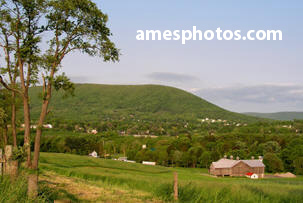
What is the etymology of the term? The origins of "Nittany" are a bit obscure, but most likely the word comes from a Native American term meaning, "single mountain." Since a number of Algonquian-speaking tribes inhabited central Pennsylvania, the term can’t be traced to one single group. The description applied to the mountain that separates what is today Penns Valley and Nittany Valley, with its western end overlooking the community of State College and Penn State's University Park campus. The first colonial settlers in the 1700s adopted this term, or a variation of it, in formally naming Nittany Mountain (see William Ames' famed photograph of this location, here). Thus by the time Penn State admitted its first students in 1859, the word "Nittany" was already in use.

Following the emergence of the Nittany Lion mascot in the early 1900s, Nittany gained even more public prominence. Today, the word helps to define a host of places, services, and other entities in the Nittany Valley.
   
 This is said to be the last Eastern cougar to have existed in Pennsylvania; it was killed in Pennsylvania in 1874 by Thomas Anson. The felid was formerly part of the collection of Henry Shoemaker. Photo: State Museum of Pennsylvania, Pennsylvania Historical and Museum Commission, 2006.

The standard line routinely goes something like this: "The Nittany Lion is the mascot of the Pennsylvania State University in University Park, Pennsylvania, USA and its athletic teams. It refers to the mountain lions that once roamed near the school, and to Mount Nittany, a local landmark. There is also a fight song played during sporting events on campus entitled 'The Nittany Lion.'"

   
The Nittany Lion mascot pumps up the crowd 
at the 2005 football game versus Cincinnati at Beaver Stadium. 

The Masonic connection is there, however. Well, at least, technically, although it is all about the name, not the Freemasons.

According to PSU sources, the mascot was the creation of Penn State senior H. D. "Joe" Mason in 1907. While on a 1904 trip to Princeton University, Mason had been embarrassed that Penn State did not have a mascot. Mason did not let that deter him: he fabricated the Nittany Lion on the spot and proclaimed that it would easily defeat the Princeton Bengal tiger. The Lion's primary means of attack against the Tiger would be its strong right arm, capable of slaying any foes (this is now traditionally exemplified through one-armed push-ups after the team scores a touchdown). Upon returning to campus, he set about making his invention a reality. In 1907, Mason wrote in the student publication The Lemon:
Every college the world over of any consequence has a college emblem of some kind—all but The Pennsylvania State College . . .. Why not select for ours the king of beasts—the Lion!! Dignified, courageous, magnificent, the Lion allegorically represents all that our College Spirit should be, so why not 'the Nittany Mountain Lion'? Why cannot State have a kingly, all-conquering Lion as the eternal sentinel?
These words later inspired the fight song known as "The Nittany Lion", which begins "Every college has a legend...".

Mountain lions had roamed on nearby Mount Nittany until the 1880s. The origin of the name "Mount Nittany" is obscure, the most commonly accepted explanation being that it is derived of Native American words (loosely pronounced as "neet-a-nee") named after the cougars that roamed the mountain or "single mountain" - a protective barrier against the elements. The name was readily accepted without a vote of the student body. In 1907, the first tangible lion symbols appeared with the placing of two alabaster African lion statues, left over from the Pennsylvania exhibit at the 1904 Louisiana Purchase Exposition, atop the columns at the main campus entrance on College and Allen streets. They were affectionately dubbed by the student body as "Pa" and "Ma." In the 1920s, a pair of stuffed mountain lions was placed in the Recreation Building to watch over athletic events. One of these original lions is now located in Pattee Library on the Penn State campus. About that same time, the tradition was established of having a student dressed in furry-lion outfits appear at football games.

   
The Lion Shrine 
Given by the Class of 1940, the Lion Shrine is by sculptor Heinz Warnecke from a thirteen-ton block of limestone. The sculpture was formally unveiled on October 24, 1942.

In 1904, Joe Mason appears to have based the invention of the "Nittany Lion" on the African lion, not the mountain lions of Pennsylvania, but then, the urban legend around Penn State's "Lions" has a huge publicity relations machine behind it, even today. It will be working overtime as the verdict in the Sandusky trial comes in...

Sunday, June 17, 2012

Crossing Named Killer Caught in Attempted Crossing


There has been another mall shooting. On Friday night, June 15, 2012, at the University of Alberta HUB Mall, during the robbery of an armored vehicle, three guards were killed and a fourth is hanging onto life.

The University of Alberta shooting suspect at the center of an international manhunt was arrested Saturday while attempting to cross the U.S.-Canada border.

Police say Travis Baumgartner, 21, was caught at the Lynden, WA U.S.-Canada border south of Abbotsford, B.C.

Police say Baumgartner was arrested while driving his dark blue Ford F-150.
The suspect is another guard.

Travis Brandon Baumgartner

Travis
French: Crossing
Last name origins & meanings:
1. English (mainly Lancashire and Yorkshire): occupational name for a gatherer of tolls exacted for the right of passage across a bridge, ford, or other thoroughfare, from Middle English travis ‘crossing’, variant of travers.
2. German: Americanized variant of Drewes.

Brandon
Old English: Fiery hill
Last name origins & meanings:
1. English: habitational name from any of various places called Brandon, in County Durham, Northumbria, Norfolk, Suffolk, Warwickshire, and elsewhere. Most are named with Old English brōm ‘broom’, ‘gorse’ + dūn ‘hill’. One in Lincolnshire, however, may be named with the Brant river, on which it stands; Ekwall derives the river name from Old English brant ‘steep’, presumably with reference to its steep banks.
2. Irish (Kerry): Anglicized form of Gaelic Mac Breandáin ‘son of Breandán’.
3. French: from the Old French oblique case of the personal name Brand, of Germanic origin.

Baumgartner
German and Swiss German (also Baumgärtner): occupational name for someone who owned or worked in an orchard, from an agent derivative of Baumgarten, or habitational name for someone from any of various minor places called Baumgarten.


Baumgarter was caught at the US-Canadian border when he attempted to cross without a passport.

Tom Schreiber with U.S. Customs and Border Protection, said: "Sometimes you have to scratch your head an wonder why people would knowingly come up and make contact with law enforcement. Maybe he thought he would be able to get through — I don't know."


Travis Baumgartner, who had been sought in what police termed an 'international manhunt,' was arrested Saturday. (Plenty of Fish)


Read more on meanings of specific names, here.

Sunday, June 10, 2012

Fayette Factor


The Fayette Factor
Above and below, Fayette County, Georgia.


Who--or more precisely, what--is "the Fayette Factor?" It is probably one of the strangest mysteries in American Forteana, first discovered by researcher William (Bill) Grimstad, back in 1977, and written about in "Fateful Fayette," Fortean Times, No. 25, Spring 1978.

Namely, the "Fayette Factor" has been the finding of a surprisingly high incidence of Fortean (inexpliable) events linked to places named after one of the USA's Founding Fathers--the Marquis de Lafayette. 
Fayetteville, West Virginia

Since Grimstad's discovery, several items on this lexilink between Fayette (as well as its related forms - Lafayette, La Fayette, Fayetteville, Lafayetteville) and high strangeness have been published. In his book, Weird America (New York: EP Dutton, 1978), Grimstad mentions several Fayette hot spots but did not dwell on them. In exchanges with Bill, a small group of Forteans discussed the Fayette Factor privately throughout the late 1970s. It was not until Brandon's (now extremely rare) The Rebirth of Pan: Hidden Faces of the American Earth Spirit (Firebird Press, 1983) and Mysterious America (Boston: Faber and Faber, 1983) that more in-depth analyses of the Fayette "coincidences" seriously occurred. These examinations were followed by updates and other comments in Mysterious America (NY: Simon and Schuster, 2006), and Mothman and Other Curious Encounters (NY: Paraview, 2002).  Furthermore, the appearance of widely available material on the Fayette Factor started routinely being posted online during the 1990s-2010s.
According to Grimstad, "Lafayette traveled widely in this country (USA) and doubtless must have been the inspiration for many or most of the 18-odd counties and 28 towns and cities across the land that I have been able to find with some form of his name." 
 Lafayette County, Mississippi
Marie-Joseph Paul Roch de Motier, Marquis de Lafayette, was born in 1757. His father, a French Army officer, was killed in the battle of Minden in 1759, and the marquis was brought up by his mother's prestigious family, the de Noailles. At the age of 18, he traveled to the Americas at his own expense and became an aide to General George Washington, who loved him like a son. By the end of the War of the American Revolution, Lafayette commanded the Continental Army in Virginia. That's the Lafayette every American schoolboy knows. But, as researcher Manly Palmer Hall has pointed out, the marquis had ties to the esoteric groups of the late Eighteenth Century. 
"In addition to his political pursuits," Grimstad wrote, "Lafayette was busily involved in certain circles that should be of interest to contemporary Illuminati buffs." 
 Lafayette County, Mississippi

According to Manly Palmer Hall, Lafayette was an associate of both Dr. Anton Mesmer, "the Father of Hypnotism," and Giuseppe Balsamo, better known as Cagliostro, a Sicilian sorcerer who was an acolyte of Adam Weishaupt's Illuminati. 

Hall wrote, "In 1785, the Marquis...joined the Egyptian Masonry of Cagliostro and proclaimed his absolute confidence in the 'Grand Cophte.' When Anton Mesmer arrived from Vienna with his theories of animal magnetism, Lafayette was one of his first customers." 

Grimstad adds, "But Lafayette also had the closest ties with Benjamin Franklin, the American revolutionary sage and member of (Sir Francis) Dashwood's 'Hell-Fire Club' in Britain (also known as the 'Medmenham Monks' of High Wycombe, Buckinghamshire, northwest of London). As Hall puts it, 'Benjamin Franklin was a philosopher and a Freemason--possibly a Rosicrucian initiate. He and the Marquis de Lafayette--also a man of mystery--constitute two of the most important links that culminated in the establishment of the original thirteen American colonies as a free and independent nation.' Lafayette, Hall summarises, 'is a direct link between the (esoteric) political societies of France and the young American government.'"  

Attention to other links to other locations, such as my discovery that LaGrange is also an associated hot name, apparently due to the fact the name Chateau de LaGrange was the French home of the Marquis de Lafayette, evolved during the last thirty years of our writings and mutual exchange on the subject.

The cities, towns, and counties across the United States, which are the Fortean hotspots linked to the Fayette Factor, are tied to the renamed Masonic lodges and affiliated sites that the Marquis de Lafayette visited on his grand tour of the country in 1824-1825. His visits were highly ritualized happenings, in which he was involved with laying many cornerstones. The locations where he was taken to visit are a virtual roadmap of the "special places" in this land. For example, in 1825, The Marquis de Lafayette, on board the ship (please note!) "Enterprise," visited the Cahokia mounds, and the significant Bloody Island, which then was so large that half of the Mississippi flowed east of it. (Intriguingly, Lafayette returned to France in 1825, on the day after his birthday, demonstrating a keen eye on the calendar and a desire to celebrate September 6th in America.)

Many Masonic locations have been linked beyond the easily recognized Lafayette name to a broader Freemasonry focus to mystic events and violent happenings. Some are very subtle. One man's journey, Lee Harvey Oswald, from his office across from Lafayette Square, New Orleans, would lead to the most infamous Masonic sites in the country. This vivid example of deathly weirdness is Dealey Plaza, where JFK was assassinated on November 22, 1963. Dallas' Dealey Plaza is the location of the state of Texas's first Masonic temple. 

How much of the Marquis's involvement in such matters was due to his deeply-held esoteric beliefs or to mere socializing is something for historians of the future to determine. What is of interest to Forteans is the uncanny number of unexplained incidents linked to the name Lafayette. Grimstad has an impressive list, which we have added to, of course, as the years have rolled along, hitting its 35th year in 2012. Here's a review of Grimstad's original notes, with new images.
Fayette County, Alabama

"In Fayette County, Alabama, is the Musgrove Methodist Cemetery. The tombstone of one Robert L. Musgrove there bears a discoloration, not especially realistic, that is locally believed to be the bridal- veiled figure of Musgrove's fiancee. Apparently he was killed just before the wedding, and the sorrowing girl" willed her image "onto the marble by her many visits to the grave." (Sir Arthur Conan Doyle may have used this real-life case as the basis for his Sherlock Holmes story, "The Musgrave Ritual.") 

"The engima-laden state of Arkansas has two sites. The city of Fayetteville, in the northwest corner" of Arkansas, "has long been legendary for oddities. UFOs and aerial lightshows, water monsters in the nearby White River and Springheel Jack-type window peepers are among the manifestations."
 
 Lafayette County, Arkansas

"In the southwest angle of Arkansas is a Bigfoot hotspot that has been immortalized--in America, at least-- by the (1974) movie The Legend of Boggy Creek. The critters have been known hereabouts since 1856, centering their activities lately upon the town of Fouke in Miller County and ranging eastward into Lafayette County." 
Lafayette County, Kentucky

"In the scenic Bluegrass area of Kentucky, the university city of Lexington sits atop one of America's more dramatic lost cave stories. Historian G.W. (George Washington) Ranck recorded in 1872 that hunters in 1776 had found a tunnel behind a rock panel of 'peculiar workmanship' and covered with hieroglyphics. The descending portal widened to a sort of gallery running downward a few hundred feet to a huge underground room. Ranck cited the hunters' reports that this chamber contained idols, altars and about 2,000 human mummies. Although the entrance to the amazing cavern was (of course--B.G.) lost, there are still cave true-believers who poke about looking for the weird mausoleum beneath this part of Fayette County." 
 Fayette County, Missouri

"Followers of ghost lore may have heard of the recent (1976) antics of a supposed phantom in Lilac Hill, a large old farmhouse at Fayette, Missouri. A number of psychically-sensitive individuals have been trying to discern what is troubling the alleged spirits, of whom there are said to be at least two."
LaFayette, New York


"In New York state, a farm near Cardiff, 10 miles (16 kilometers) south of Syracuse, was the starting point in October 1869 for one of the more sensational fossil controversies. The 'Cardiff Giant' is still displayed at museum near Cooperstown," and the weird stone idol was found in a quarry near "the Nineteenth Century town of La Fayette." 
Fayette, New York

Also, "it was in April of 1830 that the Church of Jesus Christ of the Latter-Day Saints (i.e. the Mormons) was founded by Joseph Smith and a few disciples, who claim to have received more than a little help from certain angelic friends in the neighborhood. The place: Fayette, New York." 
Fayetteville, North Carolina

"Another haunted house story takes us to an American state that perhaps rivals New York and Arkansas in the number and interest of its anomalies. It also brings us back across the trail of the peripatetic Marquis de Lafayette. This is the A.S. Slocumb Mansion, located in the North Carolina city of Fayetteville. The Slocumb House is supposed to have a number of special occupants. It also has, or had, a secret vault in the basement and at least one tunnel leading to the Cape Fear River channel." 
Fayette County, Tennessee

In 1977, the USA experienced one of the most severe winters in its history. "As of February 3, 1977, the National Weather Service announced that the 'hardest hit area' of the north-central states region was Fayette County, Ohio."
Fayette County, Tennessee

Bigfoot "became rather more aggressive on April 23, 1976 when it attempted to carry off a four-year-old boy from his backyard on a farm in Tennessee. A sheriff's posse pursued the entity and seems to have shot enough high-powered rifle fire into it to have felled King Kong himself. However, as if tiring of the game, the creature finally leaped out of its cul-de-sac and simply vanished. These events occurred within a few miles of the hamlet called Fayetteville, Tennessee." 
Lafayette Baker

"Now I would like to consider some examples of a more ominous character," Grimstad wrote, "We find 'the Lafayette factor' in the Abraham Lincoln assassination of the 1860s...A slippery character named Lafayette Baker had been brought in to head the Secret Service by the enigmatic Edwin M. Stanton, President Lincoln's arrogant Secretary of War. Otto Eisenschiml, the pioneer revisionist historian of this amazingly crude murder conspiracy, delved into the story as far as the surviving records would allow."
"His findings suggest that Lafayette Baker and Stanton had maneuvered to facilitate the escape into the South of assassin John Wilkes Booth, and when that proved impossible (owing to Booth's broken leg) to ensure that the killer was not brought back and that his evidently-incriminating diary did not survive intact." 

"At the same hour Lincoln was shot at Ford's Theatre, Secretary of State William Seward "was attacked and savagely knifed by a deranged giant named Lewis Paine, who had forced his way into the Seward home. This house fronted upon Lafayette Square, just across Pennsylvania Avenue from the White House." 
Andrew Jackson statue and White House, Lafayette Square, with Masonic obelisk of Washington's Monument in the background, Washington, D. C.

"Residents of the District of Columbia sometimes refer to the area "as 'Tragedy Square.' No other section of Washington has had so much intrigue, mystery, murder and macabre happenings as has the area directly opposite 1600 Pennsylvania Avenue.'"
Fayetteville, Pennsylvania

The Fayette Factor has also come into play in occult crimes, as well. "On July 3, 1977, 23-year-old Gary Rock was charged on two counts of criminal homicide after two local volunteer firemen were killed by a sniper while responding to a fire alarm at Rock's isolated cabin, near Fayetteville, Pennsylvania."
Lafayette High School, New York City

"On July 31, 1977, two young people sitting in a parked car along the Brooklyn, New York seashore were shot several times by a mysterious assailant who had become known as 'the Son of Sam.' The girl, Stacy Moskowitz, died of her injuries; her companion, Robert Violante, suffered eye damage. Miss Moskowitz was an alumna of (Brooklyn's) Lafayette High School. When she and Violante were shot, it was while they were sitting 'not far from Lafayette High School,' according to the New York Times" of August 1, 1977, page 34-C."

It's just all part of the enduring mystery we call "the Fayette Factor." 

Sources: Fortean Times No. 25 for Spring 1978, "Fateful Fayette" by Bill Grimstad, page 3; Why Was Lincoln Murdered? by Otto Eisenschiml, Little, Brown & Co., Boston, Mass., 1937; America's Assignment with Destiny by Manly Palmer Hall, Philosophical Research Society, Los Angeles, Cal., 1951; and Weird America by Jim Brandon, E.P. Dutton Co., New York, N.Y., 1978.
Fortean Times February 13, 2004 
+ 2012 enhancements.
Flashback reflections from Loren Coleman

Fayette incidents continue...
Fayette, Pennsylvania, 2009 Bigfoot sighting drawing.
Bigfoot Lunch Club montage.

 
Also from Loren Coleman
For more specific "Fayette" sites 
and further updates on the "Fayette Factor," 
please consult Mysterious America.


Fayette County, Pennsylvania, continues to have frequent Bigfoot and Thunderbird sightings. Fayette, Maine, is a hotspot of weirdness. What "Fayette" links have you found?


Monday, April 30, 2012

Occupy Beltane

by Loren Coleman


May Day is a traditional day for pagan, political, and power events of all kinds. The ancient Celtic fertility holiday celebrates the rites of Spring with much frolicking and fun. May 1st is also traditionally recognized as International Workers’ Day.

In 2012, expect something a little more than usual. Do not be surprised by what you discover occurring on this first Tuesday in May this year. Get ready for Occupy Beltane.


Bloomberg News states, "Calls for a general strike with no work, no school, no banking and no shopping have sprung up on websites in Toronto, Barcelona, London, Kuala Lumpur and Sydney, among hundreds of cities in North America, Europe and Asia."


The conservative CNS News reported on April 19th: "As part of Occupy Wall Street’s call for a nationwide 'general strike' May 1, elements within the group are looking to shut down bridges and tunnels in both New York and San Francisco. Occupy Oakland, the most radical of all the local Occupy groups, passed a resolution April 15 that vows to shut down all travel from Marin to San Francisco."


What I shall call "Occupy Beltane" events are planned in 115 cities throughout the U.S., from college towns such as Amherst, Massachusetts, and Ann Arbor, Michigan, to Los Angeles, Houston, Chicago and Philadelphia.


Pay attention to what landmarks get the media spotlights: the Golden Gate Bridge, the Brooklyn Bridge, the Holland Tunnel, and other symbolic (phallic) sites. Or as Adam Parfrey points out to me, the "new World Trade Center will be erected."


Keith Haring's 1978 Drawing Of The Twin Towers


At this time, it is unclear how involved (if at all) the movement Anonymous will be in the May 1st events.


Anonymous at Scientology in Los Angeles

Beltane or Beltaine (/ˈbɛlteɪn/) is the anglicised spelling of Old Irish Bel(l)taine or Beltine (modern Irish Bealtaine [ˈbʲal̪ˠt̪ˠənʲə], Scottish Gaelic Bealltainn [ˈbʲal̪ˠt̪ˠənʲ]), the Gaelic name for either the month of May or the festival that takes place on the first day of May.

The date is known by several names, including Kala-Hanv (Breton), Cala Me (Cornish), Giamonia (Gaulish), Belltaine, Boaldyn (Manx), Cétshamain (Modern Irish), Bealtuinn (Scottish-Gaelic), Cyntefin, Dydd Calan Mai, Calan Mai (Welsh).


Beltane is the time of the May Pole, the ultimate phallic symbol, celebrating the fertility of both the earth and of mankind. It is a time of sexual liberation, of love and growth. It is the youth of the year, and like any youth, it is fertile and sex is on the brain. This year, it will be a time for more. Although the planners are not talking about it, the significant of "fire" behind the day may not be denied.


Whether the name of the day is translated as "shining fire" or "Beli's fire" is uncertain; the Welsh name for the day is unhelpful--Calan Mai, which simply means "First of May."


The Beltane fires were lit on the hill of Uisnech; according to the text The Fitness of Names, the practice was begun during the age of the Nemedians, by the druid Mide; it, like the Samhain fire, became the source for all the fires of the season. It is said that the druids would drive cattle through two bonfires on this day in order to prevent disease.

Watch the name games too. 

Being a "Coleman," "Coalman," "Coal man," one of the perceivers, the ones that began the beacon fires at the Beltane hilltops on the Old Track, the leylines, I've done a good deal of research on the name "Cole." 

It can be a first name employed as a nickname for Nicholas (one of the power names identified by Jim Brandon). More commonly Cole is the common surname, derived from the Old English "cola," meaning "coal" - that coal in those Beltane fires on the high points of the leylines.

I'll be watching the "fires" (whatever that might mean) during this Occupy Beltane moment.


Anniversary Footnote:  United States President Barack Obama took to a White House podium a year ago on May 1st, to tell the world that al Qaeda leader Osama bin Laden had been killed. Osama bin Laden was killed in Bilal Town, Abbottabad, Pakistan, on Monday, May 2, 2011, shortly after 1:00 am local Pakistani time by DEVGRU/SEAL Team 6, a United States special operations military unit. Threats of terrorist incidents from a weakened al Qaeda have been mentioned for May 1st, American time. Few officials publicly feel such attacks will be carried out.


Sources: News articles (see above), Jones Celtic Encyclopedia, Dedroidify, Drudge Report, and Wikipedia. The medieval tract is also called Cóir Anmann ("The Fitness of Names").