Showing posts with label Devil Names. Show all posts

Wednesday, July 11, 2012

Hockomock Name Game


Hockomock Swamp, Massachusetts.

I have written frequently of the bond between places named Devil and Forteana. Europeans coming to America were quite taken with the sinister experiences they had or they would hear about from the Native Americans already here, and these colonists started giving the name Devil to all the locations that were tied to unexplainable phenomena. Almost four decades ago, I wrote my first article about "Devil Names and Fortean Place," and people are still looking into it. A researcher with a remarkable names database living in the Pacific Northwest, Henry Franzoni, told me that as of August 1998, for example, he had found 2,635 places named (or which were formerly named) Devil, Diablo or Diabla in the United States.

Hockomock Point, Lincoln County, Maine.

In a related vein is the Algonquin Indian word for the Devil - Hockomock. I first mentioned this connection to the word "devil" in my book Curious Encounters and in early columns in Fortean Times. Franzoni found a total of 10 places in the US named Hockomock: six in Maine, where I now live; two in Massachusetts; one in New Jersey (Hockamik); and one in Minnesota (Hockamin Creek).

I once traveled to, explored thoroughly, and wrote about one of the most famous Hockomocks in the country - the Hockomock Swamp in the Bridgewater (Massachusetts) Triangle. It is a place where people vanish and creatures like giant snakes, Bigfoot, Thunderbirds, and Mystery Cats are frequently seen. Also, sinister crimes and cultic activity centers on locations within the area too. I have talked to Hockomock-area residents and Native Americans about the meaning of the name "Hockomock" to first discover its link to the word devil. Then I looked in a Depression-era Writers Project Administration (WPA) guide, the one entitled Massachusetts, and found it defined the variant name for the swamp, "Hoccomocco," as "evil spirit".

WPA guides are wonderful books to use to track down the origins of place names.

Most libraries have a specific reference book that is usually helpful in the playing of this game, George R. Stewart's American Place Names (NY: Oxford University Press 1970). The book contains and defines the meanings of 12,000 place names, and is a wonderful resource. But Stewart does not always get it completely correct.

Stewart, for instance, writes that "Hockanum, Hockamock, and Hocquan" are Algonquian for "the general idea of being hook-shaped." I know from my research about Hockomock in Massachusetts and Maine, that is not the whole story. Stewart goes on, however, and relates the words "Hobomak, Hobbomoc, Hobbomocka [as] Algonquian, with reference to an evil spirit (cf. Medicine, Waban) or the idea of a place being haunted; by the colonists taken to be 'the Indian devil,' [the name is found in connection to] several features in New England." (p. 207)

In Maine, of course, the "Indian devil" (or locally, "Injun Devil") was a Bigfoot-like creature in the mountains, seen up until the turn-of-the-19th-20th-century, or a panther-like beast in sighted in some forests.

Stewart is not to be totally trusted. For example, even though he clearly senses a relationship between the "evil spirit" origins of his "Hobomak" and "Waban," he defines "Waban" elsewhere in his book as "Algonquin, a name for the east wind," (p. 516).

For more, I have written about these lexilinks, of course, in 1983's and later editions of Mysterious America and in 1985's and later versions of Curious Encounters.

Also, you may find more on these name games:

Fayette/Lafayette/Fayetteville/Lafayetteville/LaGrange

Manitou

Bell/Beall

Watts/Watkins

Hopkins/Hopkinsville

Hobbs (plus 33 + 23)

Hemingway

Adamski/Burr Oak

Name Game and Synchromysticism

Monday, June 25, 2012

Manitou: Fires of the Great Spirit


Over the weekend, specifically on the Eve of St. John's Day and St. John's Day, June 23-24, 2012, wildfires swept over Colorado, encompassing nature, homes and cabins (shown above). Readers here were probably not too surprised by these events considering the past.

Upon closer inspection, the epicenter reveals yet another name game. The news reports have signaled the fires have been concentrating, at least in one major outbreak, on Manitou Springs, Colorado.


A wildfire burns west of Manitou Springs, Colorado, on Sunday, June 24, 2012. The fire erupted and grew out of control to more than 3 square miles early Sunday, prompting the evacuation of more than 11,000 residents and an unknown number of tourists. (Credit: Christian Murdock, The Colorado Springs Gazette)


Manitou Springs is a "name game" wonder. The settlement was "Manitou" until changed in 1885. "Manitou" is a term for the "Great Spirit," in its most basic interpretation. The main street through the town is a direct route to Pikes Peak. One of the town's major attractions, Briarhurst Manor, is a Victorian manor house built in 1876 by the founder of Manitou Springs, Dr. William Abraham Bell (April 26, 1841–June 6, 1921). Bell earlier had been the 32nd parallel expedition's photographer, as the southern route for the Union Pacific Railroad was being mapped in the late 1860s. (See more on the significance of the "Bell" name here.)

In my breakthrough article, "Devil Names and Fortean Places," published in Summer 1979, in Fortean Times 29, I looked at how names used by Native Americans, First Peoples, and other indigenous folks have left their sinister/spiritual feelings on the land, whether the names used be devil, diablo, hockomock, or manitou.

In my Mysterious America: The Ultimate Guide to the Nation's Weirdest Wonders, Strangest Spots, and Creepiest Creatures, I reprinted and expanded on this "devil names" article in Chapter 3. There I note the following about the name Manitou,
...the WPA guides are wonderful books for tracking down the origins of place names. One of my favorities is the story behind Lake Manitou, Indiana. “Manitou” is an Indian word demonstrating some power and connection to the unknown - “The Great Spirit,” similar in a fashion to what we are talking about here regarding “devil.” According the WPA guide for Indiana (page 436), Lake Manitou was inhabited by three “monster devilfish” that began destroying all the fish there after arriving from Lake Michigan. “They even drove the wild game away, for when the buffalo, elk, deer, and other animals came to the lake to drink, fearsome serpentine tentacles shot out and dragged them beneath the surface of the murky water.” The prayers of the Natives exterminated the monsters and out of gratitude, they named the lake after the Great Spirit. While the exact details of the encounters may be shrouded in folkloric overtones, the underlying nature of such stories are an intriguing bit of evidence for some historical links to real events, as we have seen over and over again. The land reveals its secrets for those who wish to look.
To expand a bit on the meaning of Manitou, the generally accepted definition is "a supernatural force that according to an Algonquian conception pervades the natural world."


But the lines between "god," "spirit," "Great Spirit," "evil spirit," "demon," and "devil" are very thin in how Manitou was used or understood by Western settlers or invaders. The notion of a continuum is at work here, with most North Americans of nonnative background considering Manitou to be a positive "spirit" term and the other end of the range being Hockomock (and its other forms) being a negative "devil" word. For Amerindians, the differences may not be so clear, for example, as any concept can hold both "good" and "evil" meanings. In the Hockomock Swamp, Massachusetts, naturally, there exists both ends of the continuum.


Western Europeans, using an Algonquian name, have now painted the landscape of North America.


Wikipedia points out, "In 1585 when Thomas Harriot recorded the first glossary of an Algonquian language, Roanoke (Pamlico), he included the word mantóac meaning "gods" (with a plural ending). Similar terms were found in nearly all of the Algonquian languages."


Besides Manitou Springs, El Paso County, Colorado, and Lake Manitou, Fulton County, Indiana, other Manitou forms that show up on the landscape of North America include:
Province of Manitoba, Canada
Manitou Island, off Keweenaw Peninsula, Lake Superior, Michigan
North Manitou Island, off Leelanau Peninsula, Lake Michigan, Michigan
South Manitou Island, off Leelanau Peninsula, Michigan
Manitou Island, White Bear Lake, Minnesota
Manitoulin Island, Lake Huron, Ontario
Manitouwadge, Ontario
Big Manitou Falls, Douglas County, Wisconsin
Manitou Island, one of Apostle Islands, Lake Superior, Wisconsin, and
Manitowoc, Manitowoc County, Wisconsin.

Tuesday, April 17, 2012

Top Twenty Twilight Language Theorists

Top Twenty Twilight Language Theorists


The Living


Who are the top theorists presently doing "twilight language" research? Here is my list. They are given alphabetically by their first names, so as not to show any preference or ranking.


(1) Adam Gorightly, author of 2003's The Prankster and the Conspiracy: The Story of Kerry Thornley and How He Met Oswald and Inspired the Counterculture, and 2008's James Shelby Downard's Mystical War.


(2) Adam Parfrey, publisher at Amok Press & Feral House; editor/author of numerous works, including 1988's The Manson File, 1990's Apocalypse Culture, 1995's Cult Rapture, 2000's Apocalypse Culture II; and coauthor of 2012's Ritual America.


(3) Andrew W. Griffin, creator of Red Dirt Report.


(4) Christopher Knowles, creator of The Secret Sun.


(5) Craig Heimbichner, author of 2005's Blood on the Altar, coauthor of 2012's Ritual America.

(6) Greg Bishop, author of 2000's Wake Up Down There! Excluded Middle Anthology, 2005's Project Beta: The Story of Paul Bennewitz, National Security, and the Creation of a Modern UFO Myth, and other works.


(7) Henrik Palmgren, creator of Red Ice Radio. 


(9) Kenn Thomas, publisher of Steamshovel Press; coauthor of 1996's The Octopus: Secret Government and the Death of Danny Casolaro and 1999's Inside the Gemstone File; author of 1996's NASA, Nazis & JFK, 1997's Mind Control, Oswald & JFK, 1999's Maury Island UFO: The Crisman Conspiracy, and many other books.


(10) Loren Coleman, author of 1987's Suicide Clusters and 2004's The Copycat Effect, and the creator of this Twilight Language blog. (To exclude myself seemed beyond modesty.)


(11) Michael Anthony Hoffman II, author of 2001's Secret Societies and Psychological Warfare; and editor of various works by James Shelby Downard.

(12) Robert Schneck, author of 2005's The President's Vampire.

(13) SMiles Lewis, creator of Anomaly Archives and Anomaly Television.

(14) Theo Paijmans, author of 2004's Free Energy Pioneer and 2008's The VRIL Society.


(15) Tim Binnall, creator of Binnall of America.


(16) Todd Campbell, creator of Through the Looking Glass.


The Departed


Some significant theorists have passed away, so with a historical ranking by death date, here they are:


(17) James Shelby Downard (March 13, 1913 – March 16, 1998), author of 2006's The Carnivals of Life and Death, and essays, including “King-Kill/33: Masonic Symbolism in the Assassination of John F. Kennedy” and “Sorcery, Sex, Assassination."


(18) Jim Keith (September 21, 1949 – September 7, 1999), author of 1992's Gemstone File, 1993's Secret and Suppressed, 1994's Black Helicopters over America, 1995's Saucers of the Illuminati, 1996's The Octopus, 1996's Okbomb! Conspiracy and Coverup, and other works.


(19) Robert Anton Wilson (January 18, 1932 – January 11, 2007), coauthor of 1975's The Illuminatus! Trilogy; author of 1973's The Sex Magicians, 1979-1981's Schrödinger's Cat Trilogy, 1977-1995's Cosmic Trigger Trilogy, and other works.


(20) John A. Keel (March 25, 1930 – July 3, 2009), author of 1957's Jadoo, 1970's UFOs: Operation Trojan Horse, 1971's Our Haunted Planet, 1975's The Mothman Prophecies, 1975's The Eighth Tower, and other works.

++++
Special note: Some theorists and researchers shall remain unnamed and invisible from this list due to the low profile they wish to keep.  My sincere thanks to them and all those above who have freely exchanged intellectual ideas and data in this field.

Monday, October 25, 2010

Devil Sighting Causes 11 To Jump From Paris Window

A baby died when a family of 12 leapt from their second floor balcony in Paris claiming they were fleeing the devil. Eight more were injured, some seriously, in the tragedy when they jumped 20ft into a car park in Paris suburb of La Verriere.
The baffling incident occurred when a wife woke to see her husband moving about naked in the room, police said.
She began screaming 'it's the devil! it's the devil!', and the man ran into the other room where 11 others adults and children were watching television. One woman grabbed a knife and stabbed the man before others pushed him out through the front door.
When the man forced his way back in, they all began screamed in terror and leapt from the balcony screaming 'Jesus! Jesus!'
The naked man also leapt from the balcony, detectives said.
A four-month old baby died in his mother's arms, while a two-year-old was critically injured in yesterday’s incident.
Police said they had found no evidence of hallucinogenic drugs or unusual religious rituals.
Versailles assistant prosecutor Odile Faivre added: “A wife in the next room saw her husband moving around naked and began screaming that he was the devil.
“In the confusion following this apparent case of mistaken identity, the naked man's sister-in-law stabbed him in the hand and he was ejected through the front door of the flat.
“When he attempted to get back in, panic erupted and the other occupants of the flat fled by jumping out of the window.
“A number of points surrounding this incident remain to be cleared up,” Mr Faivre said
Source

Thanks to Chris. 

Friday, December 19, 2008

Synchromysticism's Godfather

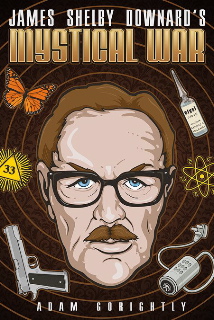
Adam Gorightly's newest book documents the remarkable phantasmagoria that was the person named James Shelby Downard, an American theorist and pamphleteer who shared his thoughts about conspiracies, coincidences, synchronicity, and symbolism.


James Shelby Downard's Mystical War was released by Virtual Bookworm Publishing, in November 2008. The subject of the book, Downard, lived from March 13, 1913 to March 16, 1998, unless, of course, his death was a disappearing act and he's still alive somewhere, writing under an assumed name. (I'm joking, right?)

Downard appeared on the scene when many of my contemporaries and I were just beginning to have lexilinked thoughts and overlapping insights into coincidences. His influence, as Gorightly notes, today has spread far beyond this strange man's life and death.

I easily understand the reach of Downard's impact within my own life from this twilight realm. In the 1960s and 1970s, first in correspondence, and then later in Fortean Times columns, I wrote about the connections I found between names and weirdnesses. Some of those writings appeared (see Devil Names and Fortean Places) in my 1983 book, Mysterious America, along with another chapter, entitled "Name Game."

In the beginning, I pointed to names such as Devil, Diablo, Manitou, and Hockomock for locations, and people names like Hobbs and Wetzel to watch. These were early explorations on the edges of what today is a vast journey in onomatology (the study of names) and toponomy (the study of places).

In the 1960s, John A. Keel carried on a lively correspondence with me and others, in which he examined the frequent appearance of certain proper names, like Reeves/Reaves, McDaniel, Hill, Allen, Maddox, and Heflin, as eyewitnesses of anomalistic incidents.

Soon, I was also corresponding with Bill Grimstad and Michael Anthony Hoffman II, who were close associates of Downard. Many people feel they got letters from Downard, but mostly, it was Hoffman and Grimstad who were assisting in getting Downard's thoughts and words to the rest of us.

Exchanging ideas with Grimstad, about locations linked to Fayette and LaGrange, and names like Bell, Mason/Macon, Pike, Warren, and Lafayette, all went hand in hand with being a Fortean in the 1960s-1970s, especially if an interest in assassinations and strange suicides fit into the mindset.

Hoffman, who authored the modern notion of the twilight language (versus the ancient Buddhist understanding of the phrase) and Grimstad, who was the source of the Fayette factor, were interesting and stimulating correspondents who nicely intellectualized many of Downard's ideas. Hidden meanings were there for the finding, and Hoffman, Grimstad, and Downard were the miners.

James Shelby Downard, who wrote short tracts, which later were published in various anthologies from Adam Parfray at Feral House, examined his own perceived decodings behind historical events in the 20th century, on a parallel track to what was happening with Forteans, anomalists, and demonologists. Downard's approach was mostly cryptopolitical, and some of us drifted over into his world, as often happens in attempting to get a holistic view of history and current events.

How does a biographer working with a secretive subject capture the life of the hidden one? That was Gorightly's task.

As you begin to read this new book about Downard, you might think that you have opened a cryptocomedic LSD trip about a conspiracy-oriented Forrest Gump-like character, who amazingly finds himself in all the wrong places at the wrong times.

Gorightly escorts the reader abroad a rollercoaster ride in which Downard is a Freemason scapegoat being ritualistically abused, watching the KKK hang a person at a crossroads, seeing Alexander Graham Bell receiving homoerotic sex magik fellatio, visiting J. Edgar Hoover's office, and getting a phone call from FDR.

The opening sections of the book are so breathlessly delivered that by the time I arrived at the chapter noting that Downard was at the "first ever meeting of the Baker Street Irregulars on July 5, 1934" in a New York City eating establishment, I hardly was startled by the statement.

All of this made me flashback to what Gorightly observed in his second paragraph of the book: "Some cynics have gone so far to suggest that Downard never actually existed, the group creation of Michael Hoffman, William Grimstad and Adam Parfrey."

Indeed!

The publisher's tagline for James Shelby Downard’s Mystical War, tells us that author Adam Gorightly "chronicles the famed conspiracy researcher’s life long battles against Masonic Sorcery as an investigator and exposer of the Science of Symbolism, Onomatology and Mystical Toponomy."

Well, yes, but what is real and what are Downard's fantasies? We clearly can't tell from Gorightly's text, because, of course, who knows?

The book is an odd mix, at points, of biographical tales about Downard's unbelievable life, his intellectual perceptions in symbol decoding, and details of specific historical milestones along the twilight highway.

When you realize that James Shelby Downard's first published work was only released in 1979, via the short work, The Masonic Assassination of John Fitzgerald Kennedy, you do come to grips with the fact his overall output was limited, but powerful.

Downard's refined and well-edited King-Kill 33° had everything to do with the skills of Michael Hoffman channeling Downard. Combined with Grimstad's Sirius Rising reel-to-reel tapes of conversations with Downard, the two works had a ripple effect. “King-Kill/33: Masonic Symbolism in the Assassination of John F. Kennedy” eventually was published by Adam Parfrey in the first edition of the book Apocalypse Culture. The essay theorizes the Freemasons were responsible for the assassination of President John F. Kennedy.

Grimstad, writing even before it was published, was able to walk a wonderfully skeptical open-minded fence, as he passed along the following summary of Downard's JFK insights in Weird America in 1978:

Would you believe John F. Kennedy as a ceremonial king-who-must-die? I'm afraid there is a certain body of opinion, undoubtedly the farthest-out brain wave of assassinology yet, that maintains the killing was pulled off, not by the Russians, the Cubans, the CIA, or the Mafia, but by alchemists.

As I understand the hypothesis, President Kennedy was for some reason chosen as The King (remember "Camelot," "Macbird" and all that?) after the fashion of James G. Frazer and Mary Renault whose "The King Must Die" he had been given to read before his death. This killing of the king in Dallas was related somehow to the touching off of the world's first atomic bomb at the Trinity Site in New Mexico 18 years earlier. Apparently the Bomb was the "destruction of primordial matter" stage of the grand alchemical working, but these conspiracy buffs aren't much more specific on details than were the early alchemists in their recipes. Anyway, Kennedy represented the next stage of the process - the "Death of the White King" - when he was immolated on a trinity site of his own. For, aren't Dealey Plaza and the ill-famed Triple Underpass on the bank of the old Trinity River?

William Grimstad


Popular cultural outlets, such as Robert Anton Wilson's works (e.g. Cosmic Trigger), the music of Marilyn Manson, and the various books and movies about the numbers 23 and 33, have Downard living onward into the morrow. My own books, including The Copycat Effect, show Downard influences.

Everyone has the sense they "discovered" the significance of certain names or dates, or even factoids like Dealey Plaza being the first Masonic temple in Texas, but remarkably, most of these revelations track back to Downard.


Adam Gorightly, who authored the underground classic, The Prankster and the Conspiracy: The Story of Kerry Thornley and How He Met Oswald and Inspired the Counterculture (with its foreword by Robert Anton Wilson), is a good person to be at the wheel for this biography of Downard. Oh, I wish it would have been twice as long, but I understand how difficult it is to write biographies of people that do not wish to be known.

Gorightly's book does an excellent job, nevertheless, in opening the door to a comprehensive world of symbol decodifications that may be new to many people. Today, there is much 21st century intrigue involving Downard's legacy, in new areas such as synchromysticism.

Several writers and commentators, including Todd Campbell, Robert Schneck, Theo Paijmans, SMiles, Michael Janitch, Mike Gos, Goro Adachi, Greg Bishop, Ben Fairhall, Henrik Palmgren, Richard Hendricks, Craig Heimbichner, Christopher Knowles, Fredrik Palmgren, Anthony Sutton, Kenn Thomas, the late Jim Keith, the late Ron Bond, and Jake Kotze inhabit the netherworld of conspiracies and synchromysticism, with the later being "an emerging field of study and subculture existing on the fringe of areas already considered fringe – primarily mysticism and Jungian psychology."

The word "synchromysticism" was first coined by Jake Kotze in August 2006, on his website-at-the-time, Brave New World Order. Kotze defined the concept as: "The art of realizing meaningful coincidence in the seemingly mundane with mystical or esoteric significance."

Downard's modern influence on Forteana, assassination studies, occult symbolism decoding, twilight language research and synchromysticism is so deep that he must be acknowledged as the Godfather to many of the points of view that inhabit those arenas.

I'm not sure if I take even half of what Downard wrote about as reality, but to get caught up in that intellectual side trick in critical thinking misses the point. In realizing the reality behind the twilight language, the metaphor is the method and the Downard as revealed by Gorightly is the message.


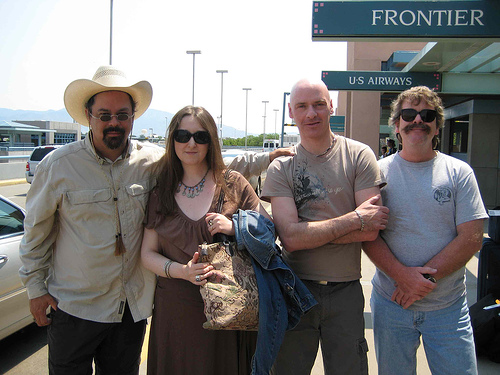
Greg Bishop, Farah Yurdozu, Nick Redfern, and Adam Gorightly somewhere near Roswell, on 07/09/07. Photo by Sigrid Hudson.

Glossary ~ James Shelby Downard examined the world through a variety of methodologies, including the following:

Onomastics or onomatology is the study of proper names of all kinds and the origins of names. The word is Greek: ὀνοματολογία (from ὄνομα (ónoma) "name").

Toponymy or toponomastics, the study of place names, is one of the principal branches of onomastics.

Anthroponomastics (or Anthroponymy), a branch of onomastics, is the study of anthroponyms (anthropos, 'man', + onuma, 'name'), the names of human beings.

Etymology is the study of the history of words — when they entered a language, from what source, and how their form and meaning have changed over time. In languages with a long detailed history, etymology makes use of philology, the study of how words change from culture to culture over time. The word "etymology" itself comes from the Ancient Athens ἐτυμολογία (etumologia) < ἔτυμον (etumon), “‘true sense’” + -λογία (-logia), “‘study of’”, from λόγος (logos), "speech, oration, discourse, word."