Showing posts with label Masons. Show all posts

Wednesday, May 30, 2012

Sousa's Transit of Venus

The Marine bandmaster John Philip Sousa became famous for his marches and inspired the sousaphone. Few people today realize that his Masonic links resulted in some of his most mysterious creations.

What's below the surface? How about the often forgotten gem he composed during his life, Transit of Venus?

John Philip Sousa (November 6, 1854 – March 6, 1932) was an American composer and conductor important during the turn of the centuries, from the 19th to the 20th, particularly known for American military and patriotic marches. "The March King" is especially remembered for his "Semper Fidelis" (1888) (Official March of the United States Marine Corps) and "Stars and Stripes Forever" (1896) (National March of the United States).


One year after the 1882 Transit of Venus, Sousa was commissioned to compose a processional for the unveiling of a bronze statue of American physicist Joseph Henry, who had died in 1878. Henry, who had developed the first electric motor, was also the first secretary of the Smithsonian Institution in Washington, D.C. Henry's statue is now in front of the Smithsonian "Castle" in Washington, D.C.

A Freemason, Sousa was fascinated by what the group considered mystical qualities in otherwise natural phenomena. According to Sten Odenwald of the NASA IMAGE Science Center, this played a significant role in the selection of the time and date of the performance, April 19, 1883, at 4:00 P.M. Dr. Odenwald points out that Venus and Mars, invisible to the participants, were setting in the west. At the same time, the moon, Uranus, and Virgo were rising in the east, Saturn had crossed the meridian, and Jupiter was directly overhead. According to Masonic lore, Venus was associated with the element copper, and Joseph Henry had used large quantities of copper to build his electric motors.

The Transit of Venus March apparently "never caught on (during Sousa's lifetime), and went unplayed for more than 100 years. Sousa's copies of the music were destroyed in a flood." As reported on Halloween in 2003 in The Washington Post (see below), Library of Congress employee Loras Schissel found copies of the old sheet music for Venus "languishing in the library's files." The piece was resurrected in time for the 2004 Transit.

In 1920, Sousa wrote another work called The Transit of Venus, a 40,000-word story. It is about a group of misogynists called the Alimony Club who, as a way of temporarily escaping the society of women, embark on a sea voyage to observe the transit of Venus. The captain's niece, however, has stowed away on board and soon wins over the men.

Sousa also composed a march, "Nobles of the Mystic Shrine" (1923), dedicated to the Ancient Arabic Order of the Nobles of the Mystic Shrine, also known as the Shriners.

There was a "Transit of Venus" on June 8, 2004 (see this amazing image), and there will be another one on June 6, 2012. Then, there will be none for 105 years.


+++

The Washington Post, October 31, 2003

Dusting Off a Rarity for Venus's Celestial March

By Reilly Capps

Legendary Washington composer John Philip Sousa likely watched on Dec. 6, 1882, as the planet Venus eclipsed a small part of the sun. This rare alignment -- when the planet's orbit takes it between the Earth and the sun -- is called the "Transit of Venus."

Shortly after the astronomical phenomenon, Sousa began work on a musical march of the same name.

Sousa wrote at least four marches about the way the heavenly bodies march across the night sky. The march king was a member of the astrology-loving Masons, and he paid close attention to the movement of the heavens.

But the "Transit of Venus March" never caught on, and went unplayed for more than 100 years. Sousa's copies of the music were destroyed in a flood.

But now Venus is approaching another transit, and fans of Sousa are resurrecting the forgotten march. It will be performed at 8 tonight at the Schlesinger Concert Hall in Alexandria.

"The interesting thing about band leaders at the time is that their concept of the universe was that there was this hidden balance and all these cosmic things going on," says Sten Odenwald, an astronomer at NASA's Goddard Space Flight Center in Greenbelt. Odenwald is preparing for June 8, when Venus will block out part of the sun for the first time in nearly 122 years. He has also worked with the Virginia Grand Military Band to organize the performance of "Transit of Venus."

Unlike "Stars and Stripes Forever" or "The Washington Post March," Sousa's "Transit of Venus" did not bring Sousa fame, nor did the novel Sousa wrote with the same title.

Loras Schissel, who works in the music division of the Library of Congress, found the old sheet music for "Venus" languishing in the library's files.

"It's a little three-minute gem," says Schissel, who also conducts the Virginia Grand Military Band. "It was written in a time when people were less cynical and more optimistic. It was America on the threshold of thinking that anything was possible, and Sousa captured that feeling perfectly."

Because bands today use different instruments than they did in the 1880s, Schissel had to rework the score for a modern ensemble. Last year, the Virginia band trotted the new version out for a test run. But most people, including John Philip Sousa IV, the composer's great-grandson, have never heard it performed. He will attend tonight's performance and hear it live for the first time.

The band will play the "Transit" march more frequently in the next few months as astronomers wait for the actual event. The 1882 transit was accompanied by enormous fanfare. Thomas Hardy worked it into the plot of a novel, and the event was covered by the press worldwide. Boys stood on the street corners of New York, offering a glimpse through telescopes for a dime. Odenwald believes the 2004 transit should receive much the same response.

The Rachel M. Schlesinger Concert Hall is at 3001 N. Beauregard Rd., Alexandria.


Tuesday, January 5, 2010

Sherlock Holmes (2009): The Ripper Killings

I found the new Sherlock Holmes (2009) movie intriguingly multi-layered, with an incredible number of synchromystical symbols throughout, often tied to the Masons ("Temple of the Four Orders") and the Ripper case (see below). These are woven nicely within the plot and characters.

Lord Blackwood (who wears a black trenchcoat most of the time ~ as have the spate of recent mass killers), the secret society members, the plotting police, the usual bald giants, the ginger little people, the overly attractive prostitutes, and even the ever present ravens have a good deal to "say" to those watching this cinema closely. Needless to say, the Masonic elements have been mentioned by many reviewers and critics in the blogosphere, so no need to dwell on the straight and narrow there.

Another "character" in the movie is the Tower Bridge, which is shown under construction. Actually, since it is known that the building of the Tower Bridge started in 1886 and took eight years, it nicely dates this version of Sherlock Holmes. The official plot summary of the movie notes this film occurs in "1891 London."

The movie has many facets, overlooked by the casual moviegoer.

For example:

A number of the movie's details were taken directly from "The Adventure of the Mazarin Stone." The first is the name of the villain, Lord Blackwood. Fans may remember him as Count Negretto Sylvius (Negretto is Italian for black and Sylvius is Latin for woods). Interestingly enough, Blackwoods was a competitor of the Strand (the publisher of Doyle's work). Blackwoods also rejected some of Doyle's early work, though the Mazarin story was written 40 years after the fact and Doyle was very successful by then. In any event, Blackwood was NOT some magician with an egg tooth (a tooth most baby snakes are born with to cut through their eggs).

Another common detail is the Crown Diamond, which is the Yellow Mazarin Stone (named for Cardinal Jules Mazarin [1602-1661], minister to Louis XIV). The large yellow stone hung around Irene Adler's neck in the movie. "The Adventure of the Mazarin Stone" is also the first and only story to mention that the 221B Baker Street apartment had multiple exits and a waiting room. The extra exit was through the bedroom which Sherlock employed to follow Irene early in the movie.


I actually think few people "get" what is behind the allusion to the five prostitutes who are killed ritualistically with daggers, before the timeline of the movie begins. These definitely appear to me to be an obvious but subtle reference to the five traditionally acknowledged Ripper killings. Because the phrase "Jack the Ripper" is never used in the movie, I have yet to see it in any deciphering of this present film. Those murders took place around Whitechapel, London, in late 1888, of course, and some, like Stephen Knight, theorize they were Masonic in nature. The present movie has more links to the Sherlock Holmes in A Study in Scarlet and Christopher Plummer in Murder by Decree, than people are noting.

Release Date: December 25th, 2009 (wide)
Distributors: Warner Bros. Pictures Distribution
Produced in: United States

Actors:
Robert Downey Jr. ... Sherlock Holmes
Jude Law ... Dr. John Watson
Rachel McAdams ... Irene Adler
Mark Strong ... Blackwood
Eddie Marsan ... Inspector Lestrade
Kelly Reilly ... Mary

Directed by: Guy Ritchie
++++

Doyle: A Mason?

Sir Arthur Conan Doyle (1859-1930) was the author of fifty-six short stories and three novels with Sherlock Holmes and John H. Watson M.D., as the principal characters.

Conan Doyle was not a particularly active freemason. One widely quoted report in the October 1901 Masonic Illustrated claims: "While at the seat of war, he attended the never-to-be-forgotten scratch lodge at Bloemfontein in company with Bro. Rudyard Kipling." In fact, Kipling was in Bloemfontein only between March 17 and April 3, 1900, a period when Rising Star Lodge No. 1022 E.C., the only lodge meeting in that part of South Africa, did not meet. At an April 5, 1900 meeting letters were received by the lodge from both Lord Kitchener and Conan Doyle, expressing their regrets at being unable to attend. A "loyal resolution" to be sent to the Prince of Wales was proposed by Kitchener at an April 23, 1900 meeting; a document signed by both Lord Roberts, who had not been present at the meeting, and Conan Doyle. The minutes of the lodge’s November 7, 1901 meeting refute the newspaper report and deny that Bros. Doyle and Kipling had ever visited their lodge. Also in 1900 Conan Doyle was made an honorary member of The Lodge of Edinburgh (Mary’s Chapel) No. 1 in recognition of his acceptance of an invitation to speak at a Burns' Night Dinner.

There is no mention of Freemasonry in his autobiography, Memories and Adventures and it is said that "Dr. Doyle looked in on Freemasonry and soon looked out again." There are, however seven distinct and several other oblique references to Freemasonry in his fiction. [AQC 104 & 105]

A prolific writer and an early proponent of a tunnel connecting England and France, he was also responsible for introducing downhill skiing into Switzerland, metal helmets for combat soldiers and the inflatable life-preserver for sailors. He makes a number of Masonic references in his writings, none of them key to his story development.

However, this record exists of his membership:
Initiated: January 26, 1887
Passed: February 23, 1887
Raised: March 23, 1887
Demitted: 1889
Rejoined: 1902
Demitted: 1911
Phoenix Lodge 257, Southsea Hampshire.


See also, other links to strange "Sherlock Holmes" coincidences in 2009, including the "Dr. Watson" killing, and the sudden death of Natasha Richardson, who had made her UK television debut in 1985, in The Adventures Of Sherlock Holmes, appearing as Violet Hunter in the episode, "The Copper Beeches."

Monday, July 20, 2009

Masons, Moon, Mars

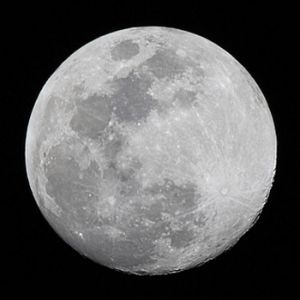
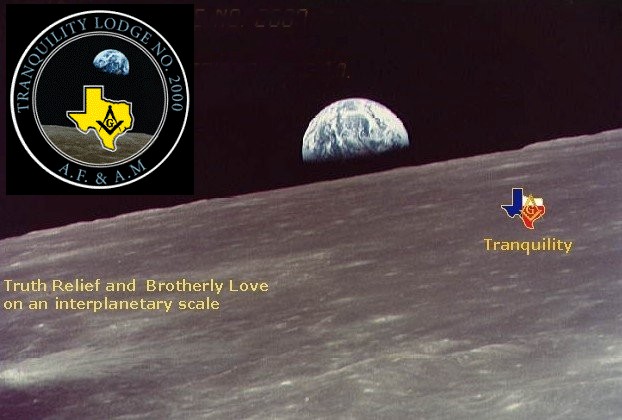
July 20, 1969: The day that Freemasonry landed on the Moon.


Now, it is definitely onward to Mars.


Wednesday, May 20, 2009

Dr. Watson '09


The cerebral and celibate (old meaning) hero of this film is Dr. John Watson, a reflection of Dr. Conan Doyle.

Robert Downey Jr. brings the legendary detective to life as he has never been portrayed before. Jude Law stars as Holmes' trusted colleague, Watson, a doctor and war veteran who is a formidable ally for Sherlock Holmes. Rachel McAdams stars as Irene Adler, the only woman ever to have bested Holmes and who has maintained a tempestuous relationship with the detective. Mark Strong stars as their mysterious new adversary, Blackwood. Kelly Reilly will play Watson's love interest, Mary.

Genres: Action/Adventure, Thriller, Adaptation and Mystery
Release Date: December 25th, 2009 (wide)
Distributors: Warner Bros. Pictures Distribution
Produced in: United States

Actors:
Robert Downey Jr. ... Sherlock Holmes
Jude Law ... Dr. John Watson
Rachel McAdams ... Irene Adler
Mark Strong ... Blackwood
Eddie Marsan ... Inspector Lestrade
Kelly Reilly ... Mary

Directed by: Guy Ritchie
++++


Sir Arthur Conan Doyle (1859-1930) was the author of fifty-six short stories and three novels with Sherlock Holmes and John H. Watson M.D., as the principal characters.

Conan Doyle was not a particularly active freemason. One widely quoted report in the October 1901 Masonic Illustrated claims: "While at the seat of war, he attended the never-to-be-forgotten scratch lodge at Bloemfontein in company with Bro. Rudyard Kipling." In fact, Kipling was in Bloemfontein only between March 17 and April 3, 1900, a period when Rising Star Lodge No. 1022 E.C., the only lodge meeting in that part of South Africa, did not meet. At an April 5, 1900 meeting letters were received by the lodge from both Lord Kitchener and Conan Doyle, expressing their regrets at being unable to attend. A "loyal resolution" to be sent to the Prince of Wales was proposed by Kitchener at an April 23, 1900 meeting; a document signed by both Lord Roberts, who had not been present at the meeting, and Conan Doyle. The minutes of the lodge’s November 7, 1901 meeting refute the newspaper report and deny that Bros. Doyle and Kipling had ever visited their lodge. Also in 1900 Conan Doyle was made an honorary member of The Lodge of Edinburgh (Mary’s Chapel) No. 1 in recognition of his acceptance of an invitation to speak at a Burns' Night Dinner.

There is no mention of Freemasonry in his autobiography, Memories and Adventures and it is said that "Dr. Doyle looked in on Freemasonry and soon looked out again." There are, however seven distinct and several other oblique references to Freemasonry in his fiction. [AQC 104 & 105]

A prolific writer and an early proponent of a tunnel connecting England and France, he was also responsible for introducing downhill skiing into Switzerland, metal helmets for combat soldiers and the inflatable life-preserver for sailors. He makes a number of Masonic references in his writings, none of them key to his story development.
Initiated: January 26, 1887
Passed: February 23, 1887
Raised: March 23, 1887
Demitted: 1889
Rejoined: 1902
Demitted: 1911
Phoenix Lodge 257, Southsea Hampshire

Saturday, May 9, 2009

De Naald Attack: 8th Person Dies

An eighth person has died in the wake of the assassination attempt on the Dutch Royal Family. (See here for full details on the attack.)


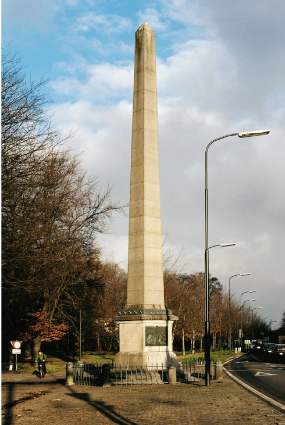
De Naald (in English The Needle), is the obelisk monument in the Dutch city of Apeldoorn that became the final resting place for Karst Tates' automobile.

A woman died of her injuries more than a week after a man plowed his car into a crowd during a parade, becoming the seventh victim of a failed attack (#8 when the attacker is counted) on the Dutch royal family, authorities said Saturday, May 9, 2009.

The 46-year-old woman, whose identity was not released, was among about a dozen people struck down in the April 30 attack. Apeldoorn municipality spokesman Toon Schuiling said she died Friday night, May 8, 2009, in a hospital, the same evening as more than 1,000 people gathered for a memorial service.

Five bystanders died on the day of the April 30 attack near Het Loo palace in Apeldoorn and another died the following day. The car's driver also died. Four other people remain hospitalized.

The car rammed into a stone monument (the Masonic structure pictured above) after speeding through the crowd, narrowly missing an open-topped bus carrying Queen Beatrix and other royal family members.

Police say the car's driver, identified by Dutch media as Karst Tates, admitted attempting to attack the popular monarch shortly after his car came to a halt. He did not give a motive.

The attack on the Queen's Day national holiday raised questions in the Netherlands about the level of security surrounding the royal family.

For more on the symbolic linkages, copycat evidence, and video concerning this attack, please click here.

Tuesday, May 5, 2009

The Masonic Image of Napoléon

Napoléon Bonaparte died on May 5, 1821. The 5 feet, 7 inches of his height was normal for his time, but the British newspaper cartoonists had him shown as much smaller for political reasons.

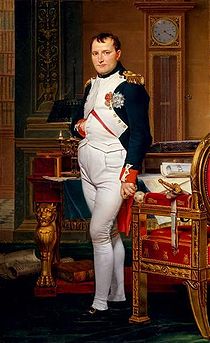
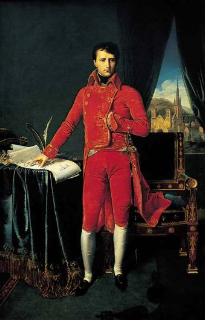
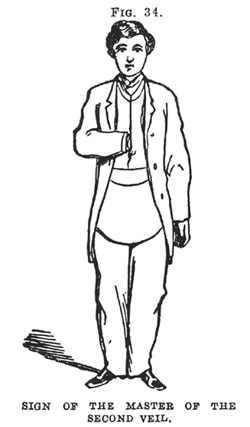
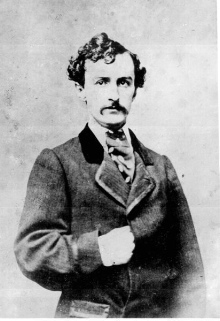
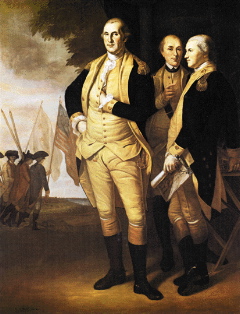
His famous "hidden hand" images were a broadcast signal of his links to the Freemasonry Brotherhood.


The Emperor Napoleon in His Study at the Tuileries, by Jacques-Louis David, 1812. Below, when he was younger.


The following drawing demonstrates the "Sign of the Master of the Second Veil," (7th Degree Mason) from Duncan's Masonic Ritual and Monitor, 1866.


View other "hidden hand" examples, here and here.


John W. Booth, whose membership among Masons is today mostly expunged.


George Washington, whose Freemasonry membership is celebrated.

"The evidence in favor of a Masonic initiation previous to Napoleon’s assumption of the imperial title is overwhelming:
The initiation took place in the body of an Army Philadelphe Lodge of the — Ecossais — Primitive Rite of Narbone, the third initiation of the 'Ecole Communique' being an advancement in that Rite. These initiations took place between 1795 and 1798." ~ J.E. S. Tucket, "Napoleon I and Freemasonry," Ars Quatuor Coronatorum vol. xxvii (1914)

Friday, May 1, 2009

Dutch Assassin Was Taxi Driver Copycat

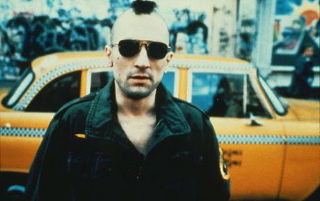
The man who drove his car into a crowded Dutch royal parade, targeting Queen Beatrix Wilhelmina Armgard, had shaved his hair into a Mohawk, like the homicidal anti-hero of the film Taxi Driver before launching the attack.


Investigators are focusing on the theory that 38-year old Karst Tates, who died of his injuries on April 30th, had embarked on a mission of vengeance against society after losing his job as a night-shift security guard earlier this year.

His neighbors and locals in the town of Huissen have described an isolated but polite man whose dress resembled that of Travis Bickle, the loner played by Robert de Niro in the 1976 film Taxi Driver, in which he plots to assassinate Senator Palantine, a candidate for the American presidency.

"He wore rolled trousers with high black boots. His hair was often very short and totally shaved at the sides," said one neighbor, according to the London Telegraph.

It will be recalled that the film Taxi Driver formed part of the delusional fantasy of John Hinckley, Jr., which triggered his attempted assassination of President Ronald Reagan in 1981, an act for which he was found not guilty by reason of insanity. Hinckley stated that his actions were an attempt to impress actress Jodie Foster, on whom Hinckley was fixated, by mimicking Travis's Mohawked appearance at the Palantine rally. His attorney concluded his defense by playing the movie for the jury.

The Dutch assassin Karst Tates was attempting to attack Queen Beatrix and other members of the royal family during an annual parade by ramming his black Suzuki Swift car into them on April 30, 2009.

Beatrix (Beatrix Wilhelmina Armgard; born January 31, 1938) has been the Queen regnant of the Kingdom of the Netherlands since April 30, 1980, when her mother, Queen Juliana, abdicated. Her maternal grandmother was Queen Wilhelmina, whom I previously wrote about here, in relationship to the Wilhelmina links to the town of Mena, Arkansas. Queen Beatrix is a member of the Bilderberg Group. Beatrix is an honorary member of the Club of Rome.

In 1965, Princess Beatrix became engaged to the German aristocrat Claus von Amsberg, a diplomat working for the German Foreign Office. Their marriage caused a massive protest during the wedding day in Amsterdam on March 10, 1966. Prince Claus had served in the Hitler Youth and the Wehrmacht and was, therefore, associated by a part of the Dutch population with German Nazism.

Queen Beatrix's father, Bernhard was a member of the Nazi Party, the Sturmabteilung and a special branch of the SS called the "Reiter SS"- an equestrian sporting organization. The Prince was not a Nazi by conviction; these memberships made life easier for an ambitious young man. People defending the Prince have stated that membership was necessary to be a student. The Prince later denied these well-documented memberships.

In the 1930s, with the rise of Adolf Hitler, Prince Bernhard's younger brother, Aschwin, publicly declared his support for the Nazi Party. Prince Bernhard was a member of the honorary German Reiter SS Corps (SS Cavalry Corps). The Prince eventually went to work for the German chemical company, IG Farben. After a period of training, he became Secretary to the Board of Directors at the Paris office in 1935.

During the planning of the invasion of Czechoslovakia and Poland, IG Farben cooperated closely with Nazi officials and directed which chemical plants should be secured and delivered to IG Farben. In 1941, an investigation exposed a "marriage" cartel between John D. Rockefeller's United States-based Standard Oil Co. and I.G. Farben. IG Farben built a factory (named Buna Chemical Plant) for producing synthetic oil and rubber (from coal) in Auschwitz, which was the beginning of SS activity and camps in this location during the Holocaust. At its peak in 1944, this factory made use of 83,000 slave laborers. The patent for pesticide Zyklon B was held by IG Farben. This cyanide-based insecticide was infamous for its use by Nazi Germany against human beings in gas chambers of extermination camps during the Holocaust. At the Nuremberg Trials, 13 IG Farben directors were sentenced to prison terms between one and eight years.

Because Prince Bernhard was a Protestant of royal rank (the Lippes were a mediatized sovereign house), Bernhard was acceptable to Queen Wilhelmina of the Netherlands as a suitable husband for her daughter, Princess Juliana. Bernhard's appropriateness as consort of the future Queen would later become a matter of some public debate.

Prince Bernhard's political affiliations with the Nazi regime have received much attention. Various members of his family and acquaintances were aligned with the Nazis prior to and during the war - a number of these being entertained shortly before and joining the royal wedding party, which occurred on January 7, 1937 in The Hague. Protocol demanded that the prospective Prince-Consort be invited to an audience with his head of state, the German dictator, Adolf Hitler. Hitler himself gives a rendering of the conversation he had with Bernard, in his ‘TischGespraeche’ (TableConversations). The ‘TableConversations’ contains a collection of monologues/remarks/speeches, which Hitler used to give during lunch/dinner-time to those who were invited to the table by him.

Queen Beatrix's time on the throne has not been without protests. A violent riot, for example, occurred on April 30, 1980, during the investiture (sovereigns of the Netherlands are not crowned as such) of Queen Beatrix. Some people, including anarchist squatters, used the occasion to protest against poor housing conditions in the Netherlands and against the monarchy in general.

The date of the attack, April 30th, therefore, is highly symbolic, and, in twilight language translation, it turns out, so was the location.

In the video of the attack, it is clearly seen that Karst Tates' automobile crashes into a monument. But what monument?

The structure is referred to as the "Needle" ~ in English translation ~ by the Dutch reporters. A Masonic monument. Shades of Dealey Plaza.


Amazingly, it is the De Naald (in English The Needle), which is an obelisk-shaped monument in the Dutch city of Apeldoorn. It is built of stone and surrounded by a low, iron fence.

The obelisk was dedicated on March 9, 1901, by the citizens of Apeldoorn. It was presented by the people to the bride and groom Queen Wilhelmina and Prince Hendrik. It is also an expression of thanks to the King Willem III and Queen Emma (who are the parents of Queen Wilhelmina). De Naald was the idea of the then mayor of Apeldoorn, Mr Nolthenius. It is 17 meter high, and, of course, based on the design of the Egyptian obelisks. It stands on the corner of Zwolseweg and Loolaan.


The car ended up hitting the Masonic monument De Naald (The Needle). Readers will recall that on 7/7 in London, the location where the attacked double-decker bus came to a standstill was against the Tavistock front door. The Tavistock Institute in London is linked to the Bilderberg Group. The Dutch Royal family are the founders of the Bilderberg group, and they held the 4/30/09 post-attack news conference at the Keizerskroon, which is part of the Bilderberg hotel.

The Dutch Royal bus and the assassin's car was on the street Loolaan. This avenue is 1024 meters long (measured from De Naald to the middle of the church Grote Kerk). From 1808, it was the first paved road in the Netherlands. The road was created by King Louis Napoleon (he was one of the previous owners of palace Het loo). He had this road built from Amersfoort, Het Loo and Apeldoorn to Deventer. It was named the Grand Route.


The latest news is that a seventh person has died as a result of the car attack during Koninginnedag 2009 (Queen's Day) celebrations in Apeldoorn, Netherlands. A 55-year-old military policeman, who was working as a driver, died of his injuries while recovering in a hospital on Friday afternoon, May 1, 2009.

Another woman is said to be in a critical condition. The condition of the other eight people still hospitalized is reportedly stable. Among them are three children.

On Friday morning it was announced that Karst Tates who deliberately drove his car at speed through the crowd of spectators had died in hospital during the night of April 30. His neighbors describe him as a quiet, withdrawn person. His motive for carrying out the attack remains a mystery, according to Radio Netherlands.

On Thursday, April 30, the public prosecutor said the man told police that his attack was aimed at the royal family. The public prosecutor ruled out any terrorist motive and the authorities believe the man was acting alone.

About 250 detectives are involved in the investigation into the incident. The police have received more than 750 tips so far. Witnesses to the incident have uploaded 165 photographs and about 10 videos to a special justice ministry website. The police are still urgently looking for photographs of the black car just before it plowed into the spectators.

The mayor of Apeldoorn, Fred de Graaf, has announced that an investigation will be launched into the security provisions surrounding the royal visit.

After the April 30th tragedy Prime Minister Jan Peter Balkenende said it was too early to speculate about future Queen's Day celebrations. After meeting Queen Beatrix and other members of the royal family in Apeldoorn, the prime minister called for serious reflection.

In a televised address, the queen, visibly shocked, offered sympathy to the victims and their relatives. Prime Minister Balkenende expressed "deep shock at the horrible event" and travelled to Apeldoorn.

Most Queen's Day celebrations across the country were cancelled. In the capital Amsterdam, where some 600,000 people were partying, and a few other towns, festivities went ahead but were toned down.

Flags were lowered to half-mast at the palace and all government buildings.

Tuesday, March 31, 2009

Masonic Origins of Baseball

Famous Freemasons and baseball go hand in glove.

Rogers "The Rajah" Hornsby, an original member of the Baseball Hall of Fame is listed on Masonic sites among the famous. The baseball stars are a who's who of famed Freemasons: Grover Alexander, Ty Cobb, Carl Hubbell, Branch Rickey, Honus Wagner, and Cy Young, to name a few. It is no mystery that some leaders of their time would be Masons. But what of the question, were the initial symbolic foundations of baseball Masonic?

I'm talking about baseball here because I am a guest on Tim Binnall's The 3rd Annual BoA: Audio Baseball Special for Sunday, April 5, 2009, on Binnall of America (also featuring Greg Bishop, Adam Gorightly, Richard Dolan, and Paul Kimball). For the broadcast, go to: BoA Audio Baseball Special.

Opening day for Major League Baseball will soon be upon us, although, with the international tournament catching on fire, the World Baseball Classic has created a new world order, so to speak.

One can keep score in a variety of ways.

I've looked at baseball clusters in "Suicide Squeeze" in one of my books. I'm not going to go there today. Another way to track baseball is through its mystic origins, Masonic and otherwise.

MasonicBB

Todd Campbell at Through the Looking Glass referenced baseball’s beginnings being Masonic, and pointed out to me the following passage from Randy Lavello’s article:

Baseball was obviously created by Freemasons, as it bears the unmistakable marks of Freemasonry. The field, from home plate to the left and right field wall forms a compass; the entire outfield wall is the semicircle which this compass draws. Upside-down, overlapping this compass, the bases form the square. Thus, the baseball field is the emblem of Freemasonry. Three strikes and three outs were assigned because three is the principle sacred number of Freemasonry. Four is a number of significance because it represents a square (the shape) and deals with the four directions, thus: four balls, four bases. Nine is sacred because it is three squared… there are nine fielding positions and nine innings. This brings us to a total of twenty-seven outs per team a game…and guess what? Twenty-seven, along with eighty-one, are the only two sacred numbers greater than ten. Though eighty-one doesn’t occur in baseball, because of the presence of two nines (fielders and innings) it’s appropriate to mention the reason eighty-one is so revered: the multiples of nine, 9, 18, 27, 36, 45, 54, 63, 72, 81, and 90 form a mirror image between the numbers 45 and 54. Also, each one of these numbers equal nine when adding the two integers which comprise the number: 18- 1+8 = 9; 27- 2+7 =9; etc. Because of this, nine times nine was deemed a ‘high’ number. This further explains the near obsession with numbers surrounding baseball averages, home runs, ERA's, etc. It is truly a game for numerologists.


Abner Doubleday

Abner Doubleday (June 26, 1819 – January 26, 1893) is often, folklorically, said to be one of the two "Fathers" of American baseball. Allegedly Doubleday played the first game at Cooperstown, New York in 1839, and that's the reason the Baseball Hall of Fame is located there, so the story goes.

Doubleday was a career United States Army officer and Union general in the American Civil War. He fired the first shot in defense of Fort Sumter, the opening battle of the War Between The States. This happened on the northern 33rd degree of latitude, at Fort Sumter and is so noted in Masonic decipherings. Doubleday had a pivotal role in the early fighting at the Battle of Gettysburg, too, where he had his finest hour, but his relief by Major General George G. Meade caused lasting enmity between the two men.

In 1871, Doubleday commanded the 24th U.S. Infantry, an all African-American regiment, in Texas. He retired from the Army in 1873, and in San Francisco, after the war, he obtained a patent on the cable car railway that still runs there.

By 1878, he was living in Mendham, New Jersey, from where, that year, he became a prominent member of the Theosophical Society. When two of the founders of that society, Helena Blavatsky and Henry Steel Olcott, moved to India at the end of that year, he was constituted as the President of the American body.

In addition, he is known for a popular myth that he invented baseball, which has been debunked by almost all sports historians. The lore of baseball credits Doubleday with inventing the game, supposedly in Elihu Phinney's cow pasture in Cooperstown, New York, in 1839.

Joseph E. Chance writing biographically in the book, My Life In The Old Army by Abner Doubleday (New-York Historical Society, 1998), claims:

A letter from Albert Graves, a resident of Cooperstown, New York, and neighbor of Doubleday, is the only documentation remaining of Doubleday's connection to baseball. Graves asserted that Doubleday had taught the Cooperstown boys his modifications of a game known as "town ball." The changes to town ball included reducing the number of players, assigning each player a location in the field, and replacing the wooden posts designated as bases by flat stones....Sports writers, functioning in our new order of "political correctness" now claim that the first game of baseball played in Texas, supposedly at Galveston, was not organized by Doubleday while stationed there in 1867! Doubleday was indeed stationed in Galveston on this date, serving as colonel of the 17th Infantry, sent to impose military rule on a defeated nation.


The Mills Commission, chaired by Abraham G. Mills, the fourth president of the National League, was appointed in 1905 to determine the origin of baseball. The committee's final report, on December 30, 1907, stated, in part, that "the first scheme for playing baseball, according to the best evidence obtainable to date, was devised by Abner Doubleday at Cooperstown, New York, in 1839."

Baseball historian George B. Kirsch has described the results of the Mills commission as a "myth." Moreover, Doubleday himself never made such a claim, but his biography notes this has to do with Doubleday's "Christian modesty."

Of course, it didn't help that only the testimony of Graves, who would have been five in 1839, is the sole proof of the Doubleday tale. It also doesn't assist the story that Graves' reliability as a witness was questioned as the years went by because he was later convicted of murdering his wife and spent his final days in an asylum for the criminally insane.

Doubleday
Was Abner Doubleday a Freemason? There seems little proof of that. Still, the synchromystic underpinnings of Abner Doubleday's life, from that first shot at Fort Sumter to the President of the Theosophical Society to his final resting place at Arlington National Cemetery with an obelisk as his tombstone (Plot: Section 1, Grave 61), should not be understated.


Alexander Cartwright, Jr.

Most baseball historians, however, note that the links between Alexander Joy Cartwright, Jr. and the origins of American baseball are much more secure. I also would say that there is no doubt as to Cartwright's heavy Masonic involvements.

Born in New York City on April 17, 1820, to Alexander Joy Cartwright Sr., a merchant sea captain, and his wife Esther Burlock Cartwright, Alex Jr. began his working life in 1836 as a clerk at the age of sixteen in Coit & Cochrane, a broker's office on Wall Street. Coit is an incredibly significant name in cryptopolitical history, from Wall Street to Skull & Bones to the firefighter's monument in San Francisco called Coit Tower. (I will have more to say about that name at another time.)

Intriguingly, Cartwright's involvement with baseball also directly overlaps with his involvement in firefighting in New York City, as well as later in his life.

Here is a passage from Mr. Baseball's look at this history:

Many of these ball-playing young men, including Cartwright, were also volunteer firemen. The first firehouse that Cartwright was associated with was Oceana Hose Company No. 36. Later, he joined Knickerbocker Engine Company No. 12, located at Pearl and Cherry Streets. It disbanded in 1843. Some speculate that the young ballplayers, possibly Cartwright himself, named their ball club after the engine company, apparently sometime between 1842 and 1845.

A huge fire in July 1845 destroyed the Union Bank where Cartwright was employed. Consequently, Alex went into the book-selling business with his brother Alfred on Wall Street. They did not give up on their ball playing, though. Meanwhile, the city was growing and changing all around them.

The Knickerbocker Base Ball Club ventured across the Hudson River by ferry to Hoboken, New Jersey. There they found a roomy spot called Elysian Fields. The team drew up a constitution and bylaws on September 23, 1845, and twenty rules in all were adopted. The Knickerbocker rules are also synonymously known as the “Cartwright Rules.” Cartwright and his friends played their first recorded game on October 6, 1845, and continued playing well into late autumn that year. Receipts exist for dinners that are dated December 5, 1845, and are labeled with "Elysian Fields Hoboken for twenty dinners at $1.50 each for the Knickerbocker Base Ball Club."

The first match game was played between the Knickerbockers and the New York Club on June 19, 1846, at Elysian Fields.


Cartwright followed the Gold Rush of 1848 to San Francisco when he moved his family there in March 1849, and then on to Hawaii in August 1849.

Knickerbockers

Interestingly, both Doubleday and Cartwright would turn up in San Francisco, historically. The link between New York and San Francisco can be shown easily, and one thread is the name Knickerbockers.

The term "Knickerbockers" began with Washington Irving's History of New York, (published 1809). Still further, the family name "Knickerbocker" can be traced to a single Dutch settler who immigrated to what is now New York in the late 1600s. By the late 19th century, the term had come to mean the style of breeches the settlers wore that buckled just below the knee, which became known as "knickerbockers," or "knickers."

The name "Knickerbocker" first acquired meaning with Washington Irving's History of New York, featured the fictional author Diedrich Knickerbocker, an old-fashioned Dutch New Yorker in Irving's satire of chatty and officious local history. In fact, Washington Irving had a real friend named Herman Knickerbocker, whose name he borrowed.

Herman Knickerbocker, in turn, was of the upstate Knickerbocker clan, which descended from a single immigrant ancestor, Harmen Jansen van Wijhe. Jansen van Wijhe invented the name upon arriving in New Amsterdam and signed a document with a variant of it in 1682. After Irving's History of New York, by 1831, "Knickerbocker" had become a local nickname for quaint Dutch-descended New Yorkers, with their old-fashioned ways and their long-stemmed pipes and knee-breeches long after the fashion had turned to trousers.

Thus the "New York Knickerbockers" were an amateur social and athletic club organized on Manhattan's (Lower) East Side in 1842, largely to play "base ball" according to written rules; on June 19, 1846 the New York Knickerbockers played the first game of "base ball" organized under those rules, in Hoboken, New Jersey, and were trounced 23 - 1.

Today, the name survives most overtly in the National Basketball Association team, the New York Knicks, short for Knickerbockers.

"Firebelle Lil" Coit, the benefactor of San Francisco's Coit Tower, gave the money for the structure in the name of that West Coast city's Knickerbocker Engine Co. 5, and also commissioned another neighborhood landmark, a statue of three firefighters on the southwest corner of Washington Square Park.

It seems clear that the "Knickerbocker" name in San Francisco has its roots in New York City, via the fire departments, specifically.

Elysian Fields

Cartwright's Knickerbockers had to play someplace, and intriguingly, the "base ball" team found a "roomy spot called Elysian Fields" in Hoboken, New Jersey.

Colonel Jacob Stevens, who would later helped found Stevens Institute of Technology (one of the top engineering institutions in the United States), owned an expanse known as the Elysian Fields. In about 1870, Stevens sold the Elysian Fields for a handsome profit, and today’s street grid was laid out, carving up the site. A small passive and children’s park bordered by Hudson Street, the right-of-way of 10th Street, and Frank Sinatra Drive bears the name “Elysian Park,” the last vestige of Col. Stevens’ Elysian Fields.

(The Stevens Institute of Technology is named after a family of accomplished inventors and engineers. In 1784, the land now occupied by Stevens Institute of Technology was purchased by John Stevens, who would later reverse engineer the British steam locomotive to American standards for domestic manufacture. Robert Stevens, one of John Stevens' sons is known for inventing the flanged T rail, a form of railroad rail in use today throughout the world. With his brother Edwin A. Stevens, Robert created America's first commercial railroad. When Edwin A. Stevens died in 1868, he left a bequest in his will as an endowment for the establishment of an "institution of learning", providing his trustees with land and funds.)

The intersection of 11th and Washington, where the Hoboken Industry and Business Association monument to baseball now stands, was converted into a full-fledged baseball tribute during the renovation of all of Washington Street in 2003. The intersection was repaved in brick, with the outline of a baseball clearly visible in the center and each of the four corners being designated as a “base” with the appropriate markings H, 1, 2, 3, according to Charles O’Reilly in 2005.

Needless to say, "Elysian Fields" carries a significant name.

The Elysian Fields, or the Elysian Plains, among the Greeks, was considered the final resting place of the souls of the heroic and the virtuous.
In Greek mythology, Elysium (Greek: Ἠλύσια πεδία) was a section of the Underworld (the spelling Elysium is a Latinization of the Greek word Elysion).

Elysium is an obscure and mysterious name that evolved from a designation of a place or person struck by lightning, enelysion, enelysios. This could be a reference to Zeus, the god of lightning, so "lightning-struck" could be saying that the person was blessed (struck) by Zeus (lightning).

Scholars have also suggested that Greek Elysion may instead derive from the Egyptian term ialu (older iaru), meaning "reeds," with specific reference to the "Reed fields" (Egyptian: sekhet iaru / ialu), a paradisaical land of plenty where the dead hoped to spend eternity.

Within twilight language decoding, it should be pointed out that William Grimstad and I have previously noted the importance of the hot name game among Fortean and anomalistic phenomena of "Reed"/"Reeder"/"Reeves" and, according to John A. Keel, in ufology and demonology, with "Reeves"/"Reaves." The name, of course, has been associated with the tragic lives of various "Reeves" who have played Superman on television and in the movies, and the Superman-like roles of Keanu Reeves in The Matrix and The Day The Earth Stood Still.

Several locations have taken on the name "Elysian Fields." They include, a spot near downtown Los Angeles, Elysian Park, which "is the city's oldest public park and, at 575-acres, the second largest after Griffith Park. It is home to numerous historic sites, including the Los Angeles Police Academy and Barlow Hospital, that are linked by miles of walking trails." The name is used for a remote section of wilderness in the northern region of Mt Rainier National Park in Washington State, and a frozen sea on Mars is called Elysium. There is a street named Elysian in New Orleans that is a setting and a symbolic element in A Streetcar Named Desire.

Today, Elysian Fields Quarterly - The Baseball Review is a popular magazine for the baseball diehard fan.

Back to Cartwright's Masonic Links

Mr. Baseball cements the Masonic nature of Cartwright's history with this paragraph:

Aside from his duties at the Honolulu Fire Department, Alexander became involved with many other aspects of the city through his involvement with Freemasonry. In 1859, for example, Queen Emma and King Kamehameha IV founded Queen's Hospital. As part of its customs and traditions, cornerstone ceremonies were held for the construction of new buildings. The first public Masonic ceremony on the islands was at the laying of the hospital cornerstone in 1860.


And further...

King Kamehameha V was the first native Hawaiian to become a Freemason. The February before he died, a cornerstone was laid in Masonic tradition with members of the lodge present, including the Acting Grand Master, Alexander Cartwright Jr. The king, together with Cartwright, spread cement beneath the Cornerstone for what would become the Judiciary Building.

The next monarch, King Kalakaua, became the first Hawaiian monarch to attend a baseball game. Cartwright was the king's financial advisor. The game took place in 1875 between the Athletes and the Pensacolas. Baseball had been growing in popularity since being played at Punahou School in the 1860s. But it is unclear whether Cartwright actually instituted the playing of the game on the islands.


Cartwright
At the Baseball Hall of Fame, there is a plaque upon which Cartwright is called the "Father of Modern Baseball." A large pink granite monument with suggestive symbols decorating it is to be found in Oahu Cemetery (formerly Nuuanu Valley Cemetery) in Honolulu, Hawaii. It marks Cartwright's final resting place. It has become an monument at which visitors routinely leave offerings, in the form of baseballs, bats, and baseball cards.

The name game kicks into high gear here, for Mr. Baseball writes:

Alexander Cartwright died on July 12, 1892, from blood poisoning from a boil on his neck. The Hawaiian monarchy was overthrown six months later on January 17, 1893. A group of Americans in Honolulu formed to request of President Benjamin Harrison that Hawaii be annexed to the United States. The president was in favor. The individual leading the cause for annexation was Lorrin Thurston. Coincidentally, Thurston had played baseball at Punahou School at the same time as Alexander III and Bruce Cartwright Sr.


Well, they (whomever they are) say there are no "coincidences," right? So July 12th is my birthday and "Lorrin" is merely another form of "Loren." I refuse to take this so personally. I won't dwell (this time) on the fact my ex-wife's family members (and thus my sons) are distantly related to the Coit family. Or that "Coit" is the middle name of my ex-father-in-law who worked on the infamous Eisenhower "vicuna coat affair" with Robert F. Kennedy, then died on RFK's birthday. Or that my own father was a career professional firefighter. Or how several generations of my family have been tied to baseball, in various ways. No, I won't take this personally. All news is local first, after all, right?

So, let's stop for now, and think about the future.

Here are my 2009 predictions for what the end of the MLB season will look like:

AL East Champs: NY Yankees
AL Central Champs: Minnesota Twins
AL West Champs: Anaheim Angels
AL Wildcard: Boston Red Sox

NL East Champs: NY Mets
NL Central Champs: Chicago Cubs
NL West Champs: LA Dodgers
NL Wildcard: Philadelphia Phillies

AL Champion: Boston Red Sox (over NY Yankees)
NL Champion: LA Dodgers (over Philadelphia Phillies)

World Series Champion: Boston Red Sox (with a few flakes of snow at the end of the game, no doubt)

Of course, my boyhood favorites, the St. Louis Cardinals (location of the highly symbolic Gateway Arch) could surprise everyone in the Central, but I'll stick with the above prophetic picks.

Other Masonic Baseball Imagery...

Play Ball!

Keep such research alive. Your assistance is greatly needed and appreciated. Please, today,...

Sunday, March 22, 2009

Slumdog & Other Dumas Gates

Slumdog Millionaire reopened in American theaters on March 20, 2009. It's time to take a look at one thread in the film and where it leads us.

An intriguing undermentioned synchromystic element of the award-winning film Slumdog Millionaire is its references throughout to The Three Musketeers (Les Trois Mousquetaires, 1844).


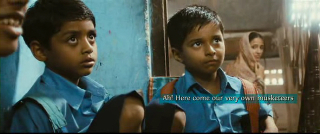
The movie's hero Jamal refers to his brother Salim and himself as Athos and Porthos, and the female of his attention Latika as the third Musketeer. The book is shown in flashbacks of the orphanage's classroom and in importance to the ending sequence regarding the last question asked on "So You Want To Be A Millionaire?"

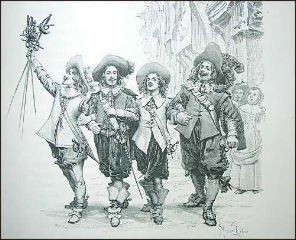
The Three Musketeers (Les Trois Mousquetaires) is a novel by Alexandre Dumas, père (French for "father", akin to 'Senior' in English). It recounts the adventures of a young man named d'Artagnan after he leaves home to become a musketeer. d'Artagnan is not one of the musketeers of the title; those are his friends Athos, Porthos, and Aramis—inseparable friends who live by the motto "one for all, all for one" ("un pour tous, tous pour un").


The director Danny Boyle does not really deal with the overt or covert appearance of the novel, in the movie or even in his interviews about the film.

The New America Media interviewed Boyle, and he gave the following rather classic non-answer to the question of the book in his motion picture.

+++
New America Media: But would slum kids in India really read "The Three Musketeers"?

Danny Boyle: We had to work around that. We originally decided to do the whole film in English. But when I got there and started auditioning, it was clear that the little kids don't really speak English. I immediately thought, 'We have to do it in Hindi.' So the kids speak in Hindi in the beginning, and I remember ringing the studio, telling them, 'Oh, by the way, the beginning of the film is going to be in Hindi.' And they were just horrified. They thought subtitles. And all I said was, 'I promise you the subtitles will make the film even more exciting.' And they bought it, fortunately. It's true someone from his background would probably not have that much English but he's a smart kid, and he picks stuff up quickly and he remembers it. That makes his dream come true - the things he remembers.

+++

Did you hear a clear response in any of that?

Why didn't he answer this inquiry about The Three Musketeers?

Perhaps Danny Boyle only likes to share visually? He, after all, was the director for two intriguing episodes of Inspector Morse ("Masonic Mysteries" and "Cherubim and Seraphim"). In "Masonic Mysteries," Morse himself becomes the prime suspect when his lady friend is murdered at a dress rehearsal of Mozart's The Magic Flute.

By the time Boyle got to Slumdog, he would have already been quite familiar with the multiple layers of Masonic symbolism in literature, music, and art.


The Three Musketeers is a tale of friendship by a Freemason.

The author of The Three Musketeers was born Dumas Davy de la Pailleterie (July 24, 1802 – December 5, 1870) ~ known simply as Alexandre Dumas. He became known as a French writer, best known for his numerous historical novels of high adventure, which have made him one of the most widely read French authors in the world. Many of the Dumas novels, including The Count of Monte Cristo, The Three Musketeers, Twenty Years After, and The Vicomte de Bragelonne were serialized and this extended his popularity. His novels were simple but multilayered. For example, his The Knight of Sainte-Hermine, his last novel, was a swashbuckling tale containing a key scene of the Battle of Trafalgar, which explains the death of the British admiral Horatio Nelson.

One of the background elements of some significance to Dumas was his Masonic twilight clues in his stories.

Freemasonry is subtly written about by Freemason Brother Alexandre Dumas, père, within his books:

The Count of Monte Cristo.
"Edmond had become as skilled in navigating the coastal waters as he had once been on the open sea. He got to know all the smugglers around the Mediterranean and learned the Masonic signs that these semi-pirates used to recognize one another." Chap. xxii, p. 189.

"But Andrea, turning around towards them, winked, put his tongue in his cheek and gave a clicking of the lips that meant a host of things to these bandits, who fell silent. These were masonic signs that Caderousse had shown him, and the hooligans recognized one of their own." Chap. cvii, p. 994.

"'More or less. We sailors are like freemasons, we recognize one another by certain signs.'" Chap. xxxi, p. 266. Penguin Classics Edition, 1103 pages, translated by Robin Buss (c) 1996, ISBN 0-14-044615-X

The Countess de Charny.
A chapter describes the advancement of three freemasons into the Illuminati of Cagliostro. [AQC xciii 4]
Philadelphia : T. B. Peterson, [1858.]. 8o.

Joseph Balsamo, or the Memoirs of a Physician.
Also deals with Cagliostro. [AQC xciii 4; xxxii 94]
London : Ward, Locke & Co., London, [1846-48]. 340p : ill ; 28cm
In 1848, Alexander Dumas wrote his The Count Of Monte Cristo. The Count is the Jesuit General. Monte=Mount, Cristo=Christ. The Count of the Mount of Christ. Alexander Dumas was talking about the Jesuit General getting vengeance when the Jesuits were suppressed, and many of them were consigned to an island, three hours sailing, West, off the coast of Portugal. And so, when the Jesuits finally regained their power, they punished all of the monarchs of Europe who had suppressed them, drove them from their thrones, including the Knights of Malta from Malta, using Napoleon. And Alexander Dumas, who fought for the Italian patriots in 1848, to free Rome from the temporal power of the Pope, wrote many books and one of the books was to expose this, and that was The Count Of Monte Cristo.

Little remembered today, Dumas was discriminated against due to his race. Dumas is included in the 2002 book by Joseph Cox, Great Black Men of Masonry. Despite Alexandre Dumas' success, despite his Freemasonry and aristocratic connections, his being of mixed-race would affect him all his life. In 1843 he wrote a short novel, Georges, that addressed some of the issues of race and the effects of colonialism. He once remarked to a man who insulted him about his mixed-race background: "My father was a mulatto, my grandfather was a Negro, and my great grandfather a monkey. You see, Sir, my family starts where yours ends."

Buried where he had been born, Alexandre Dumas remained in the cemetery at Villers-Cotterêts until November 30, 2002. Under orders of the French President, Jacques Chirac, his body was exhumed, and in a televised ceremony his new coffin, draped in a blue-velvet cloth, and flanked by four Republican Guards (costumed as the Musketeers - Athos, Porthos, Aramis, and D'Artagnan) was transported in a solemn procession to the Panthéon of Paris, the great mausoleum, where French luminaries are interred. In his speech President Chirac said:

"With you, we were D'Artagnan, Monte Cristo, or Balsamo, riding along the roads of France, touring battlefields, visiting palaces and castles — with you, we dream."

In that speech President Chirac acknowledged the racism that had existed, saying that a wrong had now been righted, with Alexandre Dumas enshrined alongside fellow authors Victor Hugo and Emile Zola.


The underlying theme of Freemasonry, so part of The Three Musketeers ("three" is one of the most powerful of numbers in Masonic symbolism), is seeded into Slumdog Millionaire.

Salman Rushdie, in his essay on film adaptations, "A Fine Pickle," argues that the plot of Swarup's novel, Q & A, is "a patently ridiculous conceit, the kind of fantasy writing that gives fantasy writing a bad name. It is a plot device faithfully preserved by the film-makers, and lies at the heart of the weirdly renamed Slumdog Millionaire. As a result the film, too, beggars belief."

Rushdie also questions director Danny Boyle's admission that he made the film in part because he was unfamiliar with India, asking, "I imagined an Indian film director making a movie about New York low-life and saying that he had done so because he knew nothing about New York and had indeed never been there. He would have been torn limb from limb by critical opinion. But for a first world director to say that about the third world is considered praiseworthy, an indication of his artistic daring. The double standards of post-colonial attitudes have not yet wholly faded away."

“The movie piles impossibility on impossibility,” the famous novelist Salman Rushdie said in a lecture Sunday, February 22, 2009 evening at Emory University (the night that Slumdog Millionaire won so many Oscar at the Academy Awards).

(Perhaps it is his enormous ego, but, frankly, sometimes Rushdie seems rather out of touch and misses the bigger picture to make his sociopolitical point, don't you think?)

"The literary motif lurking here is that of the three musketeers, a book the boys fail to study properly at school, and the only book we ever see them look at. Even so, Jamal doesn’t know, when asked on the (television show) "Who Wants to Be a Millionaire?", who the third musketeer is. He manages to guess right, a move which in turn prefigures the happy ending, but also hides part of its pathos. All too often there are only two musketeers, and we can’t save the third. Indeed, this cruel logic appears to apply even when we can save the third," wrote Michael Wood in the London Review of Books, At the Movies.

India, Freemasonry, and films are old friends, and here again "The Three Musketeers" serves as an entry point for a peek.

There is one version of "The Three Musketeers" that is a story by Rudyard Kipling. The tale introduces his three fictional British soldiers serving in India in the later nineteenth century: Privates Mulvaney, Ortheris and Learoyd. These appear in many early stories; Kipling's second collection is called Soldiers Three (1888). "The Three Musketeers" was first published in the Civil and Military Gazette on March 11, 1887, and in book form in Plain Tales from the Hills, 1888. The ability to answer the question, "Who is the Third Musketeer?" is an element of the plot of Kipling's story, just as it was in Slumdog Millionaire.


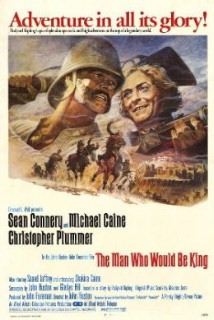
Kipling was a very overt Freemason, and his story "The Man Who Would Be King" (1888) is a tale of other fellow Freemasons. It is about two British adventurers in British India, who become kings of Kafiristan, a remote part of Afghanistan. The greatest Masonic film of all time is the adaption of this book. "In the pantheon of Masonic films, there can only be one king - and this is it," wrote Mr. Black. I could not agree more.

Director John Huston made this feature film in 1975, The Man Who Would Be King, starring Sean Connery and Michael Caine as the protagonists and Christopher Plummer as Kipling. The book and the movie share a plot also involving Alexander the Great, forms of Masonic ritual, images of Masonic symbols, and knowledge of Masonic secrets that serve as keys to the initial success of Kipling's Masonic heroes.

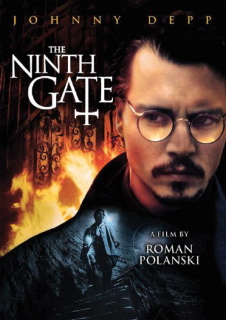
One film that has been made, full of synchromystic symbolism that is entwined with "The Three Musketeers," even though they never are overtly merged, is The Ninth Gate. It is a 1999 film based on the novel The Club Dumas by Arturo Pérez-Reverte. Spanning several genres, The Ninth Gate is a mix of Satanic mystery, iconic thriller, and neo-noir, and additionally portrays facets of the rare book business. The film was co-written and directed by Roman Polanski (Rosemary's Baby), and stars Johnny Depp as Dean Corso, a rare-book dealer hired by a book collector (Frank Langella) to validate a copy of The Nine Gates of the Kingdom of Shadows, a book by 17th century author Aristide Torchia.


Johnny Depp, I consider, so linked to so many twilight language movies, the list overwhelms. But what is so incredible about this specific movie is how rich it is but how very ignored it has been. One of the biggest elements little known to casual viewers of this film is that The Three Musketeers was originally part of this story. The source novel The Club Dumas contains numerous literary references and a subplot concerning Corso’s investigation into the original manuscript for a chapter of The Three Musketeers. Polanski and Brownjohn jettisoned these elements and focused on one particular plot line: Corso’s pursuit of the authentic copy of The Nine Gates to make it more of a Lucifer-friendly movie, in the tradition of Rosemary's Baby. The symbolism or complex nature of The Three Musketeers appears to have been lost on Polanski.

There is one date in The Ninth Gate that seems unmentioned but serves as a background temporal pivotal point of attention. The Nine Gates of the Kingdom of Shadows, a book by 17th century author Aristide Torchia is said to have developed a cult that annually recalls the anniversary of the burning at the stake of Torchia. In this created fiction, that date is given (in the book, but not noted in the movie) as February 17, 1666. Aristide Torchia is a fictional character from The Club Dumas, the 1993 novel by Arturo Pérez-Reverte. But Torchia is clearly based on the real life of Giordano Bruno, burned as a heretic on February 17, 1600.

Giordano Bruno was an Italian philosopher best-known as a proponent of the infinity of the universe. In addition to his cosmological writings, he also wrote extensive works on the art of memory, a loosely-organized group of mnemonic techniques and principles. He is often considered an early martyr for modern scientific ideas, in part because he was burned at the stake as a heretic by the Roman Inquisition. Frances Yates's books suggest that Bruno was deeply influenced by magical views of the universe inherited from Arab astrological magic, Neoplatonism and Renaissance Hermeticism. Other recent studies of Bruno have focused on his qualitative approach to mathematics and his application of the spatial paradigms of geometry to language.

Under Bruno's view of the universe, the Sun was simply one more star, and the stars all suns, each with its own planets. Bruno saw a solar system of a sun/star with planets as the fundamental unit of the universe. His view was holistic before it was cool to be holistic.

Symbolism was more overt in films like The Man Who Would Be King in 1975 and The Ninth Gate in 1999, of course. But that doesn't mean that iconic imagery is still not to be found in those of the 21st Century. Sometimes you have to look harder at what is hidden in plain sight.

Slumdog Millionaire is merely one point along the circle, which you can begin to measure anywhere.

Un pour tous, tous pour un.


Thank you for your important support during this critical time.

Friday, December 19, 2008

Synchromysticism's Godfather

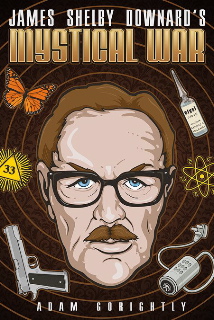
Adam Gorightly's newest book documents the remarkable phantasmagoria that was the person named James Shelby Downard, an American theorist and pamphleteer who shared his thoughts about conspiracies, coincidences, synchronicity, and symbolism.


James Shelby Downard's Mystical War was released by Virtual Bookworm Publishing, in November 2008. The subject of the book, Downard, lived from March 13, 1913 to March 16, 1998, unless, of course, his death was a disappearing act and he's still alive somewhere, writing under an assumed name. (I'm joking, right?)

Downard appeared on the scene when many of my contemporaries and I were just beginning to have lexilinked thoughts and overlapping insights into coincidences. His influence, as Gorightly notes, today has spread far beyond this strange man's life and death.

I easily understand the reach of Downard's impact within my own life from this twilight realm. In the 1960s and 1970s, first in correspondence, and then later in Fortean Times columns, I wrote about the connections I found between names and weirdnesses. Some of those writings appeared (see Devil Names and Fortean Places) in my 1983 book, Mysterious America, along with another chapter, entitled "Name Game."

In the beginning, I pointed to names such as Devil, Diablo, Manitou, and Hockomock for locations, and people names like Hobbs and Wetzel to watch. These were early explorations on the edges of what today is a vast journey in onomatology (the study of names) and toponomy (the study of places).

In the 1960s, John A. Keel carried on a lively correspondence with me and others, in which he examined the frequent appearance of certain proper names, like Reeves/Reaves, McDaniel, Hill, Allen, Maddox, and Heflin, as eyewitnesses of anomalistic incidents.

Soon, I was also corresponding with Bill Grimstad and Michael Anthony Hoffman II, who were close associates of Downard. Many people feel they got letters from Downard, but mostly, it was Hoffman and Grimstad who were assisting in getting Downard's thoughts and words to the rest of us.

Exchanging ideas with Grimstad, about locations linked to Fayette and LaGrange, and names like Bell, Mason/Macon, Pike, Warren, and Lafayette, all went hand in hand with being a Fortean in the 1960s-1970s, especially if an interest in assassinations and strange suicides fit into the mindset.

Hoffman, who authored the modern notion of the twilight language (versus the ancient Buddhist understanding of the phrase) and Grimstad, who was the source of the Fayette factor, were interesting and stimulating correspondents who nicely intellectualized many of Downard's ideas. Hidden meanings were there for the finding, and Hoffman, Grimstad, and Downard were the miners.

James Shelby Downard, who wrote short tracts, which later were published in various anthologies from Adam Parfray at Feral House, examined his own perceived decodings behind historical events in the 20th century, on a parallel track to what was happening with Forteans, anomalists, and demonologists. Downard's approach was mostly cryptopolitical, and some of us drifted over into his world, as often happens in attempting to get a holistic view of history and current events.

How does a biographer working with a secretive subject capture the life of the hidden one? That was Gorightly's task.

As you begin to read this new book about Downard, you might think that you have opened a cryptocomedic LSD trip about a conspiracy-oriented Forrest Gump-like character, who amazingly finds himself in all the wrong places at the wrong times.

Gorightly escorts the reader abroad a rollercoaster ride in which Downard is a Freemason scapegoat being ritualistically abused, watching the KKK hang a person at a crossroads, seeing Alexander Graham Bell receiving homoerotic sex magik fellatio, visiting J. Edgar Hoover's office, and getting a phone call from FDR.

The opening sections of the book are so breathlessly delivered that by the time I arrived at the chapter noting that Downard was at the "first ever meeting of the Baker Street Irregulars on July 5, 1934" in a New York City eating establishment, I hardly was startled by the statement.

All of this made me flashback to what Gorightly observed in his second paragraph of the book: "Some cynics have gone so far to suggest that Downard never actually existed, the group creation of Michael Hoffman, William Grimstad and Adam Parfrey."

Indeed!

The publisher's tagline for James Shelby Downard’s Mystical War, tells us that author Adam Gorightly "chronicles the famed conspiracy researcher’s life long battles against Masonic Sorcery as an investigator and exposer of the Science of Symbolism, Onomatology and Mystical Toponomy."

Well, yes, but what is real and what are Downard's fantasies? We clearly can't tell from Gorightly's text, because, of course, who knows?

The book is an odd mix, at points, of biographical tales about Downard's unbelievable life, his intellectual perceptions in symbol decoding, and details of specific historical milestones along the twilight highway.

When you realize that James Shelby Downard's first published work was only released in 1979, via the short work, The Masonic Assassination of John Fitzgerald Kennedy, you do come to grips with the fact his overall output was limited, but powerful.

Downard's refined and well-edited King-Kill 33° had everything to do with the skills of Michael Hoffman channeling Downard. Combined with Grimstad's Sirius Rising reel-to-reel tapes of conversations with Downard, the two works had a ripple effect. “King-Kill/33: Masonic Symbolism in the Assassination of John F. Kennedy” eventually was published by Adam Parfrey in the first edition of the book Apocalypse Culture. The essay theorizes the Freemasons were responsible for the assassination of President John F. Kennedy.

Grimstad, writing even before it was published, was able to walk a wonderfully skeptical open-minded fence, as he passed along the following summary of Downard's JFK insights in Weird America in 1978:

Would you believe John F. Kennedy as a ceremonial king-who-must-die? I'm afraid there is a certain body of opinion, undoubtedly the farthest-out brain wave of assassinology yet, that maintains the killing was pulled off, not by the Russians, the Cubans, the CIA, or the Mafia, but by alchemists.

As I understand the hypothesis, President Kennedy was for some reason chosen as The King (remember "Camelot," "Macbird" and all that?) after the fashion of James G. Frazer and Mary Renault whose "The King Must Die" he had been given to read before his death. This killing of the king in Dallas was related somehow to the touching off of the world's first atomic bomb at the Trinity Site in New Mexico 18 years earlier. Apparently the Bomb was the "destruction of primordial matter" stage of the grand alchemical working, but these conspiracy buffs aren't much more specific on details than were the early alchemists in their recipes. Anyway, Kennedy represented the next stage of the process - the "Death of the White King" - when he was immolated on a trinity site of his own. For, aren't Dealey Plaza and the ill-famed Triple Underpass on the bank of the old Trinity River?

William Grimstad


Popular cultural outlets, such as Robert Anton Wilson's works (e.g. Cosmic Trigger), the music of Marilyn Manson, and the various books and movies about the numbers 23 and 33, have Downard living onward into the morrow. My own books, including The Copycat Effect, show Downard influences.

Everyone has the sense they "discovered" the significance of certain names or dates, or even factoids like Dealey Plaza being the first Masonic temple in Texas, but remarkably, most of these revelations track back to Downard.


Adam Gorightly, who authored the underground classic, The Prankster and the Conspiracy: The Story of Kerry Thornley and How He Met Oswald and Inspired the Counterculture (with its foreword by Robert Anton Wilson), is a good person to be at the wheel for this biography of Downard. Oh, I wish it would have been twice as long, but I understand how difficult it is to write biographies of people that do not wish to be known.

Gorightly's book does an excellent job, nevertheless, in opening the door to a comprehensive world of symbol decodifications that may be new to many people. Today, there is much 21st century intrigue involving Downard's legacy, in new areas such as synchromysticism.

Several writers and commentators, including Todd Campbell, Robert Schneck, Theo Paijmans, SMiles, Michael Janitch, Mike Gos, Goro Adachi, Greg Bishop, Ben Fairhall, Henrik Palmgren, Richard Hendricks, Craig Heimbichner, Christopher Knowles, Fredrik Palmgren, Anthony Sutton, Kenn Thomas, the late Jim Keith, the late Ron Bond, and Jake Kotze inhabit the netherworld of conspiracies and synchromysticism, with the later being "an emerging field of study and subculture existing on the fringe of areas already considered fringe – primarily mysticism and Jungian psychology."

The word "synchromysticism" was first coined by Jake Kotze in August 2006, on his website-at-the-time, Brave New World Order. Kotze defined the concept as: "The art of realizing meaningful coincidence in the seemingly mundane with mystical or esoteric significance."

Downard's modern influence on Forteana, assassination studies, occult symbolism decoding, twilight language research and synchromysticism is so deep that he must be acknowledged as the Godfather to many of the points of view that inhabit those arenas.

I'm not sure if I take even half of what Downard wrote about as reality, but to get caught up in that intellectual side trick in critical thinking misses the point. In realizing the reality behind the twilight language, the metaphor is the method and the Downard as revealed by Gorightly is the message.


Greg Bishop, Farah Yurdozu, Nick Redfern, and Adam Gorightly somewhere near Roswell, on 07/09/07. Photo by Sigrid Hudson.

Glossary ~ James Shelby Downard examined the world through a variety of methodologies, including the following:

Onomastics or onomatology is the study of proper names of all kinds and the origins of names. The word is Greek: ὀνοματολογία (from ὄνομα (ónoma) "name").

Toponymy or toponomastics, the study of place names, is one of the principal branches of onomastics.

Anthroponomastics (or Anthroponymy), a branch of onomastics, is the study of anthroponyms (anthropos, 'man', + onuma, 'name'), the names of human beings.

Etymology is the study of the history of words — when they entered a language, from what source, and how their form and meaning have changed over time. In languages with a long detailed history, etymology makes use of philology, the study of how words change from culture to culture over time. The word "etymology" itself comes from the Ancient Athens ἐτυμολογία (etumologia) < ἔτυμον (etumon), “‘true sense’” + -λογία (-logia), “‘study of’”, from λόγος (logos), "speech, oration, discourse, word."