Showing posts with label James Shelby Downard. Show all posts

Tuesday, July 17, 2012

Bane/Bain Continues (Part 2)


Since the Twilight Language's Bane/Bain: Batman's Villain and Romney's Curse  was posted on 15 July 2012, the Bane/Bain dots being connected have exploded in the mainstream media.


Weird America's / The Rebirth of Pan's Jim Brandon forwards a comment with his insights linking a couple of the recent postings here:
Once again, your work-up on pop culture esoterica is fascinating. I have long cited Diamonds Are Forever to surprised Bond fans for the amazing spoofed Apollo 11 moon landing (the one with a Masonic flag inside Buzz Aldrin’s space-suit), having been aware of it since Billl Kaysing first broached the idea in 1976 (We Never Went to the Moon), long before Kenn Thomas and Childress. Downard might have called this tidbit “revelation of the method,” via Hollywood.

Their Gemstone theorizings on Onassis and the JFK killing are intriguing but seem a plausibility stretch compared with the far more succinct recent E. Howard Hunt confessions, which, if true supposedly, lead to Lyndon Baines Johnson and the shadowy coterie of Texas magnates behind him.

Speaking of Willard Whyte in Diamonds Are Forever reminds me that this may be a lower-level name of power or at least significance, if memory serves, though certainly nothing like Bain. However, it is also the curiously unused first name of Willard Mitt Romney, for what it’s worth. A Masonic angle with Willard Mitt Romney would come in with the “Mormon undies” that he presumably wears as a high LDS official. “The garments” are reported to bear conventional Masonic symbols and therefore have to be carefully burned when worn out.

Another aspect to the Las Vegas saga would be the heavy Mormon role there. The earliest American settlers (Spanish explorers seem to have hit on the name, which means “the meadows”) were Mormons in mid-1800s setting up a trading post on what Brigham Young had dreamed of as the Mormon Corridor to southern Calif.

Mormons have been active ever since. As the Wikipedia article on Las Vegas formerly pointed out ~ but which has now been laundered out ~ while it was Mafia money that built the first big post-WW2 casino expansion, that was deployed through Mormon banks. Also, Howard Hughes was well-known for having a “Mormon Mafia” as his personal retinue and 24-7 body-guards – much to the detriment of the supposed Onassis kidnapping scenario of Thomas and Childress.

What is most ironic is that the LDS church forbids gambling to its members, as meanwhile Vegas has one of the newest and most lavish Mormon Temples, dominating the skyline east of the Strip. And let’s not forget the curious episode of the alleged Mormon will of Howard Hughes, pursuit of which allegedly came all the way down from the Salt Lake hierarchy, attempting to take over the Hughes empire. This was entertainingly presented in the 1980
flick, Melvin and Howard.
Jason Robards at Howard Hughes

Readers of this blog will be familiar with the fact that I have linked Texan Tom Slick with Howard Hughes, who were friends and lived in bungalows next to each other at the Beverly Hill Hotel. Hughes was in #4. It was in another bungalow there that Hughes kept his "third man" detail, supervised by his main Mormon man, Roy E. Crawford.
Records allegedly indicate that Tom Slick was the true first hidden funding partner of the Bugsy Siegel's and Mickey Cohen's initial casino in Las Vegas (the Flamingo in December 1946). While I don't see Slick in the Bond movies, with Ivan Sanderson being so close to Ian Fleming, maybe the Bond books just didn't want to go in that direction – or even mention cryptozoology (which was being used as a spy cover) at all. Hinting at the use of birdwatching in that vein, a la' James Bond's A Field Guide to the Birds of the West Indies (1936), was apparently overt enough for these old spymasters, I suppose.

What will be "revealed" in The Dark Knight Rises, in metaphor?

In the meantime, as Friday rushes closer, let us continue below with some Bane/Bain visuals.


For more videos, see clips from Jon Stewart's Daily Show, plus also here.


See also:

Sunday, July 15, 2012

Bane/Bain: Batman's Villain & Romney's Curse (Part 1)

by Loren Coleman ©2012


Prepare to be hit in the face with a synchromystic name game of epic historical importance this summer.

The new Batman film, The Dark Knight Rises, will introduce the greater world to Bane, a villain apparently physically and mentally equal to the task of attempting to destroy the dark winged avenger. This will be occurring as we hear more and more about Mitt Romney's former company and President Obama's "villain," Bain Capital.

The former governor of Massachusetts wishes to be the first Mormon President, replacing the first AfricanAmerican President, but will Bain spoil Romney's wishes?

Will Bane in The Dark Knight Rises subconsciously drive the Bain notion home?

Bane is a fictional character who first appeared in comic books published by DC Comics. The character's origin was first in Batman: Vengeance of Bane #1 (January 1993), and was created by Chuck Dixon, Doug Moench, and Graham Nolan. Bane has been one of Batman's more physically and intellectually powerful foes. A virtually unstoppable juggernaut, he is best known for breaking Batman's back in the "Knightfall" story arc. IGN's list of the Top 100 Comic Book Villains of All Time ranked Bane as #34.

Bane was portrayed by Robert Swenson in the movie Batman & Robin (1997), directed by Joel Schumacher. That movie is so overwhelmed with George Clooney's Batman, Arnold Schwarzenegger's Mr. Freeze, Chris O'Donnell's Robin, Uma Thurman's Poison Ivy, and Alicia Silverstone's Batgirl, plus others, that Swenson's Bane is often forgotten. In Batman & Robin, Bane is Poison Ivy's bodyguard and muscle, who was originally a diminutive criminal named Antonio Diego (portrayed by Michael Reid MacKay). But then he is transformed into a large powerful Super-soldier by the steroid venom.
The current Bane (due for release 19 July in Australia, and 20 July 2012 in North America), is played by Tom Hardy in the finale of the Christopher Nolan-directed Batman film trilogy, The Dark Knight Rises. This Bane will not be overlooked as easily as the one who came to the screen in 1997. Bane plays a central role in the 2012 film as a ruthless terrorist who plans to destroy Gotham City. With the future of the city at stake, Batman (played by Christian Bale - who also starred in American Psycho) must emerge from his exile and confront Bane to bring about an end to his reign of terror.

It does not take any stretch of the imagination to compare the seemingly invisible and reclusive black President Obama of the middle years of his present term to the dark avenger Batman in exile, both of who must reemerge with strength to defeat Bain/Bane. 
Looking a bit deeper at the Twilight Language in this film, let us examine the places and names behind The Dark Knight Rises and Bane/Bain.
Toponomically and synchromystically, the following four sites for the filming of The Dark Knight Rises are worthy of our attention. A Fire Will Rise.

1. The Palace of the Parliament of Romania in Bucharest, is a multi-purpose building containing both chambers of the Romanian Parliament. According to the World Records Academy, the Palace is the world's largest civilian building, most expensive administrative building, and heaviest building. Built on the site of a hill variously known as Spirii Hill, Uranus Hill, or Arsenal Hill, construction began in 1983; the Freemason cornerstone was laid on 25 June 1984. On 30-31 May 2003, the site became the world's largest Masonic Temple with the gathering of over 2000 Scottish Rite Masons and their guests, on the 10th anniversary of the Scottish Rite being established in Romania.
The Star of Romania, that country's highest award, consists of a medal and ribbon (top) and a badge (bottom). On May 30, 2003, this great honor was conferred on Grand Commander Kleinknecht by the Hon. Ion Iliescu, President of Romania, during Masonic ceremonies held at the Palace of the Parliament in Bucharest. Photos: Bain Pugh and Associates.
2. Salina Turda is a salt mine in Turda, Transylvania, Romania. Salt was first extracted here during antiquity and the mine continuously produced table salt from the Middle Ages (the mine being first mentioned in 1075) to the early 20th century (1932). Since 1992, Salina Turda has been a halotherapy center and a popular tourist attraction.

3. The Wabash Tunnel is a former (1944 – 2004) railway tunnel through Mt. Washington in the city of Pittsburgh, Pennsylvania. French traders named the Wabash river after the Miami Indian word for the river, waapaahšiiki, meaning "it shines white," "pure white," or "water over white stones." The Miami name reflected the clarity of the river in Huntington County, Indiana where the river bottom is limestone. Several important battles have occurred here, including the Battle of Tippecanoe (1811), and the Siege of Fort Harrison (1812). (The Tippecanoe Curse is discussed here.)

4. Mehrangarh Fort, is located in Jodhpur city in Rajasthan state, and is one of the largest forts in India. It is literally, the Fort of the Sun, Mehrangarh [etymology: Mihir (Sanskrit) -sun or Sun-deity; garh (Sanskrit)-fort; i.e."Sun-fort"]. According to Rajasthani language pronunciation conventions, "Mihirgarh" has changed to "Mehrangarh." The Sun-deity has been the chief deity of the Rathore dynasty. Some very odd stories are associated with fort at this Dark Knight filming location. The foundation of the fort was laid on 12 May 1459 by Rao Jodha (1438–1488) on a rocky hill 5.6 miles (9 km) to the south of Mandore. This hill was known as Bhaurcheeria, the mountain of birds. According to legend to build the fort Jodha had to displace the hill's sole human occupant, a hermit called Cheeria Nathji, the lord of birds. Upset at being forced to move Cheeria Nathji cursed Rao Jodha with "Jodha! May your citadel ever suffer a scarcity of water!". Despite building a house and a temple in the fort very near the cave the hermit had used, even today the area is plagued by a drought every 3 to 4 years. Jodha then took an extreme measure to insure that the new site had a chance of success; he buried a man named Raja Ram Meghwal alive in the foundations. Raja Ram Meghwal was promised that in return his family would be looked after by the Rathores. To this day his descendants still live in Raj Bagh, in Raja Ram Meghwal's Garden, an estate bequeathed them by Jodha. A human stampede occurred on 30 September 2008, at the Chamunda Devi temple inside of the Mehrangarh Fort, in which 249 people were killed and more than 400 injured.

"Watch out for the bane." ~ William Grimstad

Bane and Bain are tied closely. Presidential candidate Romney's connection with Bain Capital, a "consulting, takeover, outsourcing" firm allegedly started by Bill Bain, ironically appears to be a "poison pill" for Romney, with Ron Paul being one of the first critics. 

Beyond Bain Capital, the name Bain has turned up in recent news stories, from the Tennessee family's bodies being found to the conflicts the USS Bainbridge had with Somali pirates. But it is Bain Capital that will be on people's mind as the 2012 US Presidential Campaign heats up just as The Dark Knight Rises opens.

The surname Bain originates in Scotland/northern England, where it was originally a nickname meaning "bones." It is also from the Welsh ap Einws, (son of Einws = "anvil"). SE shared that Baine is derived from the Irish word meaning "pale or white."

But there are other meanings. It is said to be from Middle English bain, bayne, bayn, beyn (“direct, prompt”), from Old Norse beinn (“straight, right, favorable, advantageous, convenient, friendly, fair, keen”), from Proto-Germanic bainaz (“straight”), from Proto-Indo-European bhei- (“to hit, beat”). Cognate with Scots bein, bien (“in good condition, pleasant, well-to-do, cozy, well-stocked, pleasant, keen”), Icelandic beinn (“straight, direct, hospitable”), Norwegian bein (“straight, direct, easy to deal with”).

James Shelby Downard's research in King Kill 33 notes that Bain relates to Bane ("fatal cause of mischief"), and in Scottish legend, the Bain Fairy is a death fairy who is the keeper of the Bain Bridge. King Kill 33 noted the American battleship Bainbridge, which was dedicated by Lyndon Baines Johnson, is a harbinger of death, according to Downard.


Author Jim Brandon shares his insights about Bane/Bain:
Question is, did James Shelby Downard anticipate the whole thing? In my “Sirius Rising,” right up-front is Downard's enthusiastic digression on the Baines / MacBeth angle behind the JFK hit. Now, checking back, I see that he may have picked up on this from the then-obscure satirical play MacBird, dating from 1967, which reportedly plays around with the onomatology.

Shelby seems to have had prescient dark suspicions about Lyndon Baines Johnson himself, whose curiously nicknamed wife (née Claudia Taylor) started the whole bizarre Bird business. Recently, new testimony against LBJ has emerged, from Jackie Kennedy and E. Howard Hunt.


LBJ waited in the wings, as JFK took central stage first.


Epilogue:

Certain middle-of-the-road to right-wing wags have already penned articles playing on the old meaning of "bane" (i.e. a thing that ruins or spoils), asking questions like, "Will Bain be the bane of Romney?"

While no other blogs, as far as I know, have done any beginning Bane/Bain synchromystic analyses, such as the one you just read, there are some writers who are naturally making the link between Bane/Bain Capital in simpler political ways. Those writers are trying to figure out, seriously or with tongue in cheek, if there is a sinister pro-Obama plot behind The Dark Knight Rises. (See here, here, and here. Also, top imagery created from concept from Rob Beschizza.)

Short answer to that conspiracy question: It is doubtful and dubious, as the creative timing is way off. But there are no coincidences, correct? 
It seems unrealistic that a subplot of this movie was consciously created to influence the 2012 Election, although it may unconsciously. No, this movie's major objective is as popular cultural moneymaker that happens to link into a wide variety of synchromystical themes. After all, who could have predicted that a character named Bane in 1993, would remind many of a significant newsworthy moniker pronounced the same but spelled Bain, in 2012?


Photo construction: PJMedia

+++++++++++++++++++++++++++++++++++++++++++


For more about James Shelby Downard, Synchromystic's Godfather, see here.

First published 15 July 2012, 7:23 PM; updated 16-17 July 2012.

The awareness of the Bane/Bain link increased on Monday, notes reporter Andrew Griffin. One of the major news items detailing this has been published here, and has surfaced at the top of the Drudge Report during the afternoon of the 16th (below). On the 17th, the linkages continued, see here. Nice to know our Twilight Language attention was on target:


DEMS TO USE 'BATMAN' AGAINST ROMNEY


Monday, July 2, 2012

Tom Cruise: 33° of Separation

Sometimes Perez Hilton gets it, even though how he stumbles into it seems a wonder to behold. Let's take the case of Tom Cruise and his now forthcoming divorce from Katie Holmes. We don't have any choice but to do a bit of synchromystic, Fortean detective work about this seemingly tabloid story. There is more here than meets the eye. First, here is the splashy news.

Not burying the lead at all, Hilton penned a short alert over the weekend, entitled "Tom Cruise Marriages End When Wives Are 33, Scientology Established On 33rd Parallel!"

Tom Cruise has had three wives. Hilton states it quickly and factually that Cruise,
wed MiMi Rogers in May of 1987, but they broke up in 1990… when she was 33. Then he moved on with Nicole Kidman. They were happy for ten years but guess what! They split when she was 33 too! And now, just a day after her divorce announcement, Katie Holmes has 33 years under her belt.
Perez Hilton, however, missed at least one. 
Cruise had a relationship with his Risky Business co-star Rebecca de Mornay; they cohabited in New York from 1983 through 1985. She was born in 1952 (the daughter of Jane Eager and Hot Seat talk show host Wally George, who was copycatted by Jerry Springer and others following its 1983 creation). De Mornay was 33 when she broke up with Cruise in 1985!!!
Cruise also had a relationship with Penelope Cruz that ended in 2004. She would have been 31 years old (unless she's lying about her age in her official bios, which she denies going to do in the future).

Tom Cruise's birthday is July 3, and he will be exactly 50 years old this year.

Two other well-known actors are born exactly on the same day (July 3, 1962) as Tom Cruise:
Aaron "Hotch" Hotchner (Thomas Gibson) on Criminal Minds.

Synchromystically, Gibson made his big-screen debut as Tom Cruise's nemesis and chief rival for Nicole Kidman’s affections in Far and Away, Ron Howard’s 1992 epic about Irish immigrants settling in the New World.

Dr. Taylor Hayes (Hunter Tylo) on The Bold and The Beautiful.

It does seem to be beyond a coincidence that Cruise would experience breakups with four women in their 33rd year of life. What's going on here?
"Watch Katie Holmes and Scientology story develop. Something creepy, maybe even evil, about these people."
~ Tweeted from Rupert Murdoch, Sunday, July 1, 2012.
Perez Hilton relates the significance of "33," in some unexplained fashion, to Cruise's love of Scientology, saying he found that
the Hubbard Association of Scientologists, the forerunner of the Church of Scientology, was established in Phoenix, Arizona. And Phoenix lies on the 33rd parallel. Hmm… 
The godfather of synchromysticism James Shelby Downard first made many of us aware of the significance of the number 33 and its specific magic along the 33rd parallel, in 1979, via the short underground classic, The Masonic Assassination of John Fitzgerald Kennedy. It has a lot to do with the 33rd degree of Freemasonry, apparently.

Downard's “King-Kill/33: Masonic Symbolism in the Assassination of John F. Kennedy” eventually was published by Ritual America's Adam Parfrey as a chapter in the first edition of the book Apocalypse Culture. A shortcut spoiler is that the essay theorizes the Freemasons were responsible for the assassination of President John F. Kennedy in a specific ritual related to "killing the King."
Jim Brandon, writing even before Downard's work was published, was able to walk a wonderfully skeptical open-minded fence, as he passed along the following summary of Downard's JFK insights in Weird America in 1978:
Would you believe John F. Kennedy as a ceremonial king-who-must-die? I'm afraid there is a certain body of opinion, undoubtedly the farthest-out brain wave of assassinology yet, that maintains the killing was pulled off, not by the Russians, the Cubans, the CIA, or the Mafia, but by alchemists.
As I understand the hypothesis, President Kennedy was for some reason chosen as The King (remember "Camelot," "Macbird" and all that?) after the fashion of James G. Frazer and Mary Renault whose "The King Must Die" he had been given to read before his death. This killing of the king in Dallas was related somehow to the touching off of the world's first atomic bomb at the Trinity Site in New Mexico 18 years earlier. Apparently the Bomb was the "destruction of primordial matter" stage of the grand alchemical working, but these conspiracy buffs aren't much more specific on details than were the early alchemists in their recipes. Anyway, Kennedy represented the next stage of the process - the "Death of the White King" - when he was immolated on a trinity site of his own. For, aren't Dealey Plaza and the ill-famed Triple Underpass on the bank of the old Trinity River?
~ Jim Brandon
Popular cultural outlets, such as Robert Anton Wilson's works (e.g. Cosmic Trigger), the music of Marilyn Manson (e.g. King Kill 33), and the various books and movies about the numbers 23 and 33, have Downard's insights influencing a broader audience. My own books, including The Copycat Effect, show the readers various purple shades of Downard.

Developing from this, then, is that severals writers have the sense they "discovered" the significance of certain names or dates, or even factoids like Dealey Plaza being near the 33° north latitude and it being the first Masonic temple in Texas. Remarkably, most of the hints to these revelations track directly back to Downard.

Downard showed clearly the linkages between the mystical landscape and the 33° latitude. Intriguingly, more awareness of the Fayette Factor seems in play than any longterm knowledge of the 33° parallel or of 33 as a harmonic digit. More people follow the 23 "coincidences," in the numbers arena than they do "33."

But this might change. Jim Brandon penned the following thoughts in his 1983 book, The Rebirth of Pan: Hidden Faces of the American Earth Spirit: "...there are certain numbers entangled with certain phenomena...."

The top numerical candidate, coming into its own, has to be 33.

Thirty-three turns up in some remarkable places. 

The unnatural nature of the 33° alignments is well-discussed in the synchromystic world. See, for example, the wild and weird, from Red Ice Creation's "Along the 33rd Parallel: A Global Mystery Circle" to Scoreboard Canada's "The 33rd Parallel: Masonic Line of Death...." and Hidden Mysteries' "Masons and Mystery at the 33rd Parallel."

All kinds of associations have been made with the 33rd Parallel: pyramids, death rows, ufo crash sites, Trinity Atomic Bomb test site, the starting site of the Scottish Rite in America, the first shots of the Civil War at Fort Sumter, and various assassination-assassination attempt locations (from Jesus to JFK & RFK, from Captain William Morgan to Gabrielle Giffords). Why should we be surprised by the Tom Cruise-Scientology 33rd degree speculations? Some of the linkages do have a basis in popular cultural fact.
Take for instance, the name "Hobbs," which is a "devil's name," a word based on a demonic origin. Hobbs had been the location of UFO sightings in the 1950s and 1960s. Hobbs, New Mexico, near the 33 degree latitude, has experienced a never-ending stream of UFO encounters since Bill Watson's April 1955 sighting became known in ufology as the "Hobbs Incident." This Southwest corner of New Mexico is a hotbed of so-called flying saucer activity with the most famous event being the "Roswell Incident." Allegedly, as is well-known today, a UFO crashed in nearby Roswell, New Mexico, on July 8, 1947, and the US Air Force recovered small bodies from the craft, according to numerous ufological researchers. The entire use of the term "little green men" appears to have been added to American slang by way of the incidents taking place in the Hobbs-Roswell area in 1947.
Trinity Site Obelisk - National Historical Landmark
Trinity was the code name of the first detonation of a nuclear device. This test was conducted by the United States Army on July 16, 1945, in the Jornada del Muerto ("single day's journey of the dead man") desert about 35 miles southeast of Socorro, New Mexico (site of Lonnie Zamora CEIII 1964 incident - pictured) at the White Sands Proving Ground; Trinity took place on the 33rd Parallel. Considering the background to the name "Hobbs," such events are not too shocking.

Perez Hilton is on to something, no matter how sensational people might think his "news." The word "synchromysticism" was first coined by Jake Kotze in August 2006, on his website-at-the-time, Brave New World Order. Kotze defined the concept as: "The art of realizing meaningful coincidence in the seemingly mundane with mystical or esoteric significance." Who are we to deny the fact these things come to us in all kinds of different ways?

In the wake of James Shelby Downard, are we now to understand that Tom Cruise and Scientology have realized the synchromystical magic of the number 33 and the 33° latitude? Ah, The Master is on its way! All shall be revealed, in the coming months, humm?

{Photo credit for top image, Perez Hilton/Will Alexander/WENN. Thanks to The Anomalist's Chris Savia & his wife for the news tip about the Perez Hilton hint.}

Friday, December 19, 2008

Synchromysticism's Godfather

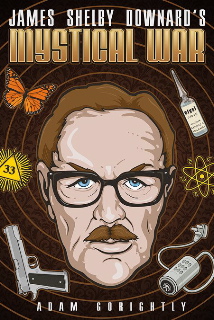
Adam Gorightly's newest book documents the remarkable phantasmagoria that was the person named James Shelby Downard, an American theorist and pamphleteer who shared his thoughts about conspiracies, coincidences, synchronicity, and symbolism.


James Shelby Downard's Mystical War was released by Virtual Bookworm Publishing, in November 2008. The subject of the book, Downard, lived from March 13, 1913 to March 16, 1998, unless, of course, his death was a disappearing act and he's still alive somewhere, writing under an assumed name. (I'm joking, right?)

Downard appeared on the scene when many of my contemporaries and I were just beginning to have lexilinked thoughts and overlapping insights into coincidences. His influence, as Gorightly notes, today has spread far beyond this strange man's life and death.

I easily understand the reach of Downard's impact within my own life from this twilight realm. In the 1960s and 1970s, first in correspondence, and then later in Fortean Times columns, I wrote about the connections I found between names and weirdnesses. Some of those writings appeared (see Devil Names and Fortean Places) in my 1983 book, Mysterious America, along with another chapter, entitled "Name Game."

In the beginning, I pointed to names such as Devil, Diablo, Manitou, and Hockomock for locations, and people names like Hobbs and Wetzel to watch. These were early explorations on the edges of what today is a vast journey in onomatology (the study of names) and toponomy (the study of places).

In the 1960s, John A. Keel carried on a lively correspondence with me and others, in which he examined the frequent appearance of certain proper names, like Reeves/Reaves, McDaniel, Hill, Allen, Maddox, and Heflin, as eyewitnesses of anomalistic incidents.

Soon, I was also corresponding with Bill Grimstad and Michael Anthony Hoffman II, who were close associates of Downard. Many people feel they got letters from Downard, but mostly, it was Hoffman and Grimstad who were assisting in getting Downard's thoughts and words to the rest of us.

Exchanging ideas with Grimstad, about locations linked to Fayette and LaGrange, and names like Bell, Mason/Macon, Pike, Warren, and Lafayette, all went hand in hand with being a Fortean in the 1960s-1970s, especially if an interest in assassinations and strange suicides fit into the mindset.

Hoffman, who authored the modern notion of the twilight language (versus the ancient Buddhist understanding of the phrase) and Grimstad, who was the source of the Fayette factor, were interesting and stimulating correspondents who nicely intellectualized many of Downard's ideas. Hidden meanings were there for the finding, and Hoffman, Grimstad, and Downard were the miners.

James Shelby Downard, who wrote short tracts, which later were published in various anthologies from Adam Parfray at Feral House, examined his own perceived decodings behind historical events in the 20th century, on a parallel track to what was happening with Forteans, anomalists, and demonologists. Downard's approach was mostly cryptopolitical, and some of us drifted over into his world, as often happens in attempting to get a holistic view of history and current events.

How does a biographer working with a secretive subject capture the life of the hidden one? That was Gorightly's task.

As you begin to read this new book about Downard, you might think that you have opened a cryptocomedic LSD trip about a conspiracy-oriented Forrest Gump-like character, who amazingly finds himself in all the wrong places at the wrong times.

Gorightly escorts the reader abroad a rollercoaster ride in which Downard is a Freemason scapegoat being ritualistically abused, watching the KKK hang a person at a crossroads, seeing Alexander Graham Bell receiving homoerotic sex magik fellatio, visiting J. Edgar Hoover's office, and getting a phone call from FDR.

The opening sections of the book are so breathlessly delivered that by the time I arrived at the chapter noting that Downard was at the "first ever meeting of the Baker Street Irregulars on July 5, 1934" in a New York City eating establishment, I hardly was startled by the statement.

All of this made me flashback to what Gorightly observed in his second paragraph of the book: "Some cynics have gone so far to suggest that Downard never actually existed, the group creation of Michael Hoffman, William Grimstad and Adam Parfrey."

Indeed!

The publisher's tagline for James Shelby Downard’s Mystical War, tells us that author Adam Gorightly "chronicles the famed conspiracy researcher’s life long battles against Masonic Sorcery as an investigator and exposer of the Science of Symbolism, Onomatology and Mystical Toponomy."

Well, yes, but what is real and what are Downard's fantasies? We clearly can't tell from Gorightly's text, because, of course, who knows?

The book is an odd mix, at points, of biographical tales about Downard's unbelievable life, his intellectual perceptions in symbol decoding, and details of specific historical milestones along the twilight highway.

When you realize that James Shelby Downard's first published work was only released in 1979, via the short work, The Masonic Assassination of John Fitzgerald Kennedy, you do come to grips with the fact his overall output was limited, but powerful.

Downard's refined and well-edited King-Kill 33° had everything to do with the skills of Michael Hoffman channeling Downard. Combined with Grimstad's Sirius Rising reel-to-reel tapes of conversations with Downard, the two works had a ripple effect. “King-Kill/33: Masonic Symbolism in the Assassination of John F. Kennedy” eventually was published by Adam Parfrey in the first edition of the book Apocalypse Culture. The essay theorizes the Freemasons were responsible for the assassination of President John F. Kennedy.

Grimstad, writing even before it was published, was able to walk a wonderfully skeptical open-minded fence, as he passed along the following summary of Downard's JFK insights in Weird America in 1978:

Would you believe John F. Kennedy as a ceremonial king-who-must-die? I'm afraid there is a certain body of opinion, undoubtedly the farthest-out brain wave of assassinology yet, that maintains the killing was pulled off, not by the Russians, the Cubans, the CIA, or the Mafia, but by alchemists.

As I understand the hypothesis, President Kennedy was for some reason chosen as The King (remember "Camelot," "Macbird" and all that?) after the fashion of James G. Frazer and Mary Renault whose "The King Must Die" he had been given to read before his death. This killing of the king in Dallas was related somehow to the touching off of the world's first atomic bomb at the Trinity Site in New Mexico 18 years earlier. Apparently the Bomb was the "destruction of primordial matter" stage of the grand alchemical working, but these conspiracy buffs aren't much more specific on details than were the early alchemists in their recipes. Anyway, Kennedy represented the next stage of the process - the "Death of the White King" - when he was immolated on a trinity site of his own. For, aren't Dealey Plaza and the ill-famed Triple Underpass on the bank of the old Trinity River?

William Grimstad


Popular cultural outlets, such as Robert Anton Wilson's works (e.g. Cosmic Trigger), the music of Marilyn Manson, and the various books and movies about the numbers 23 and 33, have Downard living onward into the morrow. My own books, including The Copycat Effect, show Downard influences.

Everyone has the sense they "discovered" the significance of certain names or dates, or even factoids like Dealey Plaza being the first Masonic temple in Texas, but remarkably, most of these revelations track back to Downard.


Adam Gorightly, who authored the underground classic, The Prankster and the Conspiracy: The Story of Kerry Thornley and How He Met Oswald and Inspired the Counterculture (with its foreword by Robert Anton Wilson), is a good person to be at the wheel for this biography of Downard. Oh, I wish it would have been twice as long, but I understand how difficult it is to write biographies of people that do not wish to be known.

Gorightly's book does an excellent job, nevertheless, in opening the door to a comprehensive world of symbol decodifications that may be new to many people. Today, there is much 21st century intrigue involving Downard's legacy, in new areas such as synchromysticism.

Several writers and commentators, including Todd Campbell, Robert Schneck, Theo Paijmans, SMiles, Michael Janitch, Mike Gos, Goro Adachi, Greg Bishop, Ben Fairhall, Henrik Palmgren, Richard Hendricks, Craig Heimbichner, Christopher Knowles, Fredrik Palmgren, Anthony Sutton, Kenn Thomas, the late Jim Keith, the late Ron Bond, and Jake Kotze inhabit the netherworld of conspiracies and synchromysticism, with the later being "an emerging field of study and subculture existing on the fringe of areas already considered fringe – primarily mysticism and Jungian psychology."

The word "synchromysticism" was first coined by Jake Kotze in August 2006, on his website-at-the-time, Brave New World Order. Kotze defined the concept as: "The art of realizing meaningful coincidence in the seemingly mundane with mystical or esoteric significance."

Downard's modern influence on Forteana, assassination studies, occult symbolism decoding, twilight language research and synchromysticism is so deep that he must be acknowledged as the Godfather to many of the points of view that inhabit those arenas.

I'm not sure if I take even half of what Downard wrote about as reality, but to get caught up in that intellectual side trick in critical thinking misses the point. In realizing the reality behind the twilight language, the metaphor is the method and the Downard as revealed by Gorightly is the message.


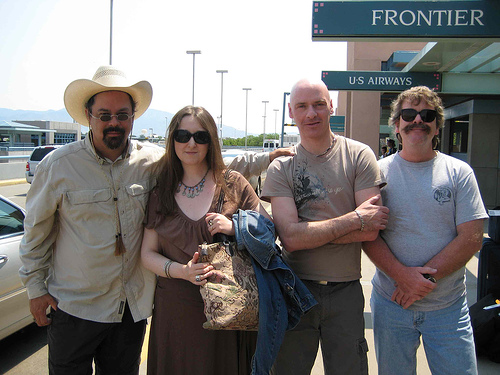
Greg Bishop, Farah Yurdozu, Nick Redfern, and Adam Gorightly somewhere near Roswell, on 07/09/07. Photo by Sigrid Hudson.

Glossary ~ James Shelby Downard examined the world through a variety of methodologies, including the following:

Onomastics or onomatology is the study of proper names of all kinds and the origins of names. The word is Greek: ὀνοματολογία (from ὄνομα (ónoma) "name").

Toponymy or toponomastics, the study of place names, is one of the principal branches of onomastics.

Anthroponomastics (or Anthroponymy), a branch of onomastics, is the study of anthroponyms (anthropos, 'man', + onuma, 'name'), the names of human beings.

Etymology is the study of the history of words — when they entered a language, from what source, and how their form and meaning have changed over time. In languages with a long detailed history, etymology makes use of philology, the study of how words change from culture to culture over time. The word "etymology" itself comes from the Ancient Athens ἐτυμολογία (etumologia) < ἔτυμον (etumon), “‘true sense’” + -λογία (-logia), “‘study of’”, from λόγος (logos), "speech, oration, discourse, word."