Showing posts with label Lee Harvey Oswald. Show all posts

Sunday, June 10, 2012

Fayette Factor


The Fayette Factor
Above and below, Fayette County, Georgia.


Who--or more precisely, what--is "the Fayette Factor?" It is probably one of the strangest mysteries in American Forteana, first discovered by researcher William (Bill) Grimstad, back in 1977, and written about in "Fateful Fayette," Fortean Times, No. 25, Spring 1978.

Namely, the "Fayette Factor" has been the finding of a surprisingly high incidence of Fortean (inexpliable) events linked to places named after one of the USA's Founding Fathers--the Marquis de Lafayette. 
Fayetteville, West Virginia

Since Grimstad's discovery, several items on this lexilink between Fayette (as well as its related forms - Lafayette, La Fayette, Fayetteville, Lafayetteville) and high strangeness have been published. In his book, Weird America (New York: EP Dutton, 1978), Grimstad mentions several Fayette hot spots but did not dwell on them. In exchanges with Bill, a small group of Forteans discussed the Fayette Factor privately throughout the late 1970s. It was not until Brandon's (now extremely rare) The Rebirth of Pan: Hidden Faces of the American Earth Spirit (Firebird Press, 1983) and Mysterious America (Boston: Faber and Faber, 1983) that more in-depth analyses of the Fayette "coincidences" seriously occurred. These examinations were followed by updates and other comments in Mysterious America (NY: Simon and Schuster, 2006), and Mothman and Other Curious Encounters (NY: Paraview, 2002).  Furthermore, the appearance of widely available material on the Fayette Factor started routinely being posted online during the 1990s-2010s.
According to Grimstad, "Lafayette traveled widely in this country (USA) and doubtless must have been the inspiration for many or most of the 18-odd counties and 28 towns and cities across the land that I have been able to find with some form of his name." 
 Lafayette County, Mississippi
Marie-Joseph Paul Roch de Motier, Marquis de Lafayette, was born in 1757. His father, a French Army officer, was killed in the battle of Minden in 1759, and the marquis was brought up by his mother's prestigious family, the de Noailles. At the age of 18, he traveled to the Americas at his own expense and became an aide to General George Washington, who loved him like a son. By the end of the War of the American Revolution, Lafayette commanded the Continental Army in Virginia. That's the Lafayette every American schoolboy knows. But, as researcher Manly Palmer Hall has pointed out, the marquis had ties to the esoteric groups of the late Eighteenth Century. 
"In addition to his political pursuits," Grimstad wrote, "Lafayette was busily involved in certain circles that should be of interest to contemporary Illuminati buffs." 
 Lafayette County, Mississippi

According to Manly Palmer Hall, Lafayette was an associate of both Dr. Anton Mesmer, "the Father of Hypnotism," and Giuseppe Balsamo, better known as Cagliostro, a Sicilian sorcerer who was an acolyte of Adam Weishaupt's Illuminati. 

Hall wrote, "In 1785, the Marquis...joined the Egyptian Masonry of Cagliostro and proclaimed his absolute confidence in the 'Grand Cophte.' When Anton Mesmer arrived from Vienna with his theories of animal magnetism, Lafayette was one of his first customers." 

Grimstad adds, "But Lafayette also had the closest ties with Benjamin Franklin, the American revolutionary sage and member of (Sir Francis) Dashwood's 'Hell-Fire Club' in Britain (also known as the 'Medmenham Monks' of High Wycombe, Buckinghamshire, northwest of London). As Hall puts it, 'Benjamin Franklin was a philosopher and a Freemason--possibly a Rosicrucian initiate. He and the Marquis de Lafayette--also a man of mystery--constitute two of the most important links that culminated in the establishment of the original thirteen American colonies as a free and independent nation.' Lafayette, Hall summarises, 'is a direct link between the (esoteric) political societies of France and the young American government.'"  

Attention to other links to other locations, such as my discovery that LaGrange is also an associated hot name, apparently due to the fact the name Chateau de LaGrange was the French home of the Marquis de Lafayette, evolved during the last thirty years of our writings and mutual exchange on the subject.

The cities, towns, and counties across the United States, which are the Fortean hotspots linked to the Fayette Factor, are tied to the renamed Masonic lodges and affiliated sites that the Marquis de Lafayette visited on his grand tour of the country in 1824-1825. His visits were highly ritualized happenings, in which he was involved with laying many cornerstones. The locations where he was taken to visit are a virtual roadmap of the "special places" in this land. For example, in 1825, The Marquis de Lafayette, on board the ship (please note!) "Enterprise," visited the Cahokia mounds, and the significant Bloody Island, which then was so large that half of the Mississippi flowed east of it. (Intriguingly, Lafayette returned to France in 1825, on the day after his birthday, demonstrating a keen eye on the calendar and a desire to celebrate September 6th in America.)

Many Masonic locations have been linked beyond the easily recognized Lafayette name to a broader Freemasonry focus to mystic events and violent happenings. Some are very subtle. One man's journey, Lee Harvey Oswald, from his office across from Lafayette Square, New Orleans, would lead to the most infamous Masonic sites in the country. This vivid example of deathly weirdness is Dealey Plaza, where JFK was assassinated on November 22, 1963. Dallas' Dealey Plaza is the location of the state of Texas's first Masonic temple. 

How much of the Marquis's involvement in such matters was due to his deeply-held esoteric beliefs or to mere socializing is something for historians of the future to determine. What is of interest to Forteans is the uncanny number of unexplained incidents linked to the name Lafayette. Grimstad has an impressive list, which we have added to, of course, as the years have rolled along, hitting its 35th year in 2012. Here's a review of Grimstad's original notes, with new images.
Fayette County, Alabama

"In Fayette County, Alabama, is the Musgrove Methodist Cemetery. The tombstone of one Robert L. Musgrove there bears a discoloration, not especially realistic, that is locally believed to be the bridal- veiled figure of Musgrove's fiancee. Apparently he was killed just before the wedding, and the sorrowing girl" willed her image "onto the marble by her many visits to the grave." (Sir Arthur Conan Doyle may have used this real-life case as the basis for his Sherlock Holmes story, "The Musgrave Ritual.") 

"The engima-laden state of Arkansas has two sites. The city of Fayetteville, in the northwest corner" of Arkansas, "has long been legendary for oddities. UFOs and aerial lightshows, water monsters in the nearby White River and Springheel Jack-type window peepers are among the manifestations."
 
 Lafayette County, Arkansas

"In the southwest angle of Arkansas is a Bigfoot hotspot that has been immortalized--in America, at least-- by the (1974) movie The Legend of Boggy Creek. The critters have been known hereabouts since 1856, centering their activities lately upon the town of Fouke in Miller County and ranging eastward into Lafayette County." 
Lafayette County, Kentucky

"In the scenic Bluegrass area of Kentucky, the university city of Lexington sits atop one of America's more dramatic lost cave stories. Historian G.W. (George Washington) Ranck recorded in 1872 that hunters in 1776 had found a tunnel behind a rock panel of 'peculiar workmanship' and covered with hieroglyphics. The descending portal widened to a sort of gallery running downward a few hundred feet to a huge underground room. Ranck cited the hunters' reports that this chamber contained idols, altars and about 2,000 human mummies. Although the entrance to the amazing cavern was (of course--B.G.) lost, there are still cave true-believers who poke about looking for the weird mausoleum beneath this part of Fayette County." 
 Fayette County, Missouri

"Followers of ghost lore may have heard of the recent (1976) antics of a supposed phantom in Lilac Hill, a large old farmhouse at Fayette, Missouri. A number of psychically-sensitive individuals have been trying to discern what is troubling the alleged spirits, of whom there are said to be at least two."
LaFayette, New York


"In New York state, a farm near Cardiff, 10 miles (16 kilometers) south of Syracuse, was the starting point in October 1869 for one of the more sensational fossil controversies. The 'Cardiff Giant' is still displayed at museum near Cooperstown," and the weird stone idol was found in a quarry near "the Nineteenth Century town of La Fayette." 
Fayette, New York

Also, "it was in April of 1830 that the Church of Jesus Christ of the Latter-Day Saints (i.e. the Mormons) was founded by Joseph Smith and a few disciples, who claim to have received more than a little help from certain angelic friends in the neighborhood. The place: Fayette, New York." 
Fayetteville, North Carolina

"Another haunted house story takes us to an American state that perhaps rivals New York and Arkansas in the number and interest of its anomalies. It also brings us back across the trail of the peripatetic Marquis de Lafayette. This is the A.S. Slocumb Mansion, located in the North Carolina city of Fayetteville. The Slocumb House is supposed to have a number of special occupants. It also has, or had, a secret vault in the basement and at least one tunnel leading to the Cape Fear River channel." 
Fayette County, Tennessee

In 1977, the USA experienced one of the most severe winters in its history. "As of February 3, 1977, the National Weather Service announced that the 'hardest hit area' of the north-central states region was Fayette County, Ohio."
Fayette County, Tennessee

Bigfoot "became rather more aggressive on April 23, 1976 when it attempted to carry off a four-year-old boy from his backyard on a farm in Tennessee. A sheriff's posse pursued the entity and seems to have shot enough high-powered rifle fire into it to have felled King Kong himself. However, as if tiring of the game, the creature finally leaped out of its cul-de-sac and simply vanished. These events occurred within a few miles of the hamlet called Fayetteville, Tennessee." 
Lafayette Baker

"Now I would like to consider some examples of a more ominous character," Grimstad wrote, "We find 'the Lafayette factor' in the Abraham Lincoln assassination of the 1860s...A slippery character named Lafayette Baker had been brought in to head the Secret Service by the enigmatic Edwin M. Stanton, President Lincoln's arrogant Secretary of War. Otto Eisenschiml, the pioneer revisionist historian of this amazingly crude murder conspiracy, delved into the story as far as the surviving records would allow."
"His findings suggest that Lafayette Baker and Stanton had maneuvered to facilitate the escape into the South of assassin John Wilkes Booth, and when that proved impossible (owing to Booth's broken leg) to ensure that the killer was not brought back and that his evidently-incriminating diary did not survive intact." 

"At the same hour Lincoln was shot at Ford's Theatre, Secretary of State William Seward "was attacked and savagely knifed by a deranged giant named Lewis Paine, who had forced his way into the Seward home. This house fronted upon Lafayette Square, just across Pennsylvania Avenue from the White House." 
Andrew Jackson statue and White House, Lafayette Square, with Masonic obelisk of Washington's Monument in the background, Washington, D. C.

"Residents of the District of Columbia sometimes refer to the area "as 'Tragedy Square.' No other section of Washington has had so much intrigue, mystery, murder and macabre happenings as has the area directly opposite 1600 Pennsylvania Avenue.'"
Fayetteville, Pennsylvania

The Fayette Factor has also come into play in occult crimes, as well. "On July 3, 1977, 23-year-old Gary Rock was charged on two counts of criminal homicide after two local volunteer firemen were killed by a sniper while responding to a fire alarm at Rock's isolated cabin, near Fayetteville, Pennsylvania."
Lafayette High School, New York City

"On July 31, 1977, two young people sitting in a parked car along the Brooklyn, New York seashore were shot several times by a mysterious assailant who had become known as 'the Son of Sam.' The girl, Stacy Moskowitz, died of her injuries; her companion, Robert Violante, suffered eye damage. Miss Moskowitz was an alumna of (Brooklyn's) Lafayette High School. When she and Violante were shot, it was while they were sitting 'not far from Lafayette High School,' according to the New York Times" of August 1, 1977, page 34-C."

It's just all part of the enduring mystery we call "the Fayette Factor." 

Sources: Fortean Times No. 25 for Spring 1978, "Fateful Fayette" by Bill Grimstad, page 3; Why Was Lincoln Murdered? by Otto Eisenschiml, Little, Brown & Co., Boston, Mass., 1937; America's Assignment with Destiny by Manly Palmer Hall, Philosophical Research Society, Los Angeles, Cal., 1951; and Weird America by Jim Brandon, E.P. Dutton Co., New York, N.Y., 1978.
Fortean Times February 13, 2004 
+ 2012 enhancements.
Flashback reflections from Loren Coleman

Fayette incidents continue...
Fayette, Pennsylvania, 2009 Bigfoot sighting drawing.
Bigfoot Lunch Club montage.

 
Also from Loren Coleman
For more specific "Fayette" sites 
and further updates on the "Fayette Factor," 
please consult Mysterious America.


Fayette County, Pennsylvania, continues to have frequent Bigfoot and Thunderbird sightings. Fayette, Maine, is a hotspot of weirdness. What "Fayette" links have you found?


Thursday, May 10, 2012

Seven Days In May, Iran, Lee Harvey Oswald, and the Preakness


You may vaguely recall Seven Days in May as a tale of the attempted overthrow of the United States of America. The book has been described as realistic, prophetic, and a page-turning tale of conspiracy at the highest political levels. What many have forgotten, in the book and movie, intriguingly, is that the story develops due to a background conflict occurring between Russia and the United States in...Iran.


Seven Days in May is an American political thriller written by Fletcher Knebel and Charles W. Bailey II, who both worked at Cowles Communications, publisher of Look Magazine.  Look Magazine, for those who think such a publication was far from the field of intelligence, spying, and agents, are cautioned to remember what was happening in the 1950s and 1960s. It was the reporters and photographers who would be allowed into the hills of Cuba to take pictures of Fidel Castro or who traveled behind the Iron Curtain to interview Communists. Journalism was a cover for espionage during the Cold War. Knebel and Bailey were well-schooled in what they wrote about, it appears.


Seven Days in May was published in 1962. It was made into a motion picture and released in February 1964, with a screenplay by Rod Serling, directed by John Frankenheimer, and starring Burt Lancaster, Kirk Douglas, Fredric March, and Ava Gardner.


The story is said to have been influenced by the right-wing anti-Communist political activities of General Edwin A. Walker, after he was forced to resign from the military. Burt Lancaster's role of Air Force General James Mattoon Scott was based, in part, on Walker. General Walker was an alleged attempted assassination target of Lee Harvey Oswald on April 10, 1963. From the period of the JFK assassination forward, General Walker wrote and spoke publicly about his belief that Oswald, who Walker thought killed JFK, also shot at him in the "April Crime."


An additional inspiration was provided by the 1961 interview conducted by Knebel, a political journalist and columnist, with the newly-appointed Air Force Chief of Staff, Curtis LeMay, an advocate of the first-strike nuclear option. LeMay went on to be the vice presidential running mate of American Independent Party presidential candidate George Wallace in 1968.


In the fictional story Seven Days in May, part of the twilight language utilized involves coded messages hidden in conversations about horse race betting and the running of not the Kentucky Derby, but the Preakness.


The Preakness Stakes is an American flat Thoroughbred horse race for three-year-olds held on the third Saturday in May each year at Pimlico Race Course in Baltimore, Maryland. It is a Grade I race run over a distance of 9.5 furlongs on dirt. Colts and geldings carry 126 pounds (57 kg); fillies 121 lb (55 kg). It is the second leg of the US Triple Crown, with the Kentucky Derby preceding it and the Belmont Stakes following it. The horse must win all three races to win the Triple Crown.


The Preakness Stakes has been termed "The Run for the Black-Eyed Susans" because a blanket of Black-eyed Susans (Rudbeckia hirta, the state flower of Maryland) is traditionally placed around the winner's neck. The attendance at the Preakness Stakes ranks second in North America and usually surpasses the attendance of all other stakes races including the Belmont Stakes, the Breeders' Cup and the Kentucky Oaks. The attendance of the Preakness Stakes typically only trails the Kentucky Derby, for more information see American Thoroughbred Racing top Attended Events.


Former Maryland Governor Oden Bowie named the then mile and one-half (2.41 km) race the Preakness in honor of the colt Preakness from Milton Holbrook Sanford's Preakness Stables in Preakness, Wayne Township, New Jersey, who won the Dinner Party Stakes on the day Pimlico opened (October 25, 1870).


The New Jersey name was said to have come from the Native American name Pra-qua-les ("Quail Woods") for the area. It was in these New Jersey woods that George Washington and his troops wintered in 1776-77, referred to in the general’s journal as “Preckiness.” Future spellings eventually came to the accepted name Preakness we use today.


Rat Race by Bob Marley


Uh! Ya too rude!
Uh! Eh! OH What a rat race!
Oh, what a rat race!
This is the rat race! Rat race! (Rat race!)

Some a lawful, some a bastard, some a jacket:
Oh, what a rat race, yeah! Rat race!

Some a gorgon-a, some a hooligan-a, some a guine-gog-a
In this 'ere rat race, yeah!
Rat race!
I'm singin' that
When the cat's away,
The mice will play.
Political violence fill ya city, ye-ah!
Don't involve Rasta in your say say;
Rasta don't work for no C.I.A.
Rat race, rat race, rat race! Rat race, I'm sayin':
When you think is peace and safety:
A sudden destruction.
Collective security for surety, ye-ah!

Don't forget your history;
Know your destiny:
In the abundance of water,
The fool is thirsty.
Rat race, rat race, rat race!

Rat race!
Oh, it's a disgrace
To see the human-race
In a rat race, rat race!
You got the horse race;
You got the dog race;
You got the human-race;
But this is a rat race, rat race!


Prophetic novels are interesting. We don't seem to be in a time of a politically divided nation with the talk of any first-strikes pointed at Iran, now do we?

Monday, April 2, 2012

JFK: Cinema Kills

Films have a strange way to foreshadow events. Or at least, the human mind thinks this may be so. No one knows how or why, but the visual component of having a permanent record of a fictional incident collides across time and space, infrequently, with the reality of an unforgettable disaster, tragedy, or assassination.


Raymond Shaw (Laurence Harvey) in the sniper's nest.

In the case of the death of John F. Kennedy, chroniclers, researchers, and theorists have often pointed to the intriguing timing and plot of one specific motion picture, The Manchurian Candidate. The 1962 film directed by John Frankenheimer, stars Frank Sinatra (a close friend of JFK), Laurence Harvey, Janet Leigh and Angela Lansbury. The central plot of the film is that the son of a prominent, right-wing political family has been brainwashed to be an unwitting assassin for an international Communist conspiracy. 

The Manchurian Candidate was nationally released on Wednesday, October 24, 1962, at the height of the Cuban Missile Crisis. It thus appeared thirteen months before JFK was killed in Dallas on November 22, 1963. 

There is a bit of the name game in the film. The actor Laurence Harvey played the assassin, which was "played" in the 1963 Dallas event by Lee Harvey Oswald. (Two names also used by Lee Harvey Oswald, allegedly, were O. H. Lee and Alek J. Hidell.) 


In another name game in The Manchurian Candidate, director Frankenheimer acknowledged the climax's connection with Hitchcock's The Man Who Knew Too Much (1934 and 1956) by naming the Presidential candidate "Benjamin Arthur." Arthur Benjamin was the composer of the cantata "Storm Clouds" used in both versions of Hitchcock's film.

But have other films been overlooked?


One assassination researcher, Bruce Campbell Adamson, points out two other movies that need to be examined more closely than they have been in the past. Adamson writes that one is a Howard Hughes film, His Kind of Woman, that has a "story plot, which sounds like Oswald being set up in Mexico 'as a patsy.'"


His Kind of Woman is a black-and-white 1951 film noir starring Robert Mitchum and Jane Russell. The film features supporting roles by Vincent Price, Raymond Burr, and Charles McGraw. The movie was directed officially by John Farrow and based on the unpublished story Star Sapphie by Gerald Drayson. (John Farrow, a filmmaker who was introduced to the craft by Robert Flaherty of Nanook of the North fame, went on in 1938, to marry Maureen O'Sullivan ~ who played Jane in several Tarzan films, including in Farrow's 1936 Tarzan Escapes. Farrow and O'Sullivan had seven children together, including Mia Farrow of Rosemary's Baby infamy.)


Post-production on His Kind of Woman was rife with problems and Howard Hughes was dissatisfied with John Farrow's work, and a number of scenes were cut, added, and re-shot by the uncredited Richard Fleischer. Hughes also organized a screenwriting team which extensively rewrote the film and added many pages to the first script. Despite the turmoil surrounding the film's production, the film was commercially successful and has developed a cult following, despite its lack of widespread distribution in the decades since its release.


The plot focuses on the down-on-his-luck, professional gambler Dan Milner (Robert Mitchum) who accepts a mysterious job for $50,000. He is told to take a charter flight to Morro's Lodge, an isolated Mexican resort, where he will receive further instructions. Milner is attracted to the only other passenger, Lenore Brent (Jane Russell).


When he arrives, Milner finds that several guests at the luxurious Baja California resort have hidden agendas. He is disappointed to find that Lenore is the girlfriend of famous movie actor Mark Cardigan (Vincent Price). Milner overhears two guests, self-proclaimed author Martin Krafft (John Mylong) and a man named Thompson (Charles McGraw), planning something which he suspects involves him. When Milner confronts them, he is given $10,000 and told that someone is on his way to Baja to see him.


Seemingly drunk Bill Lusk (Tim Holt) flies in, despite warnings of very dangerous storm conditions. Milner thinks he must be the contact, but when the two are alone, Lusk claims to be an undercover agent for the Immigration and Naturalization Service. He tells Milner that the U.S. government suspects that underworld boss Nick Ferraro (Raymond Burr), deported to Italy four years earlier, is scheming to get back into the country posing as Milner. The two men are a close physical match and Milner is a loner, so no one is likely to miss him. Krafft turns out to be a plastic surgeon.


Meanwhile, Cardigan's wife Helen (Marjorie Reynolds) and his personal manager Gerald Hobson (Carleton G. Young) show up. She had gone to Reno to get a divorce, not really intending to go through with it, as she is still fond of her husband. Hobson also thinks it is a poor idea because Cardigan's film contract is expiring and the bad publicity would make it hard to get a new one. With her own plans ruined, Lenore confesses to Milner that she is really just a singer looking to hook a wealthy spouse. Milner shows his softer side when he helps unhappy newlywed Jennie Stone (Leslie Banning) by cheating at poker to win back her husband's gambling losses from investment broker Myron Winton (Jim Backus).


Lusk sneaks into Thompson's room, but is caught and killed. Milner and Lenore stumble upon his body dumped on the beach. Milner is convinced that the dead man must have been telling the truth. That night, Thompson and his men take Milner to a newly arrived yacht. Milner is able to pass along a veiled plea for help to Lenore. She persuades Cardigan, who is tired of just pretending to be a hero, to help out. While the actor keeps the pursuing mobsters pinned down with his hunting rifle, Milner sneaks back onto the boat, knowing that the only way out of his mess is to deal with Ferraro once and for all. He is caught and brought to the crime lord. After killing two of the thugs and wounding and capturing Thompson, Cardigan mounts a rescue with the reluctant assistance of the Mexican police and a couple of the more adventurous guests. A gunfight breaks out aboard the boat, followed by a melee. Milner manages to break free and shoot Ferraro dead.


The film has weird twists and turns that remind many of David Ferrie's involvement in the JFK conspiracy theories and his alleged links to Lee Harvey Oswald.  The House Select Committee on Assassinations stated that "An unconfirmed Border Patrol report of February 1962 alleges that Ferrie was the pilot who flew Carlos Marcello back into the United States from Guatemala after he had been deported in April 1961 as part of the U.S. Attorney General Robert Kennedy's crackdown on organized crime."


Another Robert Mitchum film has a very real link to the chain of personalities involved with the JFK assassination: The Wrath of God.


The Wrath of God is an offbeat Western genre film released in 1972. It starred Robert Mitchum (as Father Oliver Van Horne), Frank Langella (as Tomas de la Plata), Rita Hayworth (as Senora de la Plata), Ken Hutchison (as Emmet Keogh), Paula Pritchett (as Native woman), and Victor Buono (as Jennings) and was directed by Ralph Nelson.


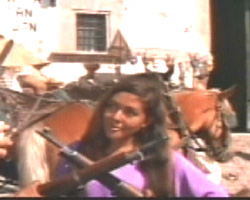
(1) Paula Pritchett with director Ralph Nelson on location in Mexico.
(2) Pritchett sharing a laugh with (l to r) Rita Hayworth, Robert Mitchum, and Ken Hutchinson.
(3) Pritchett plays Chela, a mute indian girl who is about to raped by a gang of soldiers. However, she is saved by Hutchinson and Mitchum.

Irish adventurer Emmett Keogh finds himself partnered with a hard-drinking priest named Van Horne in 1922 revolutionary Central America. Tricked into delivering guns by smuggler/con man Jennings, the three end up joining forces against despot Tomas de la Plata, who treats his subjects ruthlessly and who has a special hatred for priests. Van Horne, who seems to be a priest in costume only, decides to stand up to de la Plata and lead a revolt against him. 


The film marks the final screen appearance by Rita Hayworth, whose health worsened as Alzheimer's disease took hold.


Adamson noted, "In 1972, Robert Mitchum was in a film with George de Mohrenschildt's daughter Alexandria in The Wrath of God. Mitchum was great in this film and Alexandra was an extra. Looking as good as Paula Pritchett, if not better." 


Alexandra de Mohrenschildt


"G. H. W. Bush and de Mohrenschildt were all friends of Howard Hughes," wrote Adamson. "De Mohrenschildt claimed to be friends with Howard Hughes since 1938. Hughes was also from Houston and a Texas oilman and tied to George H.W. Bush."


Tom Slick's name was in George de Mohrenschildt's address book, the same one that interested the Warren Commission so much, which also contained "George Poppy Bush."


Alexandra's father, George de Mohrenschildt (April 17, 1911 – March 29, 1977) was a petroleum geologist and professor who befriended Lee Harvey Oswald in the summer of 1962 and maintained that friendship until Oswald's death two days after the assassination of U.S. President John F. Kennedy. He had personal acquaintance with the Bush family, including George H. W. Bush, with whose nephew, Edward G. Hooker, he had been roommates at Phillips Academy at Andover, Massachusetts. He also had personal acquaintance with the Bouvier family, including Jacqueline Bouvier Kennedy, the president's wife, when she was still a child. His testimony before the Warren Commission investigating the assassination was one of the longest of any witness.

Dresser Industries was a multinational corporation headquartered in Dallas, Texas, United States, which provided a wide range of technology, products, and services used for developing energy and natural resources. In 1928 the Wall Street investment-banking firm of W. A. Harriman and Company, Inc., converted the firm into a public company by issuing 300,000 shares of stock. H. Neil Mallon was selected as president and chief executive officer; holding that position until his retirement in 1962.

George H. W. Bush got his start in the Texas oil business through his father's friend Henry Neil Mallon, the president of Dresser Industries. Mallon offered George his first job at Dresser subsidiary International Derrick and Equipment Company (Ideco), in Odessa, Texas. Brown Brothers Harriman had underwritten Dresser’s transition from a private company to a publicly traded one. Years later, George named a son after Mallon (Neil Mallon Bush).

In 1953, Bush got money from Brown Brothers Harriman and, with partners Hugh and Bill Liedtke, formed Zapata Petroleum. By the late 1950s they were millionaires. Bush bought subsidiary Zapata Off-Shore from his partners and went into business on his own in 1954. By 1958, the new company was drilling on the Cay Sal Bank in the Eastern Gulf of Mexico. These islands had been leased to Nixon supporter and CIA contractor Howard Hughes the previous year and were later used as a base for CIA raids on Cuba. Tom Slick and Howard Hughes became such close friends that they had adjoining cottages at the Beverly Hills Hotel. Slick was Director on the Board for Dresser, until his death on October 6, 1962.

In 1998, Halliburton merged with Dresser Industries, which included Kellogg. Prescott Bush and Tom Slick were directors of Dresser Industries, which is now part of Halliburton.


Monday, August 1, 2011

Own The Texas School Book Depository Building


The Texas School Book Depository Building was rebuilt in 1902 on the foundation of the Rock Island Plow Company's warehouse. The original five-story building was destroyed by fire in 1901. Located in Dealey Plaza in Dallas (the site of the first Masonic Lodge in Texas), the TSBD was the one time employer of Lee Harvey Oswald, who was the lone person charged with the killing of John F. Kennedy on November 22, 1963. 


The original Hertz/Chevrolets sign at the moment of the JFK assassination (12:30 pm), above, was replaced by a Hertz/Fords sign, below, years later.


A replica building of this site has been made by InFocus Tech.  For assassination researchers, it is well worth owning. This model is 3-1/4" tall and is finished in antique pewter. It can be obtained in a brick red finish with gold highlights, also. The original signage and time at the moment of the assassination have been preserved on the top of the TSBD.


I highly recommend it be acquired by serious investigators. Click here. 


(No financial benefit has been received by me from InFocus Tech for my favorable mention of this item. I merely was struck by its detail and wanted to share its discovery with my fellow researchers/collectors of such material.)


Credit: Sketchup

Tuesday, December 8, 2009

JFK Doctor Dies

Malcolm Oliver Perry II, 80, the doctor who attended JFK in Dallas has died, reports the Dallas Daily News.

As noted in the Paraview Press book, Trauma Room One: The JFK Medical Coverup Exposed by Charles A. Crenshaw, et al., Perry was one of the doctors who believed the fatal head shot that killed Kennedy had come from the front (not the back, as was the conventional Warren Commission finding).

Dr. Malcolm Oliver Perry II, who attended to President John F. Kennedy at Parkland Memorial Hospital after he was shot in Dallas on Nov. 22, 1963, has died.

The University of Texas Southwestern Medical Center, the teaching hospital for Parkland, said Monday that Perry died Saturday, December 5, 2009, in Tyler, Texas, after a battle with lung cancer.

Perry was an assistant professor of surgery at UT Southwestern and a vascular surgeon on the Parkland staff when he became the first staff surgeon to treat Kennedy.

In an extensive interview by the Warren Commission, which investigated the assassination, Perry recalled taking the case over from the senior resident, checking the president's vital signs and finding none but noting a convulsive effort to breath. He performed a tracheotomy on the president while other staff doctors and surgeons gathered to help.

Perry and another surgeon performed cardiopulmonary resuscitation on Kennedy until no brain activity was detected on the trauma room instruments. At 1 p.m., Kennedy was declared dead by Dr. Kemp Clark, the UT Southwestern neurosurgery chairman, from a catastrophic head wound.

Dr. Robert McClelland was the last surgeon to attend Kennedy in Trauma Room 1. McClelland, a longtime friend and Parkland and UT Southwestern colleague of Perry's, remembers that the shock of realizing whom they were treating faded quickly when they entered the trauma room.

"At Parkland we're accustomed, all of us are, to treating many different cases," McClelland told The Associated Press on Monday. "Of course, it's the president," he said. Was it hard to put that aside? "No, not really. Everything was so rapidly happening that we were called on the peak of the moment."

Perry told the commission that the neck wound Kennedy suffered from the sniper's first rifle shot would likely have not been fatal. However, he testified that neither he nor Clark could tell from their examinations from where the bullets came.

The vascular surgeon also was one of the doctors to operate on presidential assassin Lee Harvey Oswald, who was shot two days after Kennedy's death by Jack Ruby.

After a long career, Perry retired in 2000 as professor emeritus of surgery at UT Southwestern. But McClelland, now 80, said that after the assassination his friend never mentioned their role in the case, and that they never discussed it even among themselves.

"No, we didn't, for reasons he kept to himself. Immediately after, he had a bad experience with interviews that hurt him deeply. Whenever the subject threatened to come up, he'd raise an eyebrow and that would be that," he said.

Perry was born in Allen, Texas, a once-tiny farming-and-railroad town about 20 miles north of Dallas that is now one of the city's fastest-growing suburbs. He was raised by his grandfather and namesake, Dr. Malcolm O. Perry I, a general practitioner in the small town.