Showing posts with label Fayette. Show all posts

Sunday, June 10, 2012

Fayette Factor


The Fayette Factor
Above and below, Fayette County, Georgia.


Who--or more precisely, what--is "the Fayette Factor?" It is probably one of the strangest mysteries in American Forteana, first discovered by researcher William (Bill) Grimstad, back in 1977, and written about in "Fateful Fayette," Fortean Times, No. 25, Spring 1978.

Namely, the "Fayette Factor" has been the finding of a surprisingly high incidence of Fortean (inexpliable) events linked to places named after one of the USA's Founding Fathers--the Marquis de Lafayette. 
Fayetteville, West Virginia

Since Grimstad's discovery, several items on this lexilink between Fayette (as well as its related forms - Lafayette, La Fayette, Fayetteville, Lafayetteville) and high strangeness have been published. In his book, Weird America (New York: EP Dutton, 1978), Grimstad mentions several Fayette hot spots but did not dwell on them. In exchanges with Bill, a small group of Forteans discussed the Fayette Factor privately throughout the late 1970s. It was not until Brandon's (now extremely rare) The Rebirth of Pan: Hidden Faces of the American Earth Spirit (Firebird Press, 1983) and Mysterious America (Boston: Faber and Faber, 1983) that more in-depth analyses of the Fayette "coincidences" seriously occurred. These examinations were followed by updates and other comments in Mysterious America (NY: Simon and Schuster, 2006), and Mothman and Other Curious Encounters (NY: Paraview, 2002).  Furthermore, the appearance of widely available material on the Fayette Factor started routinely being posted online during the 1990s-2010s.
According to Grimstad, "Lafayette traveled widely in this country (USA) and doubtless must have been the inspiration for many or most of the 18-odd counties and 28 towns and cities across the land that I have been able to find with some form of his name." 
 Lafayette County, Mississippi
Marie-Joseph Paul Roch de Motier, Marquis de Lafayette, was born in 1757. His father, a French Army officer, was killed in the battle of Minden in 1759, and the marquis was brought up by his mother's prestigious family, the de Noailles. At the age of 18, he traveled to the Americas at his own expense and became an aide to General George Washington, who loved him like a son. By the end of the War of the American Revolution, Lafayette commanded the Continental Army in Virginia. That's the Lafayette every American schoolboy knows. But, as researcher Manly Palmer Hall has pointed out, the marquis had ties to the esoteric groups of the late Eighteenth Century. 
"In addition to his political pursuits," Grimstad wrote, "Lafayette was busily involved in certain circles that should be of interest to contemporary Illuminati buffs." 
 Lafayette County, Mississippi

According to Manly Palmer Hall, Lafayette was an associate of both Dr. Anton Mesmer, "the Father of Hypnotism," and Giuseppe Balsamo, better known as Cagliostro, a Sicilian sorcerer who was an acolyte of Adam Weishaupt's Illuminati. 

Hall wrote, "In 1785, the Marquis...joined the Egyptian Masonry of Cagliostro and proclaimed his absolute confidence in the 'Grand Cophte.' When Anton Mesmer arrived from Vienna with his theories of animal magnetism, Lafayette was one of his first customers." 

Grimstad adds, "But Lafayette also had the closest ties with Benjamin Franklin, the American revolutionary sage and member of (Sir Francis) Dashwood's 'Hell-Fire Club' in Britain (also known as the 'Medmenham Monks' of High Wycombe, Buckinghamshire, northwest of London). As Hall puts it, 'Benjamin Franklin was a philosopher and a Freemason--possibly a Rosicrucian initiate. He and the Marquis de Lafayette--also a man of mystery--constitute two of the most important links that culminated in the establishment of the original thirteen American colonies as a free and independent nation.' Lafayette, Hall summarises, 'is a direct link between the (esoteric) political societies of France and the young American government.'"  

Attention to other links to other locations, such as my discovery that LaGrange is also an associated hot name, apparently due to the fact the name Chateau de LaGrange was the French home of the Marquis de Lafayette, evolved during the last thirty years of our writings and mutual exchange on the subject.

The cities, towns, and counties across the United States, which are the Fortean hotspots linked to the Fayette Factor, are tied to the renamed Masonic lodges and affiliated sites that the Marquis de Lafayette visited on his grand tour of the country in 1824-1825. His visits were highly ritualized happenings, in which he was involved with laying many cornerstones. The locations where he was taken to visit are a virtual roadmap of the "special places" in this land. For example, in 1825, The Marquis de Lafayette, on board the ship (please note!) "Enterprise," visited the Cahokia mounds, and the significant Bloody Island, which then was so large that half of the Mississippi flowed east of it. (Intriguingly, Lafayette returned to France in 1825, on the day after his birthday, demonstrating a keen eye on the calendar and a desire to celebrate September 6th in America.)

Many Masonic locations have been linked beyond the easily recognized Lafayette name to a broader Freemasonry focus to mystic events and violent happenings. Some are very subtle. One man's journey, Lee Harvey Oswald, from his office across from Lafayette Square, New Orleans, would lead to the most infamous Masonic sites in the country. This vivid example of deathly weirdness is Dealey Plaza, where JFK was assassinated on November 22, 1963. Dallas' Dealey Plaza is the location of the state of Texas's first Masonic temple. 

How much of the Marquis's involvement in such matters was due to his deeply-held esoteric beliefs or to mere socializing is something for historians of the future to determine. What is of interest to Forteans is the uncanny number of unexplained incidents linked to the name Lafayette. Grimstad has an impressive list, which we have added to, of course, as the years have rolled along, hitting its 35th year in 2012. Here's a review of Grimstad's original notes, with new images.
Fayette County, Alabama

"In Fayette County, Alabama, is the Musgrove Methodist Cemetery. The tombstone of one Robert L. Musgrove there bears a discoloration, not especially realistic, that is locally believed to be the bridal- veiled figure of Musgrove's fiancee. Apparently he was killed just before the wedding, and the sorrowing girl" willed her image "onto the marble by her many visits to the grave." (Sir Arthur Conan Doyle may have used this real-life case as the basis for his Sherlock Holmes story, "The Musgrave Ritual.") 

"The engima-laden state of Arkansas has two sites. The city of Fayetteville, in the northwest corner" of Arkansas, "has long been legendary for oddities. UFOs and aerial lightshows, water monsters in the nearby White River and Springheel Jack-type window peepers are among the manifestations."
 
 Lafayette County, Arkansas

"In the southwest angle of Arkansas is a Bigfoot hotspot that has been immortalized--in America, at least-- by the (1974) movie The Legend of Boggy Creek. The critters have been known hereabouts since 1856, centering their activities lately upon the town of Fouke in Miller County and ranging eastward into Lafayette County." 
Lafayette County, Kentucky

"In the scenic Bluegrass area of Kentucky, the university city of Lexington sits atop one of America's more dramatic lost cave stories. Historian G.W. (George Washington) Ranck recorded in 1872 that hunters in 1776 had found a tunnel behind a rock panel of 'peculiar workmanship' and covered with hieroglyphics. The descending portal widened to a sort of gallery running downward a few hundred feet to a huge underground room. Ranck cited the hunters' reports that this chamber contained idols, altars and about 2,000 human mummies. Although the entrance to the amazing cavern was (of course--B.G.) lost, there are still cave true-believers who poke about looking for the weird mausoleum beneath this part of Fayette County." 
 Fayette County, Missouri

"Followers of ghost lore may have heard of the recent (1976) antics of a supposed phantom in Lilac Hill, a large old farmhouse at Fayette, Missouri. A number of psychically-sensitive individuals have been trying to discern what is troubling the alleged spirits, of whom there are said to be at least two."
LaFayette, New York


"In New York state, a farm near Cardiff, 10 miles (16 kilometers) south of Syracuse, was the starting point in October 1869 for one of the more sensational fossil controversies. The 'Cardiff Giant' is still displayed at museum near Cooperstown," and the weird stone idol was found in a quarry near "the Nineteenth Century town of La Fayette." 
Fayette, New York

Also, "it was in April of 1830 that the Church of Jesus Christ of the Latter-Day Saints (i.e. the Mormons) was founded by Joseph Smith and a few disciples, who claim to have received more than a little help from certain angelic friends in the neighborhood. The place: Fayette, New York." 
Fayetteville, North Carolina

"Another haunted house story takes us to an American state that perhaps rivals New York and Arkansas in the number and interest of its anomalies. It also brings us back across the trail of the peripatetic Marquis de Lafayette. This is the A.S. Slocumb Mansion, located in the North Carolina city of Fayetteville. The Slocumb House is supposed to have a number of special occupants. It also has, or had, a secret vault in the basement and at least one tunnel leading to the Cape Fear River channel." 
Fayette County, Tennessee

In 1977, the USA experienced one of the most severe winters in its history. "As of February 3, 1977, the National Weather Service announced that the 'hardest hit area' of the north-central states region was Fayette County, Ohio."
Fayette County, Tennessee

Bigfoot "became rather more aggressive on April 23, 1976 when it attempted to carry off a four-year-old boy from his backyard on a farm in Tennessee. A sheriff's posse pursued the entity and seems to have shot enough high-powered rifle fire into it to have felled King Kong himself. However, as if tiring of the game, the creature finally leaped out of its cul-de-sac and simply vanished. These events occurred within a few miles of the hamlet called Fayetteville, Tennessee." 
Lafayette Baker

"Now I would like to consider some examples of a more ominous character," Grimstad wrote, "We find 'the Lafayette factor' in the Abraham Lincoln assassination of the 1860s...A slippery character named Lafayette Baker had been brought in to head the Secret Service by the enigmatic Edwin M. Stanton, President Lincoln's arrogant Secretary of War. Otto Eisenschiml, the pioneer revisionist historian of this amazingly crude murder conspiracy, delved into the story as far as the surviving records would allow."
"His findings suggest that Lafayette Baker and Stanton had maneuvered to facilitate the escape into the South of assassin John Wilkes Booth, and when that proved impossible (owing to Booth's broken leg) to ensure that the killer was not brought back and that his evidently-incriminating diary did not survive intact." 

"At the same hour Lincoln was shot at Ford's Theatre, Secretary of State William Seward "was attacked and savagely knifed by a deranged giant named Lewis Paine, who had forced his way into the Seward home. This house fronted upon Lafayette Square, just across Pennsylvania Avenue from the White House." 
Andrew Jackson statue and White House, Lafayette Square, with Masonic obelisk of Washington's Monument in the background, Washington, D. C.

"Residents of the District of Columbia sometimes refer to the area "as 'Tragedy Square.' No other section of Washington has had so much intrigue, mystery, murder and macabre happenings as has the area directly opposite 1600 Pennsylvania Avenue.'"
Fayetteville, Pennsylvania

The Fayette Factor has also come into play in occult crimes, as well. "On July 3, 1977, 23-year-old Gary Rock was charged on two counts of criminal homicide after two local volunteer firemen were killed by a sniper while responding to a fire alarm at Rock's isolated cabin, near Fayetteville, Pennsylvania."
Lafayette High School, New York City

"On July 31, 1977, two young people sitting in a parked car along the Brooklyn, New York seashore were shot several times by a mysterious assailant who had become known as 'the Son of Sam.' The girl, Stacy Moskowitz, died of her injuries; her companion, Robert Violante, suffered eye damage. Miss Moskowitz was an alumna of (Brooklyn's) Lafayette High School. When she and Violante were shot, it was while they were sitting 'not far from Lafayette High School,' according to the New York Times" of August 1, 1977, page 34-C."

It's just all part of the enduring mystery we call "the Fayette Factor." 

Sources: Fortean Times No. 25 for Spring 1978, "Fateful Fayette" by Bill Grimstad, page 3; Why Was Lincoln Murdered? by Otto Eisenschiml, Little, Brown & Co., Boston, Mass., 1937; America's Assignment with Destiny by Manly Palmer Hall, Philosophical Research Society, Los Angeles, Cal., 1951; and Weird America by Jim Brandon, E.P. Dutton Co., New York, N.Y., 1978.
Fortean Times February 13, 2004 
+ 2012 enhancements.
Flashback reflections from Loren Coleman

Fayette incidents continue...
Fayette, Pennsylvania, 2009 Bigfoot sighting drawing.
Bigfoot Lunch Club montage.

 
Also from Loren Coleman
For more specific "Fayette" sites 
and further updates on the "Fayette Factor," 
please consult Mysterious America.


Fayette County, Pennsylvania, continues to have frequent Bigfoot and Thunderbird sightings. Fayette, Maine, is a hotspot of weirdness. What "Fayette" links have you found?


Sunday, September 6, 2009

Fayette Cannonball

Police said a man in Georges Township, Fayette County, Pennsylvania, fired a metal cannon that sent a two-pound lead ball into his neighbor's house, reported the Pittsburgh Post-Gazette.

William Edward Maser, 54, fired the cannon in his yard on Tent Church Road Wednesday evening, September 2, 2009, said Trooper Brian Burden of the Pennsylvania State Police. He said he was not sure how regularly Maser fired his cannon.

The cannon shot a lead ball through the side of his neighbor's house, breaking a window and traveling through a wall before landing in a clothes closet. No one was injured.

The cannon is an 80-pound homemade replica of cannons used during the French and Indian War. It has been impounded as evidence.

Maser regularly participates in battle re-enactments, Trooper Burden said.

He has been charged with reckless endangerment, criminal mischief and disorderly conflict.

Tuesday, August 4, 2009

Death at Bridgeville {Killer Updates}

Update:

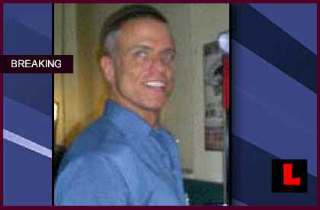
The killer, identified by authorities, and noted by himself on his website diary as "George A. Sodini, a.k.a crazygeorge" has left a vast Internet trail of his musings of hate (e.g. black men have their choice of the best white girls). The 48-year-old's rampage plans are also documented in his web DOD ("Date of Death") entries. Sodini said he would die on August 4, 2009. See the bottom of this posting for further details on Sodini's angle of the story.


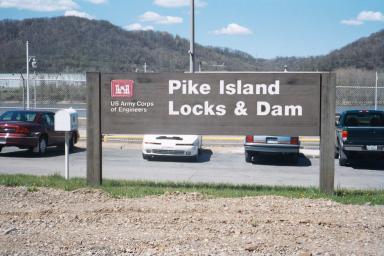
The published photos from his vacations do show an intriguing pull to some of the names of interest, as for example, this one above from his website.

+++
Posted August 4, 2009:

Shootings have occurred tonight at a highly symbolic geographic "intersection" where people use to say to each other, "Meet me at the bridge."

That's how a little community outside Pittsburgh called Bridgeville got it's name, when folks use to meet each other for trading at the very first bridge built at the crossing of Chartiers Creek at the south end of what is now Washington Avenue.

Before today, Bridgeville, Pennsylvania, had been most famous in current popular culture for being the home of Jenna Morasca, a winner of Survivor: The Amazon. Well, actually, Morasca tells people she's from Bridgeville because she really is a resident of South Fayette Township, but everyone uses the Bridgeville mailing address.

Yes, South Fayette Township is the adjoining town, and running right through the 1.1 square mile borough that is Bridgeville is the Washington Pike. The name game runs deep here.


A deathly "rampage-style" shooting occurred in Bridgeville on Tuesday, August 4, 2009. Initial reports said five women are dead and the shooter too, who has died by suicide.

[Update: Overnight reports indicate three gym victims died and the gunman, who left an unreleased note, took his own life.

The names of some of the LA Fitness Shooting victims have been released. Elizabeth Gannon, Heidi Overmier, and Jody Billingsley have died.

Elizabeth Gannon was 49 of Pittsburgh (Scott Twp).
Heidi Overmier was 46 of Carnegie.
Jody Billingsley was 38 of Mt. Lebanon.]

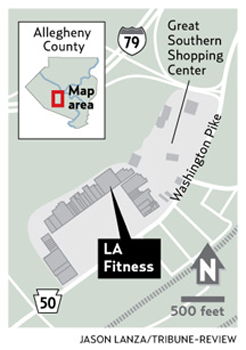
It all happened at a LA Fitness gym, in the Great Southern Shopping Center in Collier/Bridgeville. Specifically, it is known as the Bridgeville Club in Pittsburgh, by the LA Fitness staff.

Witnesses said a gunman wearing a black hat walked into an aerobics room filled with women shortly after 8:00 p.m. Eastern, turned out the lights and opened fire, according to breaking news services and the Pittsburgh Tribune-Review.

Several witnesses told a WTAE Channel 4 Action News crew first at the scene that a man unrecognized by the gym's staff, entered the facility, turned off the lights and shot people in a Latin dance class in the aerobics center at the time of the shooting. Every witness to whom WTAE Channel 4's Jon Greiner spoke said they didn't realize what they were hearing was gunfire.

"The lights were off and I could see flashes in the dark," said Jared Frederick, a witness.

A woman in the class at the time of the shooting, identified as Nicole, told WTAE Channel 4 Action News that the class had started about 10 minutes before the gunfire. She said about 30 people -- all women -- were in the class when "a middle-aged white male walked into the class. He had a big gym bag."

"He looked out of place in a class full of women," according to the witness, who said the man put his bag down, turned the lights off and opened fire. "It was horrible. He was 20 feet from me. He got off a lot of shots."

The woman said she ran out of the gym as quickly as she could and got into a stranger's car to escape the gunfire.

Others said 100 people were in the gym area.

Police responses came from Bridgeville, Scott Township, Collier Township, Upper St. Clair and Mount Lebanon, among others.

An Allegheny County policeman said he believes one of the dead was the gunman. Witnesses said they saw two to four wounded women lying outside the back door and two others lying in a parking lot at the side of the LA Fitness center along Washington Pike, noted the Pittsburgh Tribune-Review.

Witnesses reported hearing dozens of gunshots before the shooting stopped.

"All of a sudden there was a really loud noise," said Julia Zorzi, 27, of Crafton, who was on a treadmill on the main floor when the gunfire began. "I heard 40 to 50 shots, and I hit the deck. I saw people running out. I ran outside and there were two girls lying outside.

"The shots came very fast," she said. "It sounded like he was using a serious piece of machinery."

Police and paramedics from throughout the South Hills and Pittsburgh responded to the shootings shortly after 8 p.m. A St. Clair Hospital spokesperson put the death toll at six, including the gunman. Others reported later another victim had died.

"He kept firing and firing," said Dennis Curry, 28, of Scott, who said he was working out on an elliptical machine upstairs when he heard the gunfire. "There was chaos. I ran out the back door, saw a girl lying there with a gunshot wound. I put a shirt on her to try and stop (the bleeding). There was blood everywhere."

+++


Killer Updates


LALATE has broken the news that the killer's, George Sodini’s online diary website preparing for LA Fitness Shooting was GeorgeSodini.com.

Lee Ann Valdiserri is referenced by George Sodini in his website GeorgeSodini.com. A Lee Ann Valdiserri is listed as dead in online obituaries printed years back, as early as potentially 2006.

On it, he writes the following claims about Lee Ann Valdiserri:

“Miscellaneous:

1. Probably 99% of the people who know me well don’t even think I was this crazy. Told by at least 100 girls/women over the years I was a “nice guy”. Not kidding.

2. Lee Ann Valdiserri had my baby in early 1991. Haven’t seen her since she was about four months into it. I knew her sister, Chris, from high school.

3. Net worth slightly more than $250K, (after all debt) as of end of 2008.

4. Death Lives!”


ABC's "Good Morning America" has confirmed that George Sodini, 48, of Scott Township, Pa., was the man who police say Wednesday walked quietly into an aerobics class at LA Fitness in Bridgeville, Pa., where he was a member, turned off the lights and started shooting. Police said they found 52 casings at the scene.

Three women, 46-year-old Heidi Obermier, 49-year-old Elizabeth Gannon and 39-year-old Jody Billingsley, were killed in the attack, according to the Allegheny coroner's office.

Among those reportedly shot were Sodini's ex-girlfriend, who survived, and the class instructor, who had just told her class she was pregnant, according to the Pittsburgh Post-Gazette.

Jen Malley told "Good Morning America's" Chris Cuomo that she was in the Latin dance class at LA Fitness Tuesday when the shooting started. It's a class she takes every week with friends.

According to LALATE, Monday Sodini finally writes the following:

“The biggest problem of all is not having relationships or friends, but not being able to achieve and acquire what I desire in those or many other areas.

“Everything stays the same regardless of the effert (sic) I put in. If I had control over my life then I would be happier. But for about the past 30 years, I have not.”

As broke earlier today on LALATE, George Sodini in the LA Fitness shooting shot his ex girlfriend, the aerobics instructor, who had just told her class she was pregnant, but she survived. George Sodini, 48, of Scott Township, Pa. was found dead along with four women. UPMC Mercy Hospital says five of the women injured are in critical condition, two are in fair condition. The conditions of the remaining injured women are still unknown.


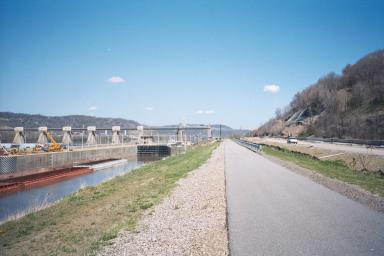
Above, another bridge, from Wheeling WV Bike Trail. Pictures taken on Saturday, April 15, 2000. Information provided and page created by George A. Sodini, a.k.a crazygeorge

As comment maker Ryan noted, Sodini says: "This is like the Twilight Zone."

Saturday, April 25, 2009

Lafayette in America

Come view the "Fayette Factor" up close:

WHAT: Lafayette in America book event with Alan R. Hoffman, Translator and Author
WHEN: Tuesday, April 28, 2009, from 12:00pm - 1:00pm
WHERE: Maine Historical Society, 489 Congress Street, Portland, Maine

COST: This event is free and open to the public.

FMI: For more information call (207) 774-1822 or e-mail info[at]mainehistory.org

According to the MHS:

Explore General Lafayette's 1824-1825 Farewell Tour of the United States, including his visits to Kennebunk, Saco, and Portland, Maine.

Translated from the journal kept by Auguste Levasseur, Private Secretary to General Lafayette, this rich new book describes the adoring welcome the 67-year-old hero of the American Revolution and apostle of liberty received from the American people.

With its panoramic view of the young country - its burgeoning cities and towns, its technological innovations like the Erie Canal, and its industrious people - Levasseur captures America on the cusp of its jubilee year. Hoffman will share this story and chronicle Lafayette's affectionate visits with his old friends John Adams, Thomas Jefferson, James Madison, James Monroe, and John Quincy Adams.


Kermit scarf


See you there.

Thursday, April 9, 2009

Passover 1865: Lincoln Assassination

Events out of context often float adrift in time. April 14, 1865 has become important as the day that John Wilkes Booth shot Abraham Lincoln. For Americans of the Jewish faith, it was also Passover.

I share the following snippet to revisit how it felt during these under-discussed moments of the War Between the States.

Chapters in American Jewish History

Of Civil Seders in the Civil War

For American Jewry during the Civil War, the Passover story was especially powerful. Northern soldiers saw clear parallels between the Union freeing the South's slaves and Moses leading the ancient Hebrews out of Egypt. However, creating a seder during in a war zone requires flexibility and creativity.

In 1862, the Jewish Messenger published an account by J. A. Joel of the 23rd Ohio Volunteer Regiment of a seder celebrated by Union soldiers in Fayette, West Virginia. Joel and 20 other Jewish soldiers were granted leave to observe Passover. A soldier home on leave in Cincinnati shipped matzot and hagaddot to his colleagues. Joel wrote:

We . . . sen[t] parties to forage in the country [for Passover food] while a party stayed to build a log hut for the services. . . We obtained two kegs of cider, a lamb, several chickens and some eggs. Horseradish or parsley we could not obtain, but in lieu we found a weed whose bitterness, I apprehend, exceeded anything our forefathers "enjoyed.?"?

We had the lamb, but did not know what part was to represent it at the table; but Yankee ingenuity prevailed, and it was decided to cook the whole and put it on the table, then we could dine off it, and be sure we got the right part.

The necessaries for the choroutzes we could not obtain, so we got a brick which, rather hard to digest, reminded us, by looking at it, for what purpose it was intended.


Yankee ingenuity indeed! Historian Bertram Korn observes, "It must have been quite a sight: these twenty men gathered together in a crude and hastily-built log hut, their weapons at their side, prepared as in Egypt-land for all manner of danger, singing the words of praise and faith in the ancient language of Israel."

The seder proceeded smoothly until the eating of the bitter herbs. Joel recounted:

We all had a large portion of the herb ready to eat at the moment I said the blessing; each [ate] his portion, when horrors! What a scene ensued . . . The herb was very bitter and very fiery like Cayenne pepper, and excited our thirst to such a degree that we forgot the law authorizing us to drink only four cups, and . . . we drank up all the cider. Those that drank more freely became excited and one thought he was Moses, another Aaron, and one had the audacity to call himself a Pharaoh. The consequence was a skirmish, with nobody hurt, only Moses, Aaron and Pharaoh had to be carried to the camp, and there left in the arms of Morpheus.


More problematic was the situation of Union soldiers who, unable to form their own seders, were forced to "fraternize" with local Jews. Myer Levy of Philadelphia, for example, was in a Virginia town one Passover late in the war when he saw a young boy sitting on his front steps eating a piece of matzo. According to Korn, when Levy "asked the boy for a piece, the child fled indoors, shouting at the top of his lungs, "Mother, there's a damn Yankee Jew outside!" The boy's mother invited Levy to seder that night. One wonders how the Virginian family and the Yankee soldier each interpreted the hagadah portions describing the evils of bondage.

On the eve of the fifth day of Passover (April 14), 1865, Abraham Lincoln was shot and died of his wounds in the early morning of April 15th, which had already been scheduled as a national day of prayer to mark the end of the Civil War. Jews across the land were gathering in synagogues to give thanks. When news of Lincoln's death arrived, Korn notes, the synagogue altars were quickly draped in black and, instead of Passover melodies, the congregations chanted Yom Kippur hymns. Rabbis set aside their sermons and wept openly at their pulpits, as did their congregants. Lincoln had been protective of American Jewry, overturning General Grant's infamous General Order #11 expelling Jews from the Department of the Tennessee and supporting legislation allowing Jewish chaplains to serve in the military. The Jewish Record drew the analogy between Lincoln not having lived to see the reconciliation of North and South and Moses dying on Mount Pisgah before he saw the Israelites enter the Promised Land.

When no American armed forces are in combat anywhere in the world, it is easy to forget how difficult it can be for Jewish soldiers to serve their country while maintaining the traditions that beautify Judaism. Nevertheless, for Jewish Union soldiers fighting between 1861 and 1865 to free others from slavery, the Passover parallels must have made each seder particularly sweet and meaningful.