Friday, July 17, 2009

Walter Cronkite Has Died; Man of Mysteries

Walter Cronkite, 92, died on July 17, 2009, three days before the 40th anniversary of the first landing on the Moon of humans. Cronkite was tied to that event, as well as other historically significant moments.

CBS vice president Linda Mason says Cronkite died at 7:42 p.m. Eastern, after a long illness with his family by his side.

Walter Cronkite covered many mysteries and disasters during his lifetime. His Dutch family's surname originally was Krankheyt, which intriguingly means "illness."

Growing up, Cronkite was a member of the Houston chapter of DeMolay, a Masonic fraternal organization for boys. Cronkite was one of eight journalists selected by the U.S. Army Air Forces to fly bombing raids over Germany in a B-17 Flying Fortress. He also landed in a glider with the 101st Airborne in Operation Market-Garden and covered the Battle of the Bulge. After the war, he covered the Nuremberg trials, and served as the United Press main reporter in Moscow for two years.

Some of the historic events that were entwined with Cronkite's CBS Evening News broadcast life (1962–81) include the Dallas-based JFK assassination of 1963, the Dexter, Michigan UFO series of 1966, the Memphis-based MLK assassination in 1968, and the lunar landing of 1969. (Apparently, Cronkite had his own UFO experience in the 1950s.)


From 1953 to 1957 and in a 1970s revival version, Cronkite hosted the CBS program You Are There, which reenacted historical events, using the format of a news report. His famous last line for these programs was: "What sort of day was it? A day like all days, filled with those events that alter and illuminate our times... and you were there."

He also hosted The Twentieth Century, a documentary series about important historical events of the century which was made up almost exclusively of newsreel footage and interviews. It became a long-running hit.

Walter Cronkite was there.

On the CBS Evening News of March 6, 1981, Walter Cronkite's gave this farewell statement:

This is my last broadcast as the anchorman of The CBS Evening News; for me, it's a moment for which I long have planned, but which, nevertheless, comes with some sadness. For almost two decades, after all, we've been meeting like this in the evenings, and I'll miss that. But those who have made anything of this departure, I'm afraid have made too much. This is but a transition, a passing of the baton. A great broadcaster and gentleman, Doug Edwards, preceded me in this job, and another, Dan Rather, will follow. And anyway, the person who sits here is but the most conspicuous member of a superb team of journalists; writers, reporters, editors, producers, and none of that will change. Furthermore, I'm not even going away! I'll be back from time to time with special news reports and documentaries, and, beginning in June, every week, with our science program, Universe. Old anchormen, you see, don't fade away; they just keep coming back for more. And that's the way it is: Friday, March 6, 1981. I'll be away on assignment, and Dan Rather will be sitting in here for the next few years. Good night.

Dick Hall Has Died, Lou Gentile Too.

Richard H. Hall, ufologist, historian


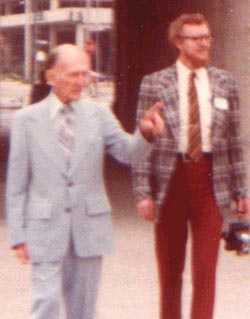
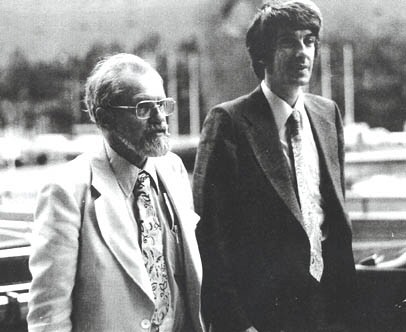
Major Donald E. Keyhoe (left) and Richard Hall (right).

I knew Dick Hall through letters in the 1960s and 1970s. He was a ufologist (something, really, of a "ufo nerd," if you know what I mean, with appreciation), although I experienced him as an open-minded Fortean, as well. Still others knew him more personally than I did, and I expect tributes to be forthcoming from those in ufology, for Richard H. Hall was a pivotal historical character.

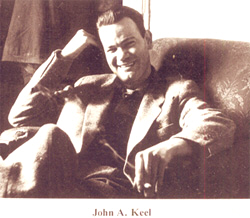
We've lost another one, and I'll introduce him to those who do not know the name as well that of John A. Keel, who died July 3rd.

Richard H. Hall was a leading ufologist and proponent of the extraterrestrial hypothesis to explain UFO sightings; he had also written numerous books and articles dealing with the role of women in the American Civil War. On the morning of July 17, 2009, Richard Hall passed away due to a long battle with cancer, according to ufologist Jerome Clark and anomalist Patrick Huyghe, who just informed me of this fact.

Hall was born on December 25, 1930 and held a bachelor's degree in philosophy from Tulane University in New Orleans. He lived most of his life in the Washington, D.C. area.

From 1958 to 1969 he worked for the National Investigations Committee on Aerial Phenomena (NICAP), one of the most prominent and influential UFO civilian research groups in American history. He began as executive secretary, and eventually became NICAP's assistant director. In this role Hall was both an eyewitness and participant to much of the early history of the UFO phenomenon in the United States. Working with NICAP director Donald Keyhoe, he helped lobby the United States Congress to hold public hearings and investigations into the UFO phenomenon.


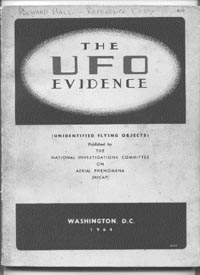
In 1964 Hall researched, edited, and wrote much of The UFO Evidence, a compendium of the best UFO sightings and incidents of the 1940's, 1950's, and early 1960's. A copy of The UFO Evidence was sent to every member of Congress in 1964, and the book is still regarded by many UFO researchers and historians as one of the best UFO books ever published.

Following Keyhoe's ouster as NICAP director in 1969, Hall left NICAP to work as a technical writer and editor. He continued to work in the UFO field. He served as the director of the Fund for UFO Research, which provides grant money to legitimate researchers working in UFO studies. He also was the editor of the MUFON Journal, the official publication of the Mutual UFO Network (MUFON), the largest civilian UFO group in America today.


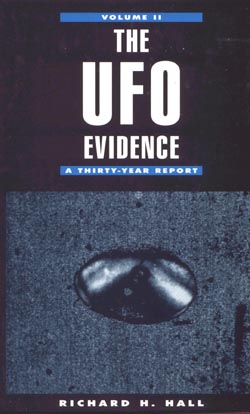
In 2001 he wrote a sequel to The UFO Evidence; it covered major UFO incidents from the mid-1960's through the 1990's. He is also the chief editor of the Journal of UFO History, which is published six times per year. He is a strong proponent of the theory that UFOs are extraterrestrial spacecraft from an advanced alien civilization. Hall is an active member of the "UFO Updates" message board and website.

To supplement his income as a UFO researcher, Hall worked for many years as an abstractor-indexer for the Congressional Information Service in Bethesda, Maryland. A member of the Authors Guild, Hall also published numerous books and magazine articles dealing with the role of women in the American Civil War, and he maintained a strong interest in Civil War history through his life.


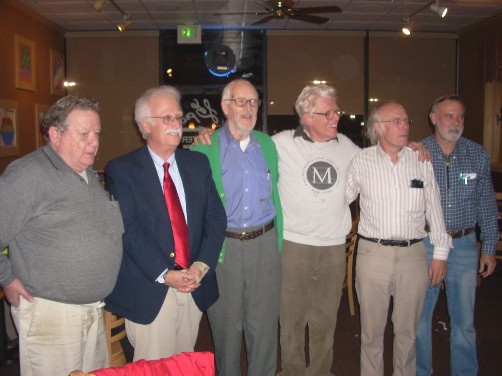
Well-known UFO researchers at November 1, 2008 Maryland conference L to R: Don Berliner, Fund for UFO Research chairman; David M. Jacobs, history professor & abduction researcher; Richard Hall; Ted Bloecher, former NICAP staff member; Bruce Maccabee, Navy physicist & photoanalyst; John Carlson, archeoastronomer & Fund for UFO Research board member.


The torch passes. John Keel, Dick Hall, and the days of sadness and passages are not finished.


Lou Gentile, radio host, demonologist, ghost hunter

Radio host Lou Gentile of Philadelphia has passed away.

Gentile was a man known to some of us because we appeared on his radio shows. In April 2006, for example, Cryptomundo's Craig Woolheater was on Lou's show talking about the then-just-opening of the "Bigfoot in Texas" exhibition.

I must admit that with the Lake Champlain phonecam footage investigations and the passing of John A. Keel, the sad news of the death of talk show host and paranormal investigator Lou Gentile slipped by without the news being mentioned here. Forgive me for this. Intriguingly, Gentile shared with Keel the desire to be called a demonologist as a way to describe himself.


On June 28, 2009, paranormal investigator and syndicated radio show host Lou Gentile lost his battle to cancer. Lou Gentile was about 40, and is survived by his wife and three children. He was born in Philadelphia, Pennsylvania and grew up in 2 haunted houses. Lou personally experienced poltergeist activity for over 20 years and became an investigator, before doing his own radio show.

Gentile had been featured on MTV's "Fear," FOX Family Channel's "Scariest Places On Earth," The Learning Channel, The Discovery Channel, "Unsolved Mysteries" and many more programs in this genre.

With a lifetime of experience and being trained by America's only Roman Catholic Lay demonologist, Lou strived to help people who are afflicted with negative, demonoic or diabolical entities all free of charge.


The Federal Communications Commission on November 18, 2007, fined Philadelphia talk show host Lou Gentile $10,000 for allegedly operating an unlicensed radio station. Gentile ran the "Lou Gentile Show," a streaming Web site that broadcast talk about "paranormal, alternative, unusual and other-than-mainstream topics." At the time, Gentile insisted that the charges against him were false."It's BS," he told a reporter. "It's just ridiculous."

He contended that although pirate stations in the Philadelphia area rebroadcast his programs, often aired on licensed AM outlets, he never ran a station himself.

When Brad Steiger heard of Gentile's death he mentioned to me that there was a side of Lou that no one saw. Steiger said that as he was just completing a radio program, Gentile mentioned that immediately after he said "good night," he was headed for New Orleans to see if he could be of any help with the destruction caused by Katrina. Steiger remembered that was right after the monster storm had struck, because they had begun the program by extending condolences to those in that listening area.

Services for Lou Gentile were held on July 7th in Philadelphia at the John F. Fluehr & Son's Funeral Home.

My condolences to the friends and families of Dick Hall and Lou Gentile.

Monday, July 13, 2009

Sun God Polito Killed By Lightning

A Ukrainian politician who had tried to revive an ancient pagan cult was killed by lightning on Saturday, July 4, 2009, while on a fishing trip. Did this occur about the same time John A. Keel passed away in the USA?


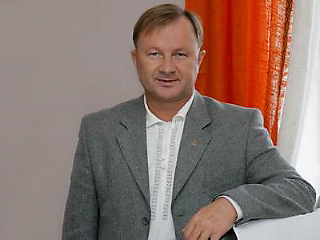
Vasily Chervoni (above) was on a fishing trip near the village of Derazhnoye and suffered a direct lightning hit during a thunderstorm. He was taken to a hospital where he died shortly afterwards, the Russian daily Komsomolskaya Pravda reported on Monday, July 6, 2009.

The newspaper noted that the late politician was a close friend of Ukrainian President Yushchenko and had at one time occupied the governor’s post in Rovno Region. A former activist in the Soviet youth movement Comsomol, Chervoni started an independent political career in the early 1990s with radical Ukrainian nationalists. At some point, Chervoni joined the religious movement Runvera – a Ukrainian sect that seeks revival of obscure ancient cults, in particular, the worship of the sun god Dažbog.

In 1992, Chervoni was excommunicated from the Russian Orthodox Church. When he was retired from the governor’s post in 2006, all Orthodox churches in Rovno Region had a special prayer thanking the Lord for deliverance.

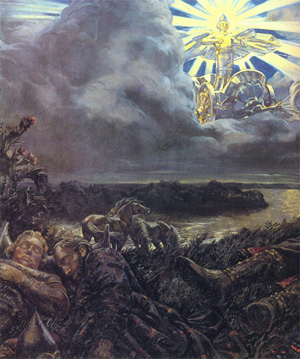
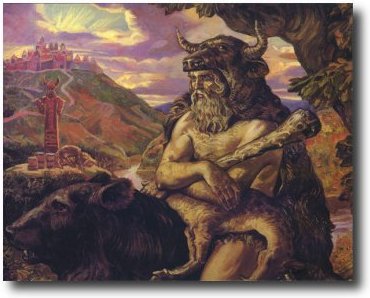
The Sun God: Dažbog


Dažbog (above) was one of the major gods of Slavic mythology, most likely a solar deity and possibly a cultural hero. He is one of several authentic Slavic gods, mentioned by a number of medieval manuscripts, and one of the few Slavic gods for which evidence of worship can be found in all Slavic nations.

While the meaning of Dažbog’s name is not completely clear (as is the case with most other Slavic gods), taking into account several different versions of the name, most scholars agree the root dažd- or daj- is derived from root of the verb dati "to give."

Thus, according to most scholars, Dažbog would be "giving god," "god-giver," "god-donor," deus dator. This is particularly interesting since the Proto-Slavic word for god, *bagu (> Common Slavic *bogъ), the suffix of Dažbog's name, is argued either to be of Iranian origin (being related to Indo-Iranian etymons such as Old Persian baga, Sanskrit bhaga), or being semantically influenced by Iranian source, both being ultimately derived from PIE root *bʰag-, whose reflexes in both Slavic and Indo-Iranian came to mean both "deity" and "wealth, share."

Translated literally, Dažbog would be "giver of fortune." This echoes the ancient Indo-European concept that the deity is, in essence, an entity which gives wealth and abundance, an indication, perhaps, that Dažbog is a relic from common Proto-Indo-European religion, or even that this was not a name for any particular Slavic god, but a general epithet of a deity.


The Slavic god Svarog had two sons: Svarožič, who represented fire on earth, and Dažbog, who represented fire in the sky and was associated with Sun. Svarog was believed to have forged the Sun and have given it to his son Dažbog to carry it across the sky.

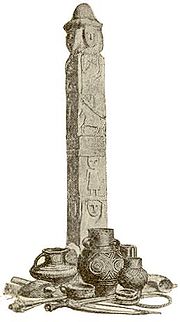
Pagan Slavs left their footprints across the region in a significant number of toponyms whose names can be associated with them and by discoveries of multi-headed statues in various Slavic lands. For example, the four-headed god Svantevit had a white horse and is represented by obelisks such as these.


Keelian Connection

I'm reminded that during the mid-1960s, John A. Keel became literally obsessed with collecting Fortean news clippings of bizarre deaths of people, livestock, and other animals killed by lightning. He would send copies of such newspaper articles to me and others, and requested that his correspondents forward any such events mentioned in local papers. For a time, Keel privately published a newsletter, Anomaly News, in which he would fill the pages with little offset copied news items of all such lightning deaths he could discover.

It is intriguing that Keel would die in New York City on July 3rd and Chervoni's lightning event is listed as July 4th. Of course, with the different time zones, maybe, in some strange Fortean twist of fate, the lightning strike and Keel's death occurred more closely in time that we realize. John would have been happy with this bit of synchronicity.

Sunday, July 12, 2009

Death of Disco

My birthday this year, July 12th, is the 30th anniversary of the White Sox Comiskey Park's "Disco Demolition Night." It turned into one of baseball's all-time worst promotions. But, indeed, the event marked the unofficial "death of disco."


Wednesday, July 8, 2009

Miracle Baby Grave Robbery

News on the body found by two men fishing in the Passaic River on Sunday, July 5, 2009, in Clifton, N.J., has been published by the Associated Press, dateline Stamford, Connecticut.

Authorities investigating the theft of a 2-year-old girl's body from a Connecticut cemetery said Wednesday that evidence at the crime scene points to a possible ritual.
...
Donna Loglisci, Stamford's town clerk who signed disinterment papers permitting authorities to exhume the coffin, identified the girl as Imani Joyner. The girl was called a miracle baby by doctors in a 2006 article in The Advocate of Stamford because she survived more than two years even though she was born with semi-lobar holoprosencephaly, a condition that kept her brain from developing fully.

"We thought the interest in this particular baby might be the background, since it was labeled a miracle baby," Conklin said. "So that's why we believe this baby in particular might have been targeted and it might not be a random act. They would seek that mystic power, perceived power of it being a miracle baby."


For the rest of article by John Christofferson, see here.

For more information on the grave theft, see ABC News.

"Imani" means "faith."

Tuesday, July 7, 2009

Vallee On Keel


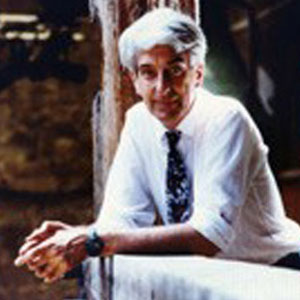
Jacque Vallée (right) and J. Allen Hynek.

Along with his colleague, astronomer J. Allen Hynek, Vallée carefully studied the phenomenon of unusual aerial sightings and close encounters with humanoids on the ground for many years.


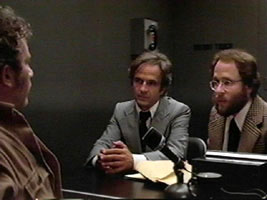
Vallée served as the real-life model for the character Lacombe, portrayed by François Truffaut (shown above, middle) in Steven Spielberg’s film Close Encounters of the Third Kind.

His first three highly thoughtful books, Anatomy of a Phenomenon (1965), Challenge to Science: The UFO Enigma (1966), and Passport to Magonia: From Folklore to Flying Saucers (1969) are classics in the field. A correspondent of mine for decades, I was able to spend some time with Vallée and his wife for the first time only a few years ago when we both spoke at a Virginia Beach, Virginia conference on unexplained phenomena.


Therefore, it was good to hear from my associate, the French-born and now California-based intellectual, ufologist, venture capitalist, computer scientist, and former astronomer, who sent along his thoughts, regarding John A. Keel passing away:

Dear Loren,

I did hear about John's death. Although this was expected, given his long fight with illness the past few years, it is very sad to realize that his voice is now silent in the debate about the nature of the phenomena that continue to fascinate us.

As you know, his writing and mine have followed a parallel course (I wish I had written JADOO, a delightful book!) as we were among a small number of "heretics" who have consistently questioned the "first-order" extraterrestrial theory. He realized very early that UFOs could not be understood apart from other, terrestrial paranormal phenomena, which put him decades ahead of most researchers. He deserves to be recognized as one of the most creative, independent thinkers in the field.

I know you had a close friendship with John, and send you all my sympathy.

Jacques Vallee
Mon Jul 6, 2009 7:08 pm PDT

Monday, July 6, 2009

Keel Is Dead

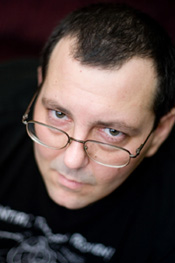
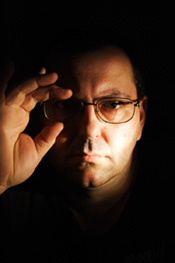
John Alva Keel, 79, a friend, Fortean, fierce fighter for his theories, professionally a writer and journalist, has died. A fellow admirer of Mothman and the anomalies all around us, such as the “name game,” is gone.

John Keel Fickle Finger of Fate
John A. Keel's non-fiction look at the very real unplanned twists in life were recorded in his 1966 novel, The Fickle Finger of Fate.

"Ufology is just another name for demonology," John Keel told me, a week before the September 11th attack on the World Trade Center, which occurred just a couple of miles from where he lives.

...as noted in Mothman and Other Curious Encounters, page 114, (NY: Paraview, 2002).


For more images and my complete, detailed obituary, please see "John A. Keel Is Dead."

John Keel
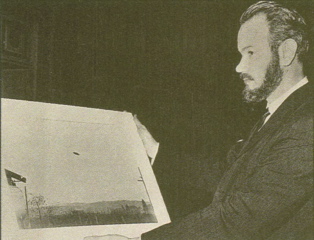
John A. Keel, in 2002.