Showing posts with label Russian. Show all posts

Monday, July 13, 2009

Sun God Polito Killed By Lightning

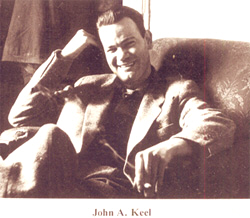
A Ukrainian politician who had tried to revive an ancient pagan cult was killed by lightning on Saturday, July 4, 2009, while on a fishing trip. Did this occur about the same time John A. Keel passed away in the USA?


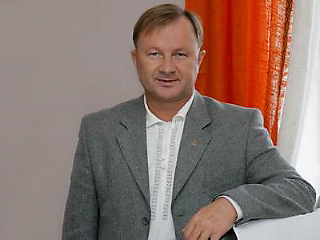
Vasily Chervoni (above) was on a fishing trip near the village of Derazhnoye and suffered a direct lightning hit during a thunderstorm. He was taken to a hospital where he died shortly afterwards, the Russian daily Komsomolskaya Pravda reported on Monday, July 6, 2009.

The newspaper noted that the late politician was a close friend of Ukrainian President Yushchenko and had at one time occupied the governor’s post in Rovno Region. A former activist in the Soviet youth movement Comsomol, Chervoni started an independent political career in the early 1990s with radical Ukrainian nationalists. At some point, Chervoni joined the religious movement Runvera – a Ukrainian sect that seeks revival of obscure ancient cults, in particular, the worship of the sun god Dažbog.

In 1992, Chervoni was excommunicated from the Russian Orthodox Church. When he was retired from the governor’s post in 2006, all Orthodox churches in Rovno Region had a special prayer thanking the Lord for deliverance.

The Sun God: Dažbog
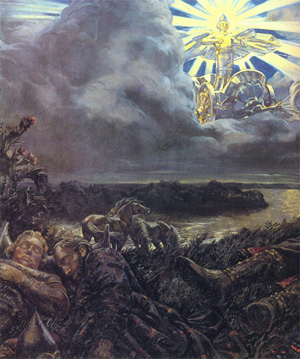


Dažbog (above) was one of the major gods of Slavic mythology, most likely a solar deity and possibly a cultural hero. He is one of several authentic Slavic gods, mentioned by a number of medieval manuscripts, and one of the few Slavic gods for which evidence of worship can be found in all Slavic nations.

While the meaning of Dažbog’s name is not completely clear (as is the case with most other Slavic gods), taking into account several different versions of the name, most scholars agree the root dažd- or daj- is derived from root of the verb dati "to give."

Thus, according to most scholars, Dažbog would be "giving god," "god-giver," "god-donor," deus dator. This is particularly interesting since the Proto-Slavic word for god, *bagu (> Common Slavic *bogъ), the suffix of Dažbog's name, is argued either to be of Iranian origin (being related to Indo-Iranian etymons such as Old Persian baga, Sanskrit bhaga), or being semantically influenced by Iranian source, both being ultimately derived from PIE root *bʰag-, whose reflexes in both Slavic and Indo-Iranian came to mean both "deity" and "wealth, share."

Translated literally, Dažbog would be "giver of fortune." This echoes the ancient Indo-European concept that the deity is, in essence, an entity which gives wealth and abundance, an indication, perhaps, that Dažbog is a relic from common Proto-Indo-European religion, or even that this was not a name for any particular Slavic god, but a general epithet of a deity.
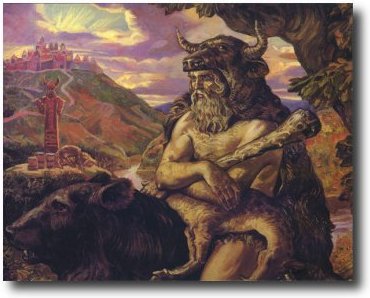


The Slavic god Svarog had two sons: Svarožič, who represented fire on earth, and Dažbog, who represented fire in the sky and was associated with Sun. Svarog was believed to have forged the Sun and have given it to his son Dažbog to carry it across the sky.

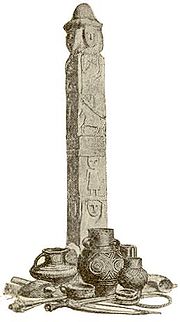
Pagan Slavs left their footprints across the region in a significant number of toponyms whose names can be associated with them and by discoveries of multi-headed statues in various Slavic lands. For example, the four-headed god Svantevit had a white horse and is represented by obelisks such as these.


Keelian Connection

I'm reminded that during the mid-1960s, John A. Keel became literally obsessed with collecting Fortean news clippings of bizarre deaths of people, livestock, and other animals killed by lightning. He would send copies of such newspaper articles to me and others, and requested that his correspondents forward any such events mentioned in local papers. For a time, Keel privately published a newsletter, Anomaly News, in which he would fill the pages with little offset copied news items of all such lightning deaths he could discover.

It is intriguing that Keel would die in New York City on July 3rd and Chervoni's lightning event is listed as July 4th. Of course, with the different time zones, maybe, in some strange Fortean twist of fate, the lightning strike and Keel's death occurred more closely in time that we realize. John would have been happy with this bit of synchronicity.
Monday, January 19, 2009

Death In Threes

Perhaps the idea is overblown, overstated, and overemphasized, but the notion does exist that "death comes in threes."

Let's look at three possible origins, expressions, or foundations for this idea that naturally reinforces a copycat mentality in reporting histories, tragedies, and breaking news:

Avery's Rule of Three

"Trouble strikes in series of threes, but when working around the house the next job after a series of three is not the fourth job -- it's the start of a brand new series of three."

Source.


The Rule of Three in Writing

The rule of three is a principle in English writing that suggests that things that come in threes are inherently funnier, more satisfying, or more effective than other numbers of things. From slogans ("Go, fight, win!") to films, many things are structured in threes. There were three musketeers, three little pigs, three billy goats Gruff, Goldilocks and the three bears, and Three Stooges.

A series of three is often used to create a progression in which the tension is created, then built up, and finally released. Similarly, adjectives are often grouped together in threes in order to emphasize an idea.

Source.


The Rule of Three in Wicca

The Rule of Three (also Three-fold Law or Law of Return) is a religious tenet held by some Wiccans. It states that whatever energy a person puts out into the world, be it positive or negative, will be returned to that person three times. Some subscribe to a variant of this law in which return is not necessarily threefold.

According to John Coughlin the Law posits "a literal reward or punishment tied to one's actions, particularly when it comes to working magic." The law is not a universal article of faith among Wiccans, and "there are many Wiccans, experienced and new alike, who view the Law of Return as an over-elaboration on the Wiccan Rede." Some Wiccans believe that it is a modern innovation based on Christian morality.

The Rule of Three has been compared by Karl Lembke to other ethics of reciprocity, such as the concept of karma in Dharmic religions and the Christian edict, "Do unto others as you would have them do unto you" (Matthew 7:12), also called the "Golden Rule."

The Rule of Three has a possible prototype in a piece of Wiccan liturgy which first appeared in print in Gerald Gardner's 1949 novel High Magic's Aid:

'Thou hast obeyed the Law. But mark well, when thou receivest good, so equally art bound to return good threefold.' (For this is the joke in witchcraft, the witch knows, though the initiate does not, that she will get three times what she gave, so she does not strike hard.)


The first published reference to the Rule of Three as a general ethical principle may be from Raymond Buckland, in a 1968 article for Beyond magazine. The Rule of Three later features within a poem of 26 couplets titled "Rede of the Wiccae," published by Gwen Thompson in 1975 in Green Egg vol. 8, no. 69 and attributed to her grandmother Adriana Porter.

Source.

Trilogies of Death

BTW, this sense of a trilogy among death is found in various popular cultures and can be demonstrated by noting the following three collected works:

1) Three Deaths: A Tale (Russian: Три смерти, Tri smerti) is a short story by Leo Tolstoy first published in 1859. It narrates the deaths of three subjects: a noblewoman, a coachman and a tree.

2) Death Times Three is a collection of Nero Wolfe novellas by Rex Stout, published posthumously by Bantam Books in 1985. The book contains three stories, one never before published:

"Bitter End," first printed in the November 1940 issue of The American Magazine, and collected in the limited-edition volume Corsage: A Bouquet of Rex Stout (1977). The story is a re-working of Stout's Tecumseh Fox story Bad for Business.

"Frame-Up for Murder," an expanded rewrite of the 1958 novella "Murder Is No Joke" that was serialized in three issues of The Saturday Evening Post (June 21, June 28 and July 5, 1958) but never published in book form.

"Assault on a Brownstone," an early draft of the 1961 novella "Counterfeit for Murder".

3) Curse, Death & Spirit is a 1992 three-part anthology of Japanese ghost stories from popular director Hideo Nakata (Ringu, The Ring 2).

The movie consist of three storylines.

The Cursed Doll: Satomi is being called by someone in her dreams. Following this voice, the voice seemed to be coming from a doll in which she realize that there is a spirit of her dead sister inside of it.

The Spirit of the Dead: A woman takes her son camping after her husband's death but was disrupted when a ghost of a woman thinks that the boy is her child.

The Haunted Inn: A spirit forces three girls who are on a vacation in a traditional Japanese inn, in which a tragedy had occurred a long time ago, to repeat the events of the day.

JFK and Threes

Writings of a "twilight language" nature on the JFK assassination often mention the first Masonic Temple site in Texas, Dealey Plaza, as the location of the shootings. When they go on and note that the killing of the President (the symbolic "King") occurred near the banks of the Trinity River, next to the Triple Overpass, lined up on a map on the 33 degree parallel with the Trinity Site in New Mexico, therefore, these may also be an extension of the "death comes in threes" literature.

Material on the last point is extensive within the triple-decker works in conspiracy, synchromystic, and assassination thoughts, which are often remarkably scholarly in nature.