Showing posts with label Self-Immolations. Show all posts

Monday, August 15, 2011

Tibetan Monk Immolation


Tibetan monk sets himself on fire in China

A Tibetan monk has set himself alight in China's Sichuan province, amid claims of a crackdown on monasteries in the region.
Western-based activists said the monk, who they named as Tsewang Norbu, had died from his injuries.
A similar action sparked weeks of confrontation earlier this year in another town in Sichuan.
Unrest is fuelled by a widespread belief that the government wants to suppress Tibetan culture.
The argument has been going on for decades, with many Tibetans accusing the government of forcing monks to attend re-education camps, encouraging the migration of Han Chinese to Tibetan areas, and crushing any sign of dissent.
But the authorities say they have brought relative wealth and prosperity to a region that was a rural backwater.
The UK-based Free Tibet movement said the 29-year-old monk had doused himself with petrol and set himself alight at the Nyitso Monastery in Dawu town.
The group said he had been calling out "we Tibetan people want freedom", "long live the Dalai Lama" and "let the Dalai Lama Return to Tibet".
Most Tibetan monks are loyal to the Dalai Lama, the spiritual leader who has lived in exile in India for decades.
The state-run Xinhua news agency quoted local government officials confirming that a monk had set himself alight, but gave no details of his condition.
In March, a monk set light to himself in Aba, about 100 miles (150km) from the latest incident.
Local people accused the authorities of locking down that monastery and carting off monks to be re-educated.
The UN later said up to 300 monks may have been illegally detained.

China has denied the accusations.

Saturday, February 12, 2011

Fires of Change, 1848, and the Kingdom of Kush


The Kingdom of Kush was established in about 1070 BC. The first cultures arose in Sudan before the time of a unified Egypt. Now, days before a new Egypt emerged on February 11, 2011, a new southern nation in the ancient land of Kush/Cush has appeared on the horizon on February 7, 2011.


Immolations & Facebook Revolution

These are incredible times. The new tomorrows are not over. Other countries, e.g. Libya, Algeria, Yemen, plus more Arab lands and even Italy and Serbia, are feeling the cries from the people calling for freedom.

We have been this way before, of course. While others have noted detailed examinations of the
timing, let us observe other specifics beyond the significance of Tahrir Square.

The important role of
self-immolations in sparking the wave of protests and changes we are seeing in governments cannot be underplayed. It began in Tunisia in December, and quickly spread throughout the Arab world, with immolations in several countries of the region.

Egypt fell on February 11, 2011, after Tunisia saw change in January. Immolations were a key. The fall of Tunisian President Zine al-Abidine Ben Ali -- the first time in generations that an Arab leader has been toppled by public protests -- sent a sharp signal to the rest of the region, dominated by autocratic regimes. The protests that brought down Ben Ali erupted after the self-immolation of 26-year-old vegetable seller Mohamed Bouazizi, who set himself on fire on December 17, 2010. The same type of incidents swept the region. More protesters set themselves afire in Egypt, Mauritania and Algeria on Monday, January 17, 2011, in fiery suicide copycats. This was followed by more in Saudi Arabia, Morocco, and France. (As noted in The Copycat Effect, fire suicides are a powerful, political form of behavior contagion.)


The self-immolations of Buddhist monks in South Vietnam, beginning in 1963, eventually pushed that government to change leadership, and foreshadowed the political overturns in Southeast Asia. 


Likewise, the fiery suicide of Jan Palach, a 20-year-old Czech who burned himself to death in Prague in 1969, was the spiritual precursor to what would grow into the blazing fire of change that would transform Eastern Europe.

These are often called "grassroots movements," although today's massive waves of political realignments are rightfully being termed the "Facebook Revolution."


Revolutions of 1848

The most comparable historical events to the current protests and changes seen throughout the Arab World are the 
Revolutions of 1848, which impacted Europe for decades.

Barricade on the rue Soufflot, an 1848 painting by Horace Vernet. 
The Panthéon is shown in the background.

The European Revolutions of 1848, known in some countries as the Spring of Nations, Springtime of the Peoples or the Year of Revolution, were a series of political upheavals throughout Europe. Described by some historians as a revolutionary wave, the period of unrest began in France and then, further propelled by the French Revolution of 1848, soon spread to the rest of Europe.

It will be recalled that in the midst of all of the calls for change from the poor classes (reflective of the situation in the Arab World today), Karl Marx and Friedrich Engels had written at the request of the Communist League in London (an organization consisting principally of German workers) The Communist Manifesto, published in German in London on February 21, 1848.

The people of each of the following locations had massive protests and revolutionary incidents: Italian states, France, German states, Denmark, Schleswig, Habsburg Empire, Hungary, Slovakia, Switzerland, Greater Poland, Wallachia, Belgium, and even Brazil.


Although most of the revolutions were quickly put down, there was a significant amount of violence in many areas, with tens of thousands of people tortured and/or killed. While the immediate political effects of the revolutions were largely reversed, the long-term reverberations of the events were far-reaching. 1848 was a watershed year for Europe, and many of the changes of the late nineteenth and early twentieth centuries have origins in this revolutionary period.


The Kingdom of Kush

While the newest governmental change in the world today is the new Egypt, the newest full nation also was announced a few days ago, on February 7, 2011. 


Due to the vote for independence, the citizens of southern Sudan voted in overwhelming numbers to break away from the northern portion of their country and form a new entity. While it may not formally have a new name yet, other than press reports calling it South Sudan, Sudan's President Omer Hassan Al-Bashir accepted the final results of the referendum where southerners almost unanimously voted (by nearly 99%) for the secession of their region.  South Sudan will be declared an independent state on July 9, 2011. This new land is very reflective of the ancient country known as the Kingdom of Kush.


We should not take the news lightly that old Kush/Cush has returned.  The Kingdom of Kush, like Egypt, is ancient and dominated by smaller pyramids and familiar artifacts.


Kush

Egypt


The Kingdom of Kush or Cush was an ancient African state centered on the confluences of the Blue NileWhite Nile and River Atbara in what is now the Republic of Sudan. It was one of the earliest civilizations to develop in the Nile River Valley. Having also been referred to as Nubia, and as "Ethiopia" in ancient Greek and Greco-Roman records, the Kushites left their mark on various aspects of the ancient world and their legacy is still readily discernible from the various archaeological field sites scattered throughout modern Sudan.


Biblical Prophecies of Cush

The name given this ancient civilization issues from the Bible's Old Testament, where Cush (Hebrew: כוש) was one of the sons of Ham (Genesis 10:6) who settled in northeast Africa. As noted in the Bible and at different times in the ancient world, a large region covering northern Sudan, modern day southern Egypt, and parts of EthiopiaEritrea, and Somalia was known as "Cush." 

The Hebrew Bible refers to "Cush" on a number of occasions, though various English translations translate this as "Nubian", "Ethiopia", "Sudan", and "Cushite" (Unseth 1999). Moses' wife, Tzipporah, is described as a Kushite in the book of Numbers 12:1. Some contend that this Cush was in southern Arabia. All of this is complicated by the fact that the Septuagint translated "Cush" as "Aethiopia," leading to the misleading conclusion that "Cush" should be equated with the borders of present day "Ethiopia."


Sudanese Christians in southern Sudan believe the independence of their nation was foretold in the Bible more than 2,000 years ago. Isaiah 18 is one of several passages that refer to the land of Cush, which describes the people as tall and smooth-skinned and the land as divided by rivers.


"It used to be read so many times on Sunday," said Ngor Kur Mayol, who drove to Nashville from Atlanta earlier this month to vote in the independence referendum. "It mentions a lot the way we were suffering in for so many years and how that same suffering, we're going to end it today, to vote for independence," (according to the Associated Press writer Travis Oller).


The interpretation is not so far-fetched, said Ellen Davis, a professor at Duke Divinity School who has been working since 2004 with the Episcopal Church of Sudan to strengthen theological education there.


"There's no doubt that Isaiah 18 really is speaking about the people of the upper Nile," she said. "It really is speaking about the Sudanese people."


Davis said the belief in the prophecy is nearly universal among the Christians she has met in Sudan.


"In general, Sudanese Christians believe to a much greater extent than mainline North American Christians that the Bible speaks to current events, specifically political events," Davis said.


Jock Paleak, pastor at the Sudanese Cumberland Presbyterian Church in the Nashville suburb of Gallatin, explained how Isaiah 18 has been interpreted to refer to independence.


"The Bible says when they will raise their flag on the mountain, the whole world will see."


Isaiah 18 concludes with a passage Paleak said predicts the end of rule by the Muslim north. He paraphrases and explains it: "'They will bring their gifts to the mountain of Zion,' which means we will be free to praise God in our own way in our own land."


Portions of this blog, in terms of photos 
and content, are reprinted under the 
as educational and/or editorial material 
of which commentary is made, 
without benefit of financial gain. 
This is applicable throughout 
the entire Twilight Language blog.
Sections of this entry may reflect summaries of data from Wikipedia.

Tuesday, January 25, 2011

Facebook Immolations


The Middle East has erupted, set afire, literally, by fire suicides. Today, it was Egypt. Leaders throughout the Arab world do not know what nation will be touched next. The copycat effect is clearly very real.


In the past, the news of politically-based self-immolations were spread by television news and newspapers. Today, it is Facebook and Twitter that are telling the word what is going on in the Middle East, in mass protests throughout the region.


Reports throughout several Arab countries tell of at least 13 self-immolations having occurred since the fiery suicide of Mohamed Al Bouazizi, a Tunisian man who helped topple his government. But the Jerusalem Post is stating today that at least six new cases of self-immolations have occurred in Egypt. News services are losing count of the widespread number of reports of immolations.


The 26-year-old Tunisian fruit vendor (shown in hospital before his death) doused himself with gasoline on December 17, 2010, to protest his alleged mistreatment by local officials. His death on January 4, 2011, caused the public outrage that collapsed the government of President Zine el-Abedine Ben Ali.


"This was really the spark, literally and figuratively, that set Tunisia on fire," said Sultan Sooud Al Qassemi, a non-resident fellow at the Dubai School of Government.


Following Bouazizi's example, at least 13 men, most of them in Egypt and Algeria but one each in Saudi Arabia, Morocco and Mauritania, have been involved in self-immolations. Here is a partial list: five Algerians - Jan. 13, 15, 16; one Mauritanian and four Egyptians - Jan. 17, 18.


Protestors carry the body of dead man during an anti-government protest in Tirana, Albania

Over the weekend, an unidentified Saudi Arabian man set himself on fire in that country's first self-immolation, reported the BBC. The incidents are part of a wave of protest in North Africa and the Arabian peninsula. Protestors filled the streets in Jordan, Egypt, Algeria and Yemen this weekend. Activists in Algeria were met with batons, while n Yemen, protestors demonstrating in support of the Tunisian revolt called for their president to step down. President Ali Abdullah Saleh has ruled Yemen for 32 years, first as president of North Yemen from 1978 to 1990, and as head of the consolidated country ever since.


Egyptian demonstrators protest in front of the Tunisian embassy in Cairo, Egypt, Saturday, Jan. 15, 2011, in support of Tunisian national protests which have swept the North African Arab country after its longtime president was forced out by protests. Arabic signs read 'revolution in Tunis, tomorrow in Egypt'. 


Today, January 25, 2011, saw thousands of anti-government protesters (above) inspired by the Tunisian revolution clashed with riot police in the centre of Cairo today demanding the overthrow of president Hosni Mubarak.

Police responded with water cannon and attacked crowds with batons and  tear gas to clear crowds demanding an end to the country's grinding poverty.

The prostest, the largest Egypt has seen for years, began peacefully, with police showing unusual restraint in what appeared to be a concerted government effort not to provoke a Tunisia-like mass revolt.

To the north, in the Mediterranean port city of Alexandria, thousands of protesters also marched in what was dubbed a 'Day of Rage' against Mr Mubarak and lack of political freedoms under his rule.


In another parallel with the Tunisia protests, the calls for rallies went out on Facebook and Twitter, with 90,000 saying they would attend.


Self-immolations were a frequent form of protest in South Vietnam in the 1960s. A Buddhist monk set himself on fire in 1963 to protest alleged persecution of Buddhists by the regime of President Diem, inspiring multiple copycats. Then immolations were used by anti-Vietnam War protestors in the U.S. in the sixties and Eastern European foes of Soviet domination employed the technique in the 1960s, 1970s, and 1980s.  


Indeed, as the New York Times noted over the weekend, "Jan Palach, a 20-year-old Czech who burned himself to death in Prague in 1969 a few months after the Soviet invasion of his country, is remembered as a martyr of the struggle against Communism....suicide sometimes spreads like a disease, especially when heavily covered in the media."


All of the fire suicides we are reading about during the last month are most certainly copycats.

Saturday, February 28, 2009

Self-Immolations Spread

Politically-related suicides-by-fires are increasing. In the wake of media attention to immolations in China and USA, there's breaking news of fires by a Tibetan monk in Asia, and a man in London's "protest" square.

A man apparently set himself on fire outside Britain's Parliament on Friday, February 27, 2009, and he was taken to a hospital with superficial burns, authorities told the UK media.

Police said the man was on fire "for a short time" in Parliament Square in the heart of London. Without saying specifically that the man attempted self-immolation, police said they did not believe anyone else was involved.

A police spokesman said the man's burns were superficial and "certainly not critical." He spoke on condition of anonymity in line with force policy.

There was no immediate word on who the man was or why he would set himself on fire. But it follows two attempts at self-immolation by men who have been reported to be ethnic Tamils based in Britain.

(In Sri Lanka, on February 26, 2009, 36-year old worker of actor Vijaykanth led DMDK attempted self immolation over the Sri Lankan Tamils issue. He poured kerosene over his body and set himself ablaze at Vellappatti village in this district, police said. He was immediately rushed to the Christian Medical College hospital, where his condition was stated to be critical.)

Back in the UK, on February 14, 2009, a Tamil was arrested outside Downing Street, home of the British prime minister, before he could set himself ablaze. That came days after a 26-year-old Sri Lankan protester poured gasoline over himself and burned to death outside the U.N. complex in Geneva.

Tamils have been holding steady protests over the Sri Lanka's military action against ethnic Tamils.

In Geneva, police found a five-page letter identifying the man and declaring that the self-immolation was to protest developments in the island nation.

Sri Lanka's government is fighting to crush the rebels and end their 25-year campaign for an independent homeland for the country's ethnic minority Tamils, who have suffered marginalization under the country's majority ethnic Sinhalese. More than 70,000 people have been killed in the violence.

Meanwhile, the Washinton Post reports on another Tibetan-related self-immolation from Asia that had an awful reaction from Chinese authorities.

A young Tibetan monk was shot by Chinese police after he set himself on fire Friday, February 27, 2009, the third day of the Tibetan New Year, at a market in Sichuan province's Aba prefecture, Tibetan activist groups said, citing eyewitnesses.

Many Tibetans this year are avoiding celebrating the New Year or are instead using the 15-day holiday to commemorate those killed in deadly riots in Lhasa last March. Chinese authorities, determined to avoid a recurrence of the violence, have sharply increased security patrols, detentions and so-called reeducation campaigns. They are especially nervous about March 10, the 50th anniversary of the 1959 Tibetan uprising, which Chinese troops forcibly suppressed shortly before the Dalai Lama fled into exile and Beijing imposed its own government in Tibet.

Witnesses told the activist groups that the monk's protest came shortly after he and about 1,000 other monks were refused entry to the main prayer hall at the Kirti Monastery in Aba because local authorities had forbidden observation of Monlam, a traditional prayer festival held after Losar, as the New Year is known. In defiance of the order, the monks sat down outside to begin their prayers about 1 p.m. while older monks pleaded with them to disperse, according to Students for a Free Tibet and the Washington-based International Campaign for Tibet.

The monks complied, but then a monk in his 20s named Tapey came out of the monastery, took out a homemade flag bearing a photograph of the Dalai Lama and at 1:40 p.m. walked to a nearby street market. He had doused himself with oil by the time he reached an intersection in the market, where he set himself on fire, the activist groups said.

Witnesses said police then fired three shots at Tapey. At the first shot, he fell, said Kate Saunders, a spokeswoman for the International Campaign for Tibet, and officials removed him from the scene.

Eyewitnesses said they believed he was dead, but his condition has not been confirmed.

Phones at the public security bureau and government offices in Aba county were not answered Friday night and early Saturday. A doctor at Aba Hospital who gave his surname as Luo said, "Even we don't know where the monk is. Hospital officials had a meeting and told us not to say anything."

After the incident, 500 monks from the monastery immediately began funeral rites for the monk.

A Chinese employee of an Internet cafe surnamed Mu said the streets of Aba were largely empty, except for armed policemen. Shops have been closing earlier than usual, , he said.

The Kirti Monastery in Sichuan has links to the Kirti Monastery in Dharmsala, India, where monks said eyewitnesses in Tibet had reported the self-immolation and the shooting, the activist groups said.

Dozens of Tibetans from in and around Aba prefecture were killed last year.


The modern history of political self-immolations began in Vietnam in 1963.

Friday, February 27, 2009

Immolations: China/Chicago


University of Washington, USA: 2008

Now Tibet, again.

Three men set themselves on fire at a busy road crossing in Wangfujing, which is close to the famous Tienanmen Square in the heart of Beijing, on Wednesday afternoon (February 25, 2009), according to Asian media reports.

The Beijing administration has indicated that they were trying to voice some grievance while making the attempt at self-immolation. But it did not disclose any details. The Beijing government did not disclose the identify of the persons, who ignited themselves inside a car around 3pm. But it said that they came from outside the city in a car bearing a non-Beijing license plate. Xinhua said there were one woman and two men in the car at the time of the incident.

The fire assumed significance because it occurred on the Tibetan New Year Day.

free tibet

Now word comes of a Chicago area man who has died in a self-immolation.

A 58-year-old Wal-Mart employee who said he "couldn't take it anymore" lit himself on fire outside the Bloomingdale store where he worked late Thursday night (February 26, 2009) and was later pronounced dead at a hospital, according to Chicago-area media reports.

The Carol Stream man, who worked the overnight shift, was in a parking lot of an adjacent sporting goods store in the west suburban strip mall when he set himself on fire with lighter fluid around 10 p.m., said Randy Sater, a watch commander with the Bloomingdale Police Department.

Wal-Mart corporate spokesman Dan Fogleman said the man had worked for the company for a little over 7 years, most recently as an overnight stocker. He said he had spoken with a member of the store's management who described him as "a good guy and fun to be around."

He called the suicide "a tragic situation, and our thoughts and prayers are with the friends and family."

Wal-Mart was cooperating with authorities in their investigation, he said, but he declined to "speculate" on whether the man had been in to work last night before the incident or had spoken with any employees.

Thanks to Todd Campbell for the heads up on the Carol Stream incident.

Monday, November 3, 2008

Another Self-Immolation

In the wake of the University of Washington self-immolation, another university-related suicide by fire has occurred on the other side of the country on Halloween. (Also, there is an update on the identity of the UW victim.)

Is there some key to understanding these deaths, based on their dates?

On November 2, 1965, Norman Morrison of Baltimore set himself afire outside the Pentagon office of the Secretary of Defense, Robert McNamara, in direct protest to the Vietnam War. Norman was the executive secretary of a Quaker community in Baltimore, and, according to his wife, appeared to decide on his act after reading an article by a South Vietnamese priest about the bombing of a village there.

A week after Norman Morrison's death, on November 9, 1965, another American Roger A. LaPorte, 21, a member of the Catholic Worker movement, died in a self-immolation protest. Norman sat down in front of the Dag Hammarskjold Library at the United Nations in New York, calmly composed himself in the position of the Buddhist monks who had immolated themselves in Vietnam earlier, doused himself with gasoline, and set himself aflame.

La Porte died the next day from second- and third-degree burns covering 95 percent of his body. Despite his burns, he remained conscious, lucid, clearly able to speak. When asked why he had burned himself, La Porte calmly replied, "I'm a Catholic Worker. I'm against war, all wars. I did this as a religious action." (Credit to cvllelaw of Democratic Central for reawakening me to the anniversaries of these events, detailed in The Copycat Effect. The timing seems more than coincidence but then again, perhaps it only is a temporal accident.)


University of Washington, USA: 2008

Nevertheless, we appear to be going into a new cycle, if even only, hopefully, a short one.

Some new details about the 61-year-old man who died by fire (pictured above) in Red Square at the University of Washington (UW) in Seattle on October 30, 2008, have emerged.

The King County medical examiner's office has identified the 61-year-old man who set himself on fire at the University of Washington campus last Thursday as Nin Soo Chun.

The medical examiner ruled Chun's death a suicide Monday, four days after the former UW worker poured gasoline on himself and set himself ablaze in Red Square during the middle of the day.

Chun died after shortly after being brought to Harborview Medical Center with second- and third-degree burns.

The medical examiner says Chun died from "thermal burns involving 90 percent of total body surface area."

The man had worked for UW Facilities Services for some time, said UW spokesman Norm Arkans. His employment ended in late August, 2008, Arkans said, following a process to release him.

"At the very end, he had stopped coming to work, so a process was initiated to separate him from the university," Arkans said.

Chun had worked as a custodian for the UW's Facilities Services as a custodian from December 2005 to early summer this year. He emigrated to the U.S. from Korea in 1977 and became a naturalized citizen in 1982.

After several "confrontational, but not necessarily physical" altercations with co-workers in June, Chun was reassigned from his usual work site in Padelford Hall.

Soon after these incidents, which Arkans said were enough to make his co-workers "uncomfortable," Chun requested and was granted several weeks' vacation, after which he did not return to work.

The UW tried, unsuccessfully, to contact him throughout the summer. On Aug. 25, when he came to campus to collect his paycheck, he was told he was being fired, and that he had 10 days to seek reinstatement. The UW offered Chun counseling assistance but he did not accept it, Arkans said.

Chun instead filed an unemployment claim with the state, which was denied. Chun appealed the denial at an Oct. 24 hearing, Arkans said.

"The man was clearly a troubled individual, and I think everyone who's encountered this wants to be respectful" of the circumstances surrounding Chun's death, Arkans said. Until the incidents at the beginning of the summer, Chun had been a good employee, Arkans said.


Meanwhile, the day after the self-immolation in Seattle, another university-related suicide by fire occurred in New York State.

A body found burned beyond recognition in a western New York cemetery on Halloween night (October 31, 2008) is believed to be that of a college student who took his own life.

University of Rochester, Rochester, NY, officials sent an e-mail to faculty and students sent early Saturday, November 1, 2008, telling them that while authorities have yet to identify the victim or a cause of death, the apparent self-immolation appears to have been a suicide.

Rochester Police Capt. Lloyd Cuyler says officers responded the historic Mt. Hope Cemetery _ which is adjacent to the campus _ at around 11:50 p.m. Friday, October 31, after receiving a report of a person on fire.

He says they found the scorched male body in a remote section of the cemetery next to a gasoline can and a book bag.
The copycat and behavior contagion nature of self-immolations is well-documented.


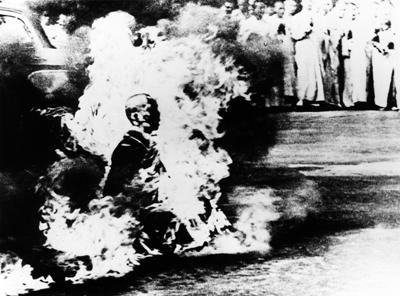
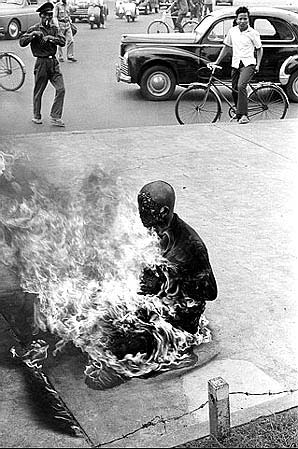
Political self-immolations in our media-conscious world, historically began in Vietnam in 1963.

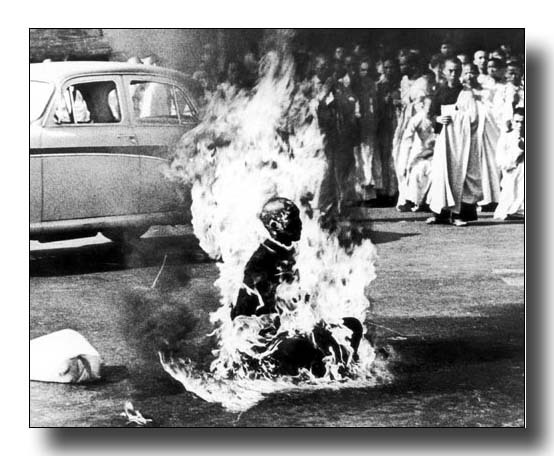
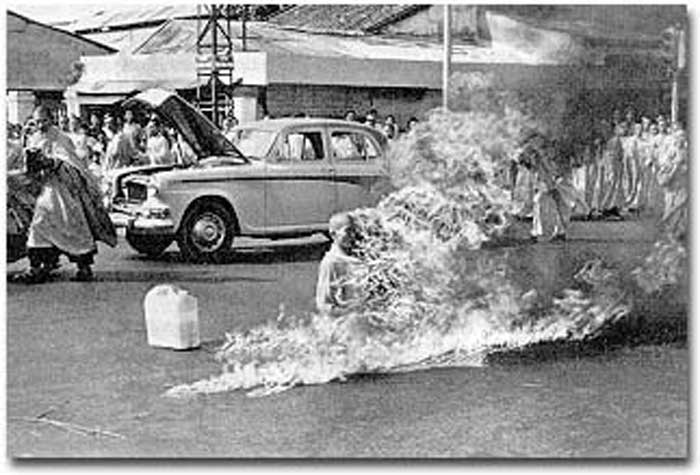
Journalist Malcolm Browne took photographs (below) of Thích Quảng Ðức during his self-immolation. These photographs were so widely disseminated, they became one of the lasting images of the early days of the Vietnam War. Browne won many awards for his photographs of the immolation, including the World Press Photo of the Year (1963) and the Pulitzer Prize for International Reporting (1964).

After Thích Quảng Ðức's death, his body was re-cremated, but his heart remained intact. The heart did not burn. It was considered to be holy and placed in a glass chalice at Xa Loi Pagoda. The intact heart relic is regarded as a symbol of compassion and Thích Quảng Đức has subsequently been revered by Vietnamese Buddhists as a bodhisattva (Bồ Tát) - an enlightened, heroic wisdom-being - and accordingly is often referred to in Vietnamese as Bồ Tát Thích Quảng Đức.


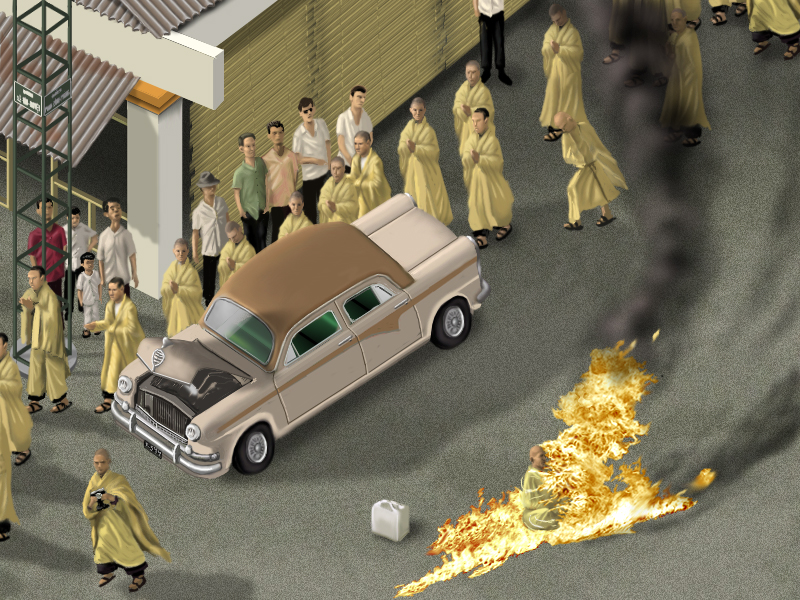
This is a Jon Haddock painting that recreates the Thích Quảng Ðức self-immolation based on Malcolm Browne's photographs.


David Halberstam won a Pulitzer Prize for his written account of Thích Quảng Ðức's fiery protest.


Fiery political suicides continue....


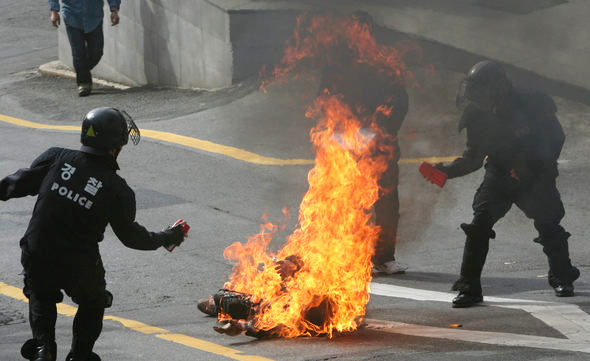
Korea: 2007


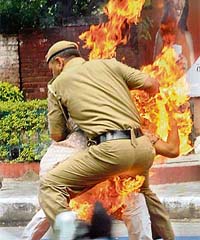
India: 2006