The 2009-2010 school year has begun with a bombing. Teachers at Hillsdale High School in San Mateo say a former student came back to class Monday carrying a pipe bomb.
+++++
Update:
CBS 5 reported on August 25, 2009, that the 17-year old former student arrested for setting off two bombs at San Mateo's Hillsdale High School was identified late Monday as Alex Youshock. This is according to more than a half dozen of the suspect's neighbors, classmates and teachers interviewed by CBS 5.
Agents with the federal Bureau of Alcohol, Tobacco and Firearms (ATF) and local police searched the suspect's apartment on Casa de Campo Street in San Mateo on Monday evening. They removed bags of evidence from the boy's apartment, including what San Mateo police Lt. Mike Brunicardi described as "bomb making materials."
Police said they were not naming the suspect because he is a minor.
14-year-old Moises Molina said officers asked him if he knew Youshock, and showed Moises a photo of the boy who lives in the apartment. "I seen him getting arrested and yeah, that was him," said Molina.
Next door neighbor, April de Guzman, said she shared high school and middle classes with Youshock. "He didn't talk much," Guzman said. "He was really quiet, didn't have that many friends. Kept to himself."
+++++
Earlier info on the incident:
No one was hurt in the blast just after 8 a.m. at Hillsdale High School at 3115 Del Monte St., authorities said. Some students reported that the explosion happened outside a room where a sophomore history class was in session, said the San Francisco Chronicle.
Authorities say an explosion at the San Mateo, California high school forced evacuation of students and cancellation of classes, according to the Associated Press.
San Mateo police Lt. Mike Brunicardi says officers received calls Monday, August 24, 2009, reporting a blast at Hillsdale High School.
Brunicardi says students were evacuated to a middle school. The suspect was confronted by two teachers after the explosions and was then tackled and restrained by a third teacher. Soon thereafter, a male suspect was arrested.
The teen was armed with a two-foot-long sword and chainsaw, in addition to eight pipe bombs strapped to his body. According to police, the suspect had detonated two of a total of ten explosive devices he had attached to a tactical vest. Those devices were cut from the suspect's vest. Raw footage on KTVU.com showed police handcuffing a young man with a closely cropped hair and a scruffy beard wearing a white T-shirt and white boxers or shorts. (It appeared that he had been stripped of his clothing due to the hidden nature of the weapons attached to his body and the noted vest.) Officers put him into a marked police car.
A bomb squad searched the school for any other explosive devices.
Hillsdale High School is starting its second week of the new school year. It has 1,200 students, and their mascot name is the Knights.
San Mateo is a city in San Mateo County, California, United States, in the San Francisco Bay Area, having been originally part of the Rancho de las Pulgas (literally "Ranch of the Fleas").
Showing posts with label Logan. Show all posts
Showing posts with label Logan. Show all posts
Monday, August 24, 2009

Tuesday, July 21, 2009
Train Derailment In Mingo County
Recently, I talked of synchromystic rail wrecks. Well, there's been another one, and it certainly seems to have happened in the midst of many dots that can be connected to some strange links.
Four workers were injured after a freight train derailed at a Wharncliffe, West Virginia coal plant and caused a nearby building to collapse, on Tuesday, July 21, 2009, around 7:30 a.m.

What could this obelisk dedicated to the Battle of Point Pleasant have to do with today's derailment? Take a short synchromystic journey to discover the answer.
Authorities told the Associated Press that the train's conductor and two coal plant workers pulled from the wrecked building suffered minor injuries. A fourth worker had to be airlifted to a hospital with serious injuries.
The Norfolk Southern Corporation train was pulling up under loading equipment when it derailed and hit a support. The loading equipment collapsed and knocked down a building. More details about the building were not available.
The Black Bear Preparation Plant in southern West Virginia employs about 30 people. The facility is operated by Cobra Natural Resources, which belongs to a subsidiary of Abingdon, Virginia-based coal producer Alpha Natural Resources.
The mine is located in Mingo County, West Virginia, and is surrounded by intriguingly named counties: to the north, Lincoln County, WV; to the northeast, Logan County, WV; and to the west, Pike County, Kentucky. Mingo, named after a Native American tribe, was created from an oversized Logan County, after a moonshiner was wrongly accused of having a still in Logan County, when, in fact, it was in Lincoln County.
The attempt to unionize coal miners in Mingo County in the 1920s led to the Battle of Blair Mountain in neighboring Logan County.
The Mingo are an Iroquoian group of Native Americans that migrated west to the Ohio Country in the mid-eighteenth century. One of their most famous leaders was Chief Logan.
The Battle of Point Pleasant, known as the Battle of Kanawha in some older accounts, was fought on October 10, 1774, primarily between Virginia militia and American Indians from the Shawnee and Mingo tribes (but probably not Chief Logan).
Along the Ohio River near modern Point Pleasant, West Virginia, American Indians under the Shawnee Chief Cornstalk attacked Virginia militia under Andrew Lewis, hoping to halt Lewis's advance into the Ohio Country. After a long and furious battle, Cornstalk retreated. After the battle, the Virginians, along with a second force led by Lord Dunmore, the Royal Governor of Virginia, marched into the Ohio Country and compelled Cornstalk to agree to a treaty, ending the war.
The battle is honored as the first battle of the American Revolution during "Battle Days," an annual festival celebrated in modern Point Pleasant. To memorialize the event, you will find the obelisk pictured above right there, near the river, in Point Pleasant, not too far from where the Silver Bridge use to stand.
The "Curse of Chief Cornstalk" is often mentioned in conjunction with Mothman and the collapse of the Silver Bridge, at Point Pleasant, West Virginia, on December 15, 1966.
Four workers were injured after a freight train derailed at a Wharncliffe, West Virginia coal plant and caused a nearby building to collapse, on Tuesday, July 21, 2009, around 7:30 a.m.
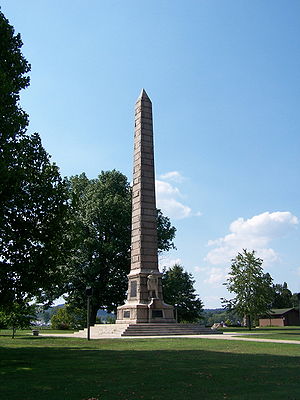
What could this obelisk dedicated to the Battle of Point Pleasant have to do with today's derailment? Take a short synchromystic journey to discover the answer.
Authorities told the Associated Press that the train's conductor and two coal plant workers pulled from the wrecked building suffered minor injuries. A fourth worker had to be airlifted to a hospital with serious injuries.
The Norfolk Southern Corporation train was pulling up under loading equipment when it derailed and hit a support. The loading equipment collapsed and knocked down a building. More details about the building were not available.
The Black Bear Preparation Plant in southern West Virginia employs about 30 people. The facility is operated by Cobra Natural Resources, which belongs to a subsidiary of Abingdon, Virginia-based coal producer Alpha Natural Resources.
The mine is located in Mingo County, West Virginia, and is surrounded by intriguingly named counties: to the north, Lincoln County, WV; to the northeast, Logan County, WV; and to the west, Pike County, Kentucky. Mingo, named after a Native American tribe, was created from an oversized Logan County, after a moonshiner was wrongly accused of having a still in Logan County, when, in fact, it was in Lincoln County.
The attempt to unionize coal miners in Mingo County in the 1920s led to the Battle of Blair Mountain in neighboring Logan County.
The Mingo are an Iroquoian group of Native Americans that migrated west to the Ohio Country in the mid-eighteenth century. One of their most famous leaders was Chief Logan.
The Battle of Point Pleasant, known as the Battle of Kanawha in some older accounts, was fought on October 10, 1774, primarily between Virginia militia and American Indians from the Shawnee and Mingo tribes (but probably not Chief Logan).
Along the Ohio River near modern Point Pleasant, West Virginia, American Indians under the Shawnee Chief Cornstalk attacked Virginia militia under Andrew Lewis, hoping to halt Lewis's advance into the Ohio Country. After a long and furious battle, Cornstalk retreated. After the battle, the Virginians, along with a second force led by Lord Dunmore, the Royal Governor of Virginia, marched into the Ohio Country and compelled Cornstalk to agree to a treaty, ending the war.
The battle is honored as the first battle of the American Revolution during "Battle Days," an annual festival celebrated in modern Point Pleasant. To memorialize the event, you will find the obelisk pictured above right there, near the river, in Point Pleasant, not too far from where the Silver Bridge use to stand.
The "Curse of Chief Cornstalk" is often mentioned in conjunction with Mothman and the collapse of the Silver Bridge, at Point Pleasant, West Virginia, on December 15, 1966.
Subscribe to:
Posts (Atom)