Showing posts with label Egypt. Show all posts

Friday, February 25, 2011

February 17th Revolution


Students hold placards and flowers during a sit-in protest in Beirut January 17, 2011, organized by Lebanese activists and Tunisians living in Lebanon to show solidarity and support for the people in Tunisia. Reuters/Jamal Saidi.

Breaking news on the evening of February 25, 2011, notes that Twitter video shows men said to be Libyan Navy members in Benghazi declaring solidarity with the "Feb. 17th Revolution."


What is the "February 17th Revolution"? It appears to be the name of the group or uprising in Libya that dates to the public actions commencing on that date, which resulted in the severe violent reactions from Gadhafi's henchmen.


Fox News from St. Paul-Minneapolis issued a report on Feb. 22, saying, in part: 
Libyan-Americans living in Minnesota spoke with FOX 9 News about the news coming out of their home country.
“What can I do?” asked one man, who asked only to be identified as Ali. “It’s very shocking.”
Ali is a real estate broker living in Hugo, Minn., but he was born in Libya and still has close family their. He said he is afraid that the crumbling regime may retaliate against his family if his comments were seen.
“Gadhafi is insane,” Ali said. “I don’t think any human being in his right mind would kill his own people.”
Ali said he is keeping up on the latest developments using Arabic media and social networking sites. He said he believes a cousin of his was killed on the first day of what’s coming to be known as the Feb. 17th Revolution. Another few relatives of his are also missing.
Zawya News noted, on Feb. 23,
Libyan officials continued to announce resignations. Following Kadhafi's speech, Interior Minister Abdul-Fatah Younis resigned and voiced support to the uprising, which he described as the "February 17th revolution". According to Aljazeera, a video statement by Younis urged the army to join the people and their "legitimate demands". 

Islam Online asked, on Feb. 23,  
Who exactly is Muammar Gaddafi after his “faults” have been revealed in front of the “Facebook” public in the February 17th revolution?
The Libyan link to February 17th goes back to at least 2006. According to the Los Angeles Times:
For Libyan anti-government activists, Feb. 17 is a symbolic date.
Security forces killed at least a dozen protesters during a peaceful demonstration in Tripoli on Feb. 17, 2006.
The following year, security forces detained 14 anti-government activists after they published an online appeal for a peaceful protest on Feb. 17. The men were initially sentenced to six to 25 years in prison, but were eventually released after the Gaddafi Foundation, headed by the son of longtime Libyan leader Moammar Kadafi, intervened.
One of the men, Jamal al-Haji, was arrested again earlier this month after he called for another demonstration Feb. 17. 


Within synchromystic thought (e.g. etemenanki), the number 17 has taken on some importance. Within the Tunisian revolution, the dates of Dec. 17, 2010 (the beginning) and Jan. 17, 2011 (the spread), were of milestone symbolism.

Christopher Knowles has written extensively of the significance of the number 17 on his blog, The Secret Sun, in "At the Edge of 17."


In Egyptian mythology, Osiris was killed on the 17th day of Athyr, the third month of the ancient calendar. 
The first officially acknowledged Masonic body, the Grand Lodge of England, was established on the Feast Day of John the Baptist in 1717. 
The last manned mission to the Moon was the Apollo 17 mission. The next is the Orion 17.
3/17 is also the date of a Masonically-created holiday, St. Patrick’s Day. The story has it that the holiday was established by high level Freemason, George Washington, allegedly to reward Irish soldiers in the Continental Army.... Considering that the day has become America’s defacto Bacchanal (which takes us back to Osiris) it’s worth noting some of the parallels of this day with Solar mythology.
The 17th card of the Tarot is the Star Trump, which features the water-bearer, associated with the constellation of Aquarius. 
Osiris was believed to be the source of barley, which was used for brewing beer in Egypt.
It’s customary to wear green on St. Patrick’s Day and Osiris was known as the “Green Man”

Look to March 17th this year to be a date linked to much turmoil. Perhaps a major incident of great impact will occur.

++++
Update: March 15, 2011:
The above was written before I was aware of the "supermoon" event tied to March 19th.


For more details and thoughts, see here.

Sunday, February 13, 2011

Egypt: Hunt For Red Mercury


In Egypt, the hunt for "red mercury" continues. Yes, this is the fabled red mercury said to be used to make nuclear bombs, but specifically the red mercury of ancient Egypt seems to have other characteristics and uses, as well.


The story about red mercury comes as background to the report that at least 17 artifacts from the Egyptian Museum of Cairo are missing following an earlier reported break-in, the country's minister of antiquities 
Zaki Hawass said Sunday, February 13, 2011. 

The missing objects include a gilded wood statue of King Tutankhamun being carried by a goddess; parts of a a gilded wood statue of Tutankhamun harpooning; a limestone statue of Akhenaten; a statue of Nefertiti making offerings; a sandstone head of an Amarna princess; a stone statuette of a scribe from Amarna; 11 wooden shabti statuettes of Yuya; and a heart scarab of Yuya.

The discovery that the ancient treasures are missing came after museum staff took an inventory, Hawass said in a statement.

The police and army plan to question people who are already in custody, Hawass said

Hawass earlier told CNN that "criminals" had broken into the museum on the night of January 28, not long after protests against President Hosni Mubarak began in Cairo and other major Egyptian cities. (Mubarak resigned on February 11, 2011.)

Hawass said January 31 the intruders had vandalized statues and display cases and stolen jewelry from the museum gift shop.

Among the 70 artifacts vandalized during anti-government protests, the most significant are a statue of King Ahkenaten wearing the blue crown and holding an offering table, King Tutankhamun’s gilded walking stick and a wooden statue of King Tut standing on the back of a panther.

The damage was caused by about six people who broke into the museum through its windowed ceiling using ropes.

“One of those people fell down on a showcase while going down using the rope. He got injured and could not escape, and was arrested inside the museum. The army also arrested about 10 more people who tried relentlessly to scale the western museum surrounding wall,” Zahi Hawass, Minister of Antiquities, said.


He added that the looters were desperately looking for a mummy in order to find “red mercury,” which it is fabled to be a magical substance used by the ancient Egyptians in mummification.

Hawass said the looters were looking for gold and what he called this fictitious substance named "red mercury" that, according to local lore, can be found in the throats of ancient mummies. Some people think it has magical powers and can be used to summon spirits.

For this reason they smashed a New Kingdom empty coffin. A number of suspects were apprehended shortly after the break-in, some of them with antiquities in their possession, Hawass said.


In June 2009, the Kuwait Times ran an article, which informed readers that the Kuwait Ministry of Interior had arrested a number of gangland hoodlums who smuggled in small pieces of red mercury stolen from ancient Egyptian mummies. These criminals were apparently intent on selling this allegedly miraculous substance to local would-be bank robbers for a KD 50,000 per portion to assist in their plots by summoning genies (jinns) - very specialist genies - apparently capable of stealing any amount of money to order from any bank without having to go through the illegal business of tying up security staff, blowing safe doors off, and being caught. Police reportedly arrested the four men — a Kuwaiti, a Syrian and two Egyptians — for attempting to sell two grams of red mercury, worth $42 million, reported the Al-Qabas Daily. During interrogation the Syrian is said to have admitted to the charge and said the substance was stolen from an Egyptian mummy by his partner in Syria.

After the January 28, 2011 Egyptian museum break-in, the army and private citizens fanned out to protect Egypt's treasures as the unrest spread.

"The Egyptian people are absolutely wonderful," said Jan Summers Duffy, an Egyptologist at the College of Idaho and curator at the Orma J. Smith Museum of Natural History. She said when the break-in was announced that she believed they can be counted on to defend museums and archaeological sites. For every looter, there are a thousand Egyptians who will defend its ancient treasures, observers commented.

So, the red mercury, a substance purportedly used in the creation of nuclear bombs as well as a variety of unrelated weapons systems, and reported to keep away evil spirits and boost the sexual potency of elderly men is safely, indirectly, being guarded by the military of Egypt and its people, as of last report.


Among the objects missing are a gilded wood statue of King Tutankhamun being carried by a goddess.

Thursday, February 10, 2011

New Egypt


Lest we forget, this is what can be seen from Tahrir Square, through the haze, and from elsewhere in Cairo. The new Egypt is a reflection of the ancient one.

Updated 2.11.2011: There has been a major change in the government of Egypt. The new Egypt has arrived. The old Egypt will be recalled, especially as the region changes and even the Kingdom of Kush is being reestablished in Southern Sudan.


Friday, February 4, 2011

Tahrir Square: Egypt's Dealey Plaza


Will Tahrir Square be tomorrow's Dealey Plaza (where a change in the USA government occurred)? Such a question is to not be taken literally but metaphorically. Sometimes, however, the metaphorical can certainly be rather grounded in a deeper meaning.

The Egyptian symbols are everywhere. 
Dealey Plaza's obelisk denotes the site of the first Masonic Lodge in Texas.


The observations made at this blog are that the answers may be in the "where" and the "when," as much as the "what" and the "who." Such threads of reality are being played out in the events from the Middle East.


Others have said this in different ways, regarding the breaking news out of Egypt. Indeed, the evidence is mounting for the pivotal role of this ancient land in the current state of affairs.  I, for example, have been pondering the location and histories of the "squares" in the events, oftentimes sparked by the self-immolations taking place within them, and then watching as they remain significant as the sites of the mass demonstrations.


Despite the beginnings in Tunisia for this current Arab/Moorish/Muslin wave of revolutionary/freedom feelings and changes, it seems to be all coming down to what is going to happen in Egypt for a clue to that part of the world's future.


"If you consider yourself a magician, and especially if you identify with the Rosicrucian or Hermetic traditions -- or even if you're a freemason, or a member of one of dozens of other traditional orders -- Egypt is the source. Egypt is where you end up when you follow all the lines of the Western Tradition to their origins," writes Magian Rumination.


One key location, of course, is Tahrir Square.  Tahrir Square or Midan Tahrir (Arabic: English translation, Liberation Square) is a major public town square in downtown Cairo, Egypt. The square was originally called Midan Ismaileyya (Ismailia Square), after the 19th-century ruler Khedive Ismail Pasha, who commissioned the new downtown district's "Paris on the Nile" design. After the Egyptian Revolution of 1952, bringing Egypt from a constitutional monarchy with British occupation into an independent republic, the square's name was changed to Midan Tahrir or "Liberation Square."

The squares were basically built as Masonic sites. Prince Ismail Pasha (1830-1895) was the Grand Master of the Grand Lodge of Egypt .


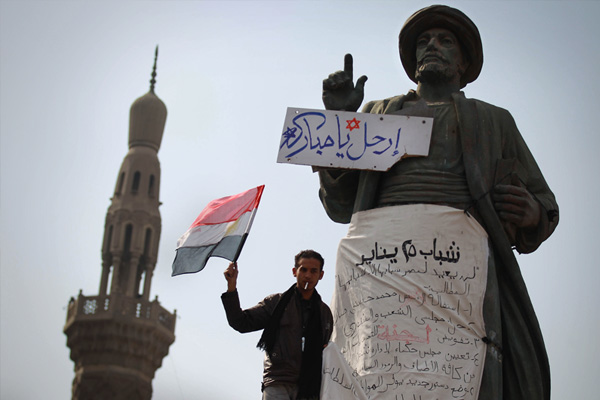
On the northeast segment of Tahrir Square is a plaza with a statue of Ottoman Egypt era Cairene Omar Makram, and beyond is the Omar Makram Mosque.


The square is the northern terminus of the historic Qasr al-Ayn Street, western end of Talaat Harb Street, and near the Qasr al-Nil Bridge crossing of the Nile River. 


The area around Tahrir Square includes the Egyptian Museum (the resting site of King Tut and most of the important treasures of Ancient Egypt), the National Democratic Party-NDP headquarters building, the Mogamma government building, the Headquarters of the Arab League building, the Nile Hotel, and the original downtown campus of the American University in Cairo.

The Cairo Metro serves Tahrir Square with the Sadat Station (named after the assassinated leader Anwar al-Sadat), which is the downtown junction of the system's two lines, linking to Giza, Maadi, Helwan, and other districts and suburbs of Greater Cairo. Its underground access viaducts provide the safest routes for pedestrians crossing the broad roads of the heavily trafficked square.


The above statue of Prince Ismail Pasha is located in Alexandria.

There is another Tahrir Square, which is the former Mohammed Ali Square, originally Place des Consuls, in downtown Alexandria, the other major city where mass demonstrations are occurring in Egypt. Alexandria's Mansheyya Square was the site of the October 1954 failed assassination attempt by the Muslim Brotherhood on Gamal Abdel Nasser.


President Obama appeared at the National Prayer Breakfast on February 3, 2011, and the Drudge Report posted a photo that placed the moment in a spiritual light.  Obama said he prays for Egypt.